Sounds can have a profound effect on people.
It can evoke a gamut of memories and emotions, both pleasant and unpleasant, but ultimately, it helps heal.
The use of sound as a healing tool dates back thousands of years across various cultures such as the Egyptians, Greeks, Indians and Tibetans.
These peoples used chants, bowls, gongs, chimes and other instruments to induce meditation, spiritual awakening and emotional/physical healing.
With roots in shamanic drumming and mantras, sounds leverage on vibrational frequencies to promote relaxation and wellness.
Today, the modern world calls these therapeutic sound baths, a form of complementary healing therapy.
Relaxing brain and body
Sound occurs when an object vibrates and transmits energy through the air, reaching our eardrums that then vibrate.
From here, a signal is sent to the brain that recognises it as sound.
As our bodies are made up of 75% water – which is a brilliant conductor for sound vibration – sounds can help relax our muscles and boost lymphatic flow, leading to lower stress levels and better sleep quality.
Sound waves and vibration frequencies help shift brain waves from an active state (beta) to relaxed (alpha) and dreamy (theta) states.
Similar to meditation (though this requires discipline and focus), sound baths tap into alpha and theta brainwaves effortlessly – all you have to do is lie down, or sit and listen.
The healing modality has gained so much traction over the past two decades that Feb 14 is designated as the annual World Sound Healing Day – the same day as Valentine’s Day.
To mark this day, participants sing or intone the “Ahhh” sound for at least five minutes, typically at noon, to send a “sonic valentine” of love and compassion to Mother Earth.
Initiated in 2002 by Jonathan Goldman – an American author, musician and teacher recognised as a pioneer in sound healing – the purpose of the day is to “heal our planet, heal our waters and raise our consciousness”.
According to The Future of Wellness 2026 Trends released recently by the Global Wellness Summit, the fastest-growing spaces in wellness are prioritising nervous-system safety, emotional repair and pleasure over metrics.
Sound healing falls into this category; it’s about quietly regulating the body in the background to feel safer, more connected and more alive.
That’s what certified sound healing therapist Selina Foong has been quietly doing over the past year – guiding others into a “self-healing” state.
“It’s a very gratifying experience to witness others heal,” she says.
Varied responses
An architect by profession, Foong co-founded a wellness business with her late husband Adam Martin in 1999, offering physical therapy, exercise rehabilitation and personalised fitness.
“I started to see first-hand how our clients’ lives were being positively impacted by the work that we did.
“It gradually became clear that I would be able to reach out and help many more people on their wellness journey, while in the process also making my own life more meaningful,“ she says.
Foong’s interest in sound therapy was sparked by chance, i.e. by her first encounter with singing bowls during a trip to Nepal.
The session left her profoundly grounded and at peace.
Drawn to it, Foong began travelling regularly to Nepal, and over time, trained intensively under several teachers in the Indian subcontinent and other teachers from different parts of the world.
She shares: “For a long time, I played the bowls only for myself and for those close to me.
“When I opened a new wellness premise last year, I decided it was the right time to officially add sound healing, as it is so effective in supporting physical recovery, mental balance and overall wellness.”
As a therapist, Foong finds she is more balanced and energised after giving a sound-healing session.
“There is a greater degree of mental clarity and the rest of the day usually goes smoothly.
“From our clients’ side, reports include feeling physically lighter and less stiff, seeing visions and colour flashes in their mind, and enjoying a sharpened alertness to their surroundings after one sound-healing session.
“These experiences are varied, because people themselves are so varied,” she points out.
There are myriad benefits from sound healing, based not only on extensive anecdotal evidence, but also on scientifically-documented studies, such as:
> A 2016 study in The Journal of Evidence-Based Integrative Medicine, which found that participants reported significantly less tension, anger, fatigue, depressed mood and increased spiritual well-being with singing bowl meditation.
> A 2023 randomised controlled trial, published in the European Journal of Investigation in Health, Psychology and Education, comparing sound from singing bowls versus progressive muscle relaxation, which found that sound-based therapy induced a strong relaxation response (via heart-rate variability, electroencephalogram or EEG, and reduced self-reported anxiety).
A single Tibetan singing bowl session produced a stronger relaxation response than progressive muscle relaxation.
> A 2025 scoping review published in the JMIR Mental Health journal summarising various sound interventions that noted the potential for lowering stress using non-invasive methods.
More importantly, sound baths help increase your awareness of your own physical and mental potential, which then opens up new possibilities to optimise your state of wellness.
Bear in mind that sound healing is not music as it may not necessarily have rhythm or beats – it goes beyond that as the specific vibrations work on a person’s subtle energy fields.
Balancing chakras
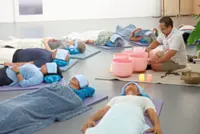
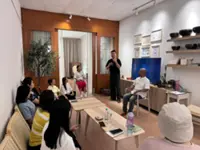
The baths can be done either one-on-one or in a group.
Foong says: “Group sound baths have a greater element of musicality, compared to one-on-one sessions.
“The emphasis in groups is different because the participants are not in close proximity to the bowls and other instruments.
“So I like to include some harmonies and subtle melodies in the group sessions, to differentiate them from the personal healing sessions.”
In single sessions, bowls are sometimes placed alongside each chakra (energy centres within the body that are believed to correspond to different aspects of our physical, emotional and spiritual well-being).
“Firstly, unbalanced chakras are reflected in a large range of mental, emotional and physical dysfunctions.
“An important role of sound healing is to help balance the chakras, so that they are more able to facilitate our natural healing processes at the cellular and systemic levels.
“Each of these seven major chakras, if functioning well, roughly corresponds to a specific pitch, and each bowl in a seven-bowl set also corresponds to a different pitch.
“So each bowl is placed next to the respective chakra that it most closely matches in pitch, in order for optimal balancing to occur,” she explains.
On occasion however, therapists might place the “therapy bowl” (a large-size, thin-rimmed bowl that produces a powerfully resonant sound) directly on the body, for a more amplified healing effect.
Foong adds: “But we need to keep in mind that when bowls are placed directly on the body, other important factors must be considered, e.g. we should not do sound healing on the body if the client has any open wound, tumour, acute inflammation, deep vein thrombosis or diseased/inflamed veins.
“As for which sounds resonate more closely with a particular person, this is very subjective.
“Some people love the shimmering, hypnotic sounds of the gong and the powerful energy it emits; others enjoy the pure, clear harmonies of the crystal bowls.
“And most people feel the benefits of the traditional multi-layered sounds produced by the hand-made Tibetan singing bowls.”
Quick results
The number of sessions needed vary depending on the type of results participants expect.
Foong notes: “We find that most of our clients experience deep relaxation and have better sleep after just one session.
“Others also report sharper mental awareness and energy, which can last for several days after a single sound-healing session.
“Regular sound-healing sessions (either weekly or fortnightly) are highly recommended, to counteract the many stresses and distractions that we encounter on a daily basis.”
While this alternative practice is pretty safe for the general public, it is not suitable for those with conditions such as sound-induced epilepsy, cardiac pacemakers, brain implants, metallic joint implants or severe forms of mental challenges such as schizophrenia.
Individuals with schizophrenia are often highly sensitive to noise and the intense sensory experience can exacerbate symptoms like hallucinations, anxiety and psychosis.
Meanwhile, the strong vibrations and potential electromagnetic fields from some sound therapy devices can interfere with the implants in the body, so make sure you let your therapist know if you have any such implants before trying a session.