A research team was able to restore sight to blind patients with advanced macular degeneration, according to a report published last week in the New England Journal Of Medicine.
The study was conducted in Europe by a team of researchers including senior author Jose-Alain Sahel, who moved from his native France to join University of Pittsburgh Medical Center (UPMC), United States, in 2016.
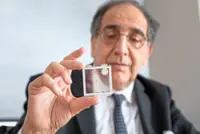
The study evaluates a procedure that implants a tiny wireless panel of electrodes into the eye that works in conjunction with eyeglasses equipped with a built-in camera and infrared projector.
More than 80% of the participants saw a clinically meaningful improvement in their vision.
“It’s the first time that any attempt at vision restoration has achieved results in such a large number of patients,” said Sahel, chairman of UPMC’s ophthalmology department and director of its Vision Institute.
Advanced atrophic age-related macular degeneration is the leading cause of irreversible blindness in people older than 80, affecting more than five million people worldwide.
As the disease advances, vision blurs in the centre of the field of vision, leaving peripheral vision intact.
The technology used in the study allows participants to blend their functional peripheral vision with enhancements in their central vision from the implanted electrodes and the glasses.
The study involved 38 European patients with advanced macular degeneration who were 60 years or older and had vision that was worse than 20/320 – meaning that they would need to be 20 feet away to see what a person with normal vision can see from 320 feet away.
Reading more lines
When the study began, participants were unable to see even the first or second line of a vision chart, said Sahel.
The participants trained with the device for several months, and 32 of the original 38 participants were still using it 12 months after the study began.
At that point, with the implant and glasses, “the average was three lines of improvement,” said Sahel. “One of them had 12 lines of improvement, which is incredible.”
Those 12 lines translated to seeing an additional 59 letters on the vision chart.
On average, the patients could see about 25 additional letters.
In addition to improvements in testing, most of the participants also reported that they found the implant and glasses useful in their everyday lives.
They used them at home to read letters, numbers and words, as well as for daily activities such as navigating the subway, said Sahel.
The device used in the study differed from previous implants used to enhance vision because it was wireless, said Sahel, as well as how it could track when patients moved their eyes, versus moving their entire head.
Sahel and others at UPMC have begun to study the technology in Pittsburgh as well.
In 2020, the first patient in the US to receive the implant did so at UPMC as part of a feasibility study.
Sahel has been studying this technology for more than 15 years, along with Stanford professor Daniel Palanker, who is also a senior author of the study.
Further research is ongoing, and the device manufacturer has also applied for clinical use authorisation in Europe and the US to bring it on the market.
In future, improvements in the electrical panel may allow participants to see at higher resolutions, and the treatment may be expanded to other vision diseases.
“Of course there will be further developments,” said Sahel. “It’s not the end of the story.” – Pittsburgh Post-Gazette/Tribune News Service