
Teens whose parents use guilt have trouble working out disagreements well into adulthood, says a new study.
“To maintain healthy relationships, it is important to be able to assert one’s own beliefs during a disagreement while also continuing to be warm toward the person,” says lead author Barbara Oudekerk, a psychologist at the University of Virginia in Charlottesville.
Previous studies have found that teens who struggle with confidently expressing their opinions during a disagreement are at risk for using hostile methods in their own relationships and experiencing depression and loneliness in close relationships in adulthood.
Experiences with parents do seem to “cascade” into future friendships, the authors found.
For the study, teens were interviewed at age 13 and again at age 18, answering questions about how often their mother or father exerted psychological control, such as using guilt, withdrawing love, fostering anxiety or employing other manipulative techniques.
Some parents used psychological control by saying, for example, “If you really cared for me, you wouldn’t do things to worry me,” or by becoming distant when their teens didn’t see eye to eye with them.
Researchers also assessed the teens’ ability to reason, to “be their own people” and to express confidence, as well as their ability to show warmth and connection at ages 13, 18 and 21, partly by recruiting and surveying the teens’ close friends.
Researchers watched the subjects and their friends or romantic partners have disagreements and discussions on tape and coded their interactions for confidence, warmth and “collaborativeness”. The study team reported their results in the journal Child Development.
“In this study, we examined psychological control on a continuum, and found that the more psychological control parents exerted, the more difficulties teens had establishing a sense of independence and closeness during a disagreement with close friends and romantic partners,” says Oudekerk.
“Overall, we found that the more psychological control youth experienced from parents, the less likely they were to express their own opinions, give reasons why they felt that way, and do so in a warm, collaborative way,” she says. “We are not able to tell, exactly, how much is ‘too much’ psychological control.”
The researchers do not know why psychological control predicts less autonomy and relatedness later in life, but these kinds of parenting practices might teach youth that disagreeing with their parents or others can hurt the relationship, and instead it is better to just agree, she says.
The findings do need to be replicated with larger groups of young people, she says.
“In general, psychological control is not a good way to parent, so it would be better if parents didn’t use psychological control at all,” says Judith Smetana, an adolescent development researcher at the University of Rochester in New York who wasn’t involved in the study. “There’s really no ‘good’ amount.”
“If you find yourself withdrawing love from your child when they misbehave or ignoring them for extended periods of time, this may be a warning sign that you’re being too psychologically controlling,” says Laura Walker at Brigham Young University in Provo, Utah.
“I think children will also let parents know when they’re feeling controlled, so pay attention to your child’s cues, they’re not often subtle,” says Walker, who also was not part of the new research.
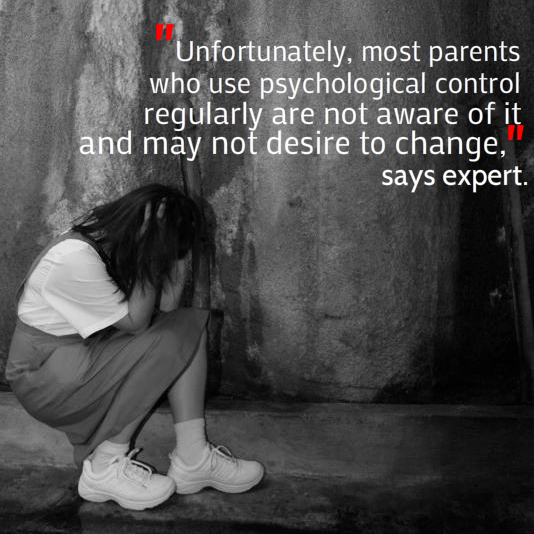
“Unfortunately, most parents who use psychological control regularly are not aware of it and may not desire to change,” she says.
Psychological control is very difficult for paediatricians or teachers to detect, Walker says.
“Psychological control is more about the parent getting what he or she wants rather than about what is best for the child, so examine your goals,” Walker says.
“One of the insidious things about psychological control is that it is so difficult to detect, even for the person being controlled,” she says. “That makes it harder to eradicate.”
Parental psychological control may directly cause teen social struggles, or there may be a more complicated explanation, she says.
“It is very possible that children with a particular personality may be more likely to illicit psychological control from their parents, and those same traits may also make social interactions more difficult,” Walker says. – Reuters
Already a subscriber? Log in
Get 20% OFF The Star Digital Access
Cancel anytime. Ad-free. Unlimited access with perks.