Out of over one million Hyrox athletes worldwide competing in the 2025/26 season, only the top 0.5% earned a place at the 2026 Hyrox World Championship in Stockholm, Sweden, this June.
Among them are four Malaysians – including three sisters – three of whom are in their 60s, and the fourth who’s nearly there, defying every expectation of age.
Not only does the quartet prove that athletic grit is not a young person’s game, but they may be among the few Malaysian seniors to have qualified for the world stage of the indoor hybrid sporting event designed to test athletes’ strength and endurance.
Consultant civil and structural engineer Tan Ay Bing, 69, together with sisters Dr Yeap Jing Eng, 65, Yeap Jing Ching, 62, and Yeap Jing Nee, 59, will carry the Malaysian flag in several categories, including Mixed Doubles, Singles and Women’s Doubles.
However, their road to Stockholm is not a typical tale of fitness.
It is a story of a lifetime’s worth of endurance peaking in one of the fastest-growing fitness race formats in the world, combining eight 1km runs with eight functional workout stations.
To qualify for the World Championship, these four athletes had to outpace the field in their categories at the regional races across Asia, including events in Taiwan, Hong Kong and Singapore.
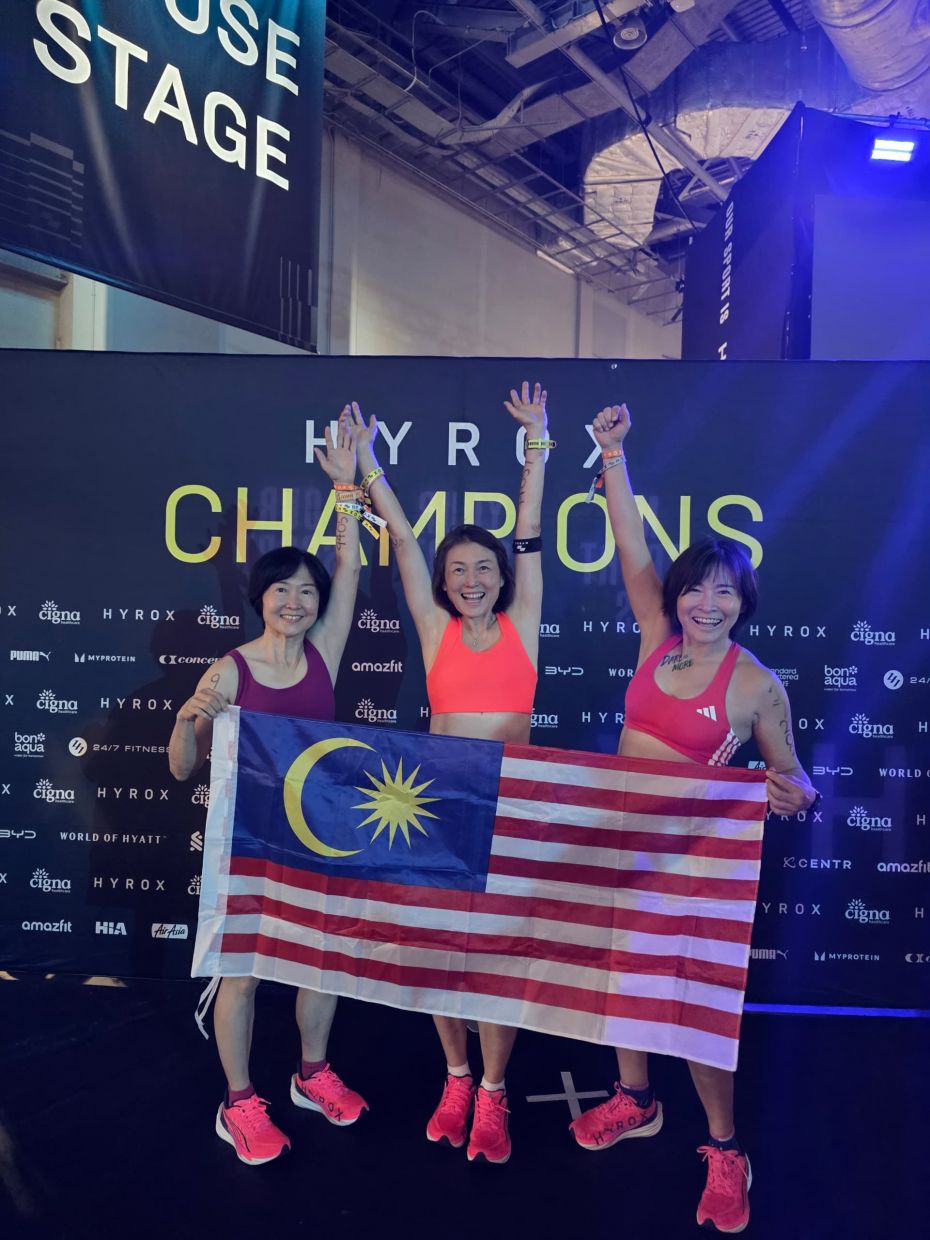
Sisters in strength
For the Yeap sisters, the journey feels almost surreal. While most women their age might be planning holidays together, these sisters are planning their route to the world stage.
The Yeap sisters grew up in Sitiawan, Perak, in a family of eight children where physical activity was simply a part of daily life.
Long before gyms, fitness trackers and structured workout programmes became their lifestyle, their childhood had already revolved around movement.
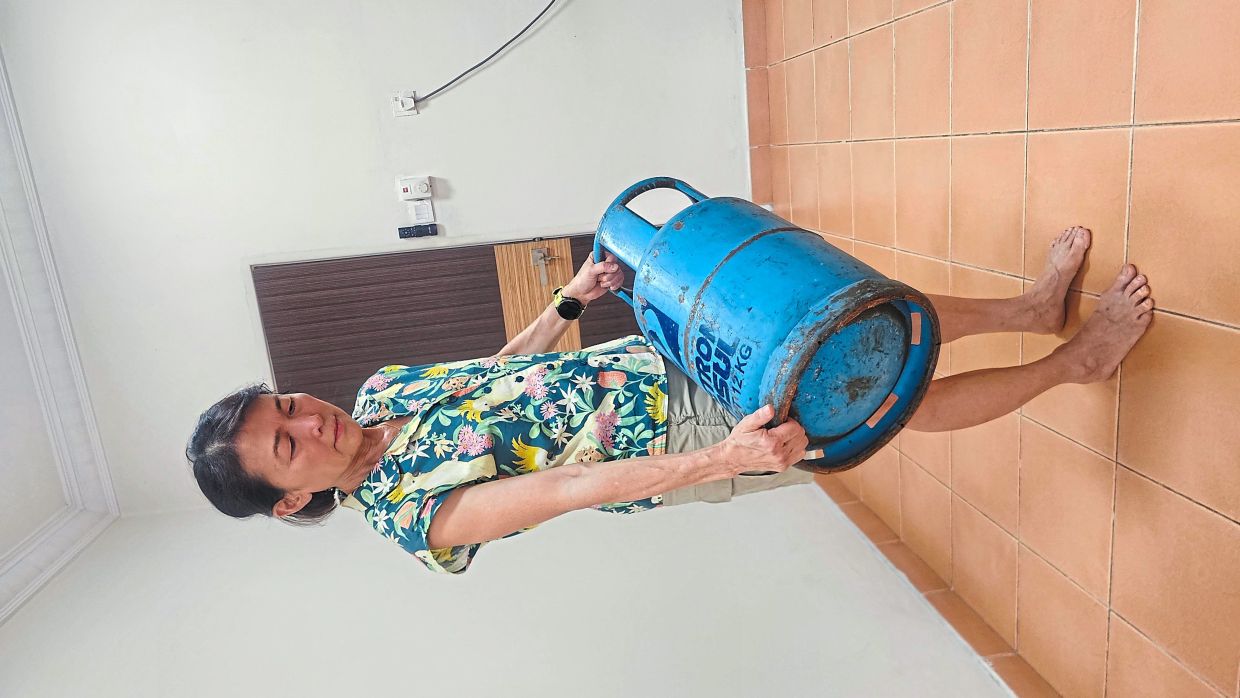
Dr Jing Eng remembers cycling to school from the age of nine, competing as a school runner and helping her parents with physically demanding chores.
“In those days, we had to carry water from a well, tap rubber trees and collect latex,” recalls the second child of the family.
Adulthood, however, shifted her focus elsewhere. Family and career responsibilities eventually replaced sports and fitness routines.
As a general practitioner running a clinic in Skudai, Johor, while raising three children, exercise and fitness had to take a back seat after work and family life.
It was only after the Covid-19 lockdowns in 2020 that she began training seriously again, committing herself to gym sessions five times a week.
Her younger sister Jing Ching, a retired secretary and grandmother, stepped into the fitness world even later.
Although active in sports during her school days, she fell in love with consistent training after joining Jing Nee in CrossFit in 2021.
From there, she gradually discovered a passion for strength training and Hyrox-specific workouts.
“I got more serious into training when Jing Nee did very well in Taipei,” says the mother of two, based in Petaling Jaya, Selangor. “She inspired me to join Hyrox races to make life more interesting.”
(Hyrox races follow a simple format: eight rounds, each pairing a 1km run with a different functional strength exercise.)
“She was the most qualified,” she laughs. “She was always a champion during her school days.”
Before their first Hyrox race in Singapore, Jing Eng travelled to Kuala Lumpur for two weeks of intensive training.
The sisters drilled transitions, practised Hyrox stations and trained their running pace together.
Singapore turned out to be their very first Hyrox competition. They won their category.
“We jumped for joy and wanted to do more races together,” she says.
Then came another surprise: The email inviting them to compete at the Hyrox World Championships in Stockholm.
Built for endurance
While two of the Yeap sisters discovered fitness later in life, competitive endurance sports had already been a serious pursuit for Jing Nee and her fitness partner, Tan, long before the Hyrox race became popular.
Among the siblings, Jing Nee is the most seasoned endurance athlete. A former school athlete in sprints and long-distance running, she later ventured into CrossFit, mountaineering, marathons and Ironman races.
At 50, inspired by several friends, she decided to attempt her first full marathon. She ended up completing ten.
Between 2022 and 2025, she completed three consecutive Ironman 70.3 races, and even managed an impressive podium finish at Ironman Langkawi.
Hyrox, however, presented a completely different challenge.
“I wanted to challenge myself to qualify for the Hyrox World Championship 2026,” says the mother of three and grandmother of one.
This June, Jing Nee will compete in both Women’s Pro Singles and Mixed Doubles alongside Tan, whose sporting journey began unexpectedly in midlife.
The father of three, from Petaling Jaya, only started running seriously at 47.
Over the last two decades, Tan has completed 60 full marathons, 10 ultramarathons and more than 20 high-altitude expeditions ranging from 5,400m to 7,000m around the world.
“After the pandemic, I learned to swim and cycle, and completed two Ironman 70.3 races and multiple triathlons and duathlons,” says Tan, who has been training in CrossFit for the past seven years.
Together, Tan and Jing Nee competed in the Taipei Hyrox race earlier this year and emerged as age-group champions in the Mixed Doubles category, while Tan also secured victory in the men’s singles division. The result ultimately earned them their invitation to Stockholm.
“The real win is walking onto the world stage and choosing to chase for it,” says Jing Nee.
The invitation to the World Championship served as a call to action, pushing them to draw up (and stick to) a punishing schedule with little room for self-indulgent inertia.
Dr Jing Eng has amped up her workout sessions, training tirelessly at her local gym to ensure she maintains the necessary power to handle the functional stations.
Tan, on the other hand, follows a structured plan that includes strength training twice a week, specific Hyrox simulations twice a week and two to three runs, alternating between intense interval sessions and longer, steady-state Zone 2 efforts (60%- 70% of max heart rate).
His Mixed Doubles partner, Jing Nee, who balances her individual Pro category with her Mixed Doubles partnership, also maintains a demanding six-day-a-week regimen.
“I am doing Women’s Pro and Mixed Doubles, which involves handling heavier weights. I make mistakes too, and we laugh at each other, but the training is necessary. We have a weekly schedule and we stick to it.”
Jing Nee calls her training a “strategic sprint” that demands constant communications, rapid recovery and teamwork.
“It’s a series of anaerobic spikes followed by forced recovery,” she says. “ I am also facing pressure as both Tan and I have agreed the pacing is dictated by a faster runner, not the slower runner. And we have set a targeted finishing time in each race.”
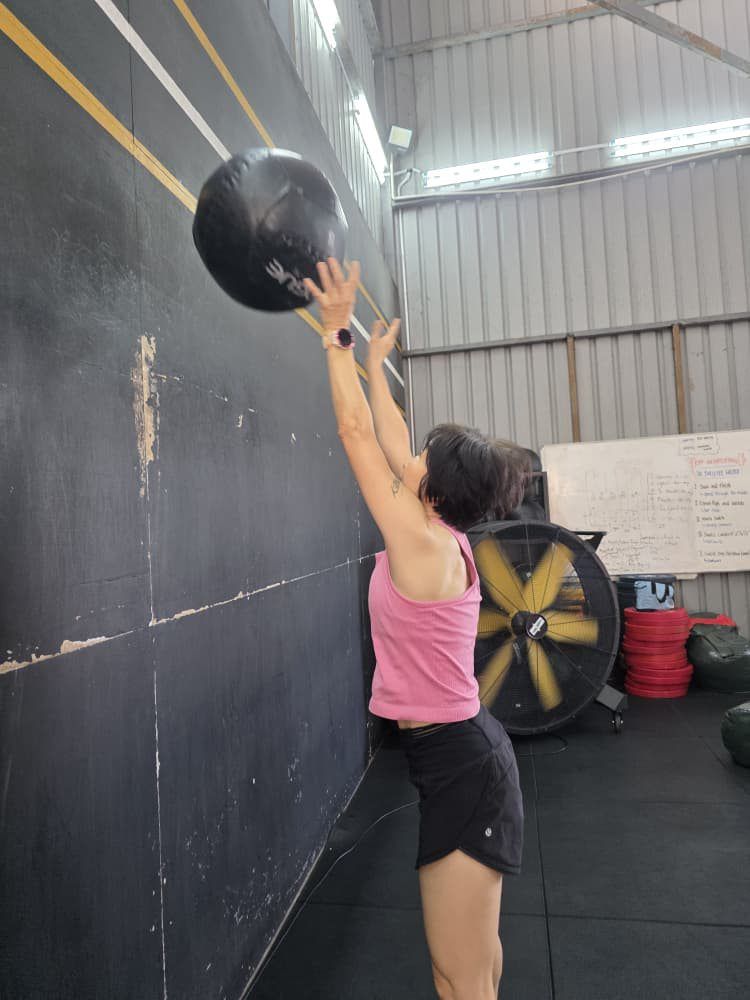
The brutal nature of the eight functional stations offers a unique mental challenge. When asked about their biggest nemesis, the group is unanimous: The Wall Balls.
“The toughest station for all Hyroxers is undoubtedly the Wall Balls (a medicine ball squat and throw to a wall target),” Tan explains. “It usually takes the longest time to complete. The good thing is that the Wall Balls are the last part, after which it is a celebration on stage.”
Jing Ching tackles this mental hurdle by shrinking the challenge down to a manageable size.
“I get through it by breaking it down into 10 reps at a time and focusing entirely on my breathing,” she shares.
For Jing Nee, the Sled Push (where athletes have to push a heavily loaded sled) presents a different kind of difficulty, often requiring her to slow her run pace to recover before the next station.
Conversely, they have all found their favourite moments of respite, particularly the Farmer’s Carry (athletes carry a pair of kettlebells over a 200m distance), which they describe as the fastest and most efficient station to complete.
“I enjoy the Farmer’s Carry because it is easy and fast,” says Jing Ching.
For Jing Nee, the Rowing station serves as a vital recovery period to flush out lactic acid.
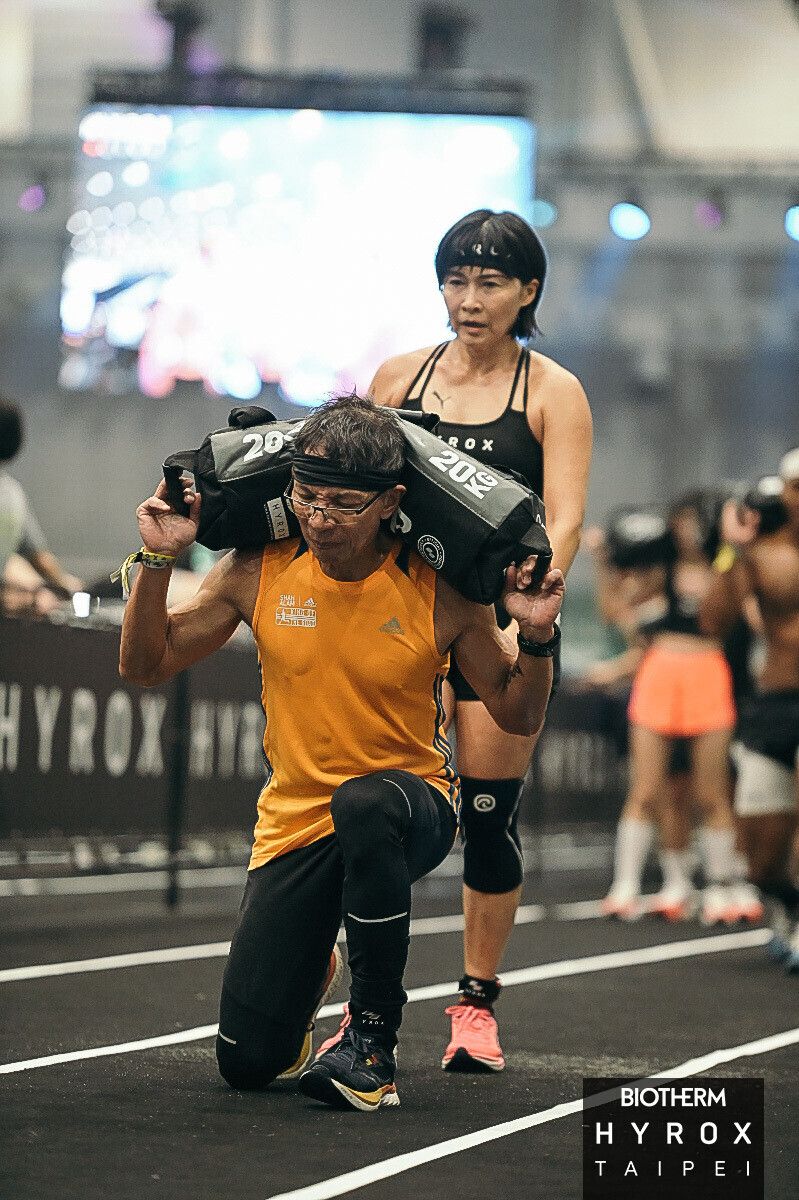
Defying age
Yet for all four athletes, the greatest challenge has never been age itself. It is the perception of what ageing is supposed to look like.
After years of training in controlled and structured environments, these seniors say their relationship with their bodies has fundamentally changed.
“A lot of people over 60 are told to slow down,” says Jing Ching. “But I enjoy the intensity. I can feel my body getting stronger and healthier with every session.”
“It changed my relationship with my body. Now I see it as capable, not fragile.”
This sentiment is echoed by Tan, who finds the discipline of Hyrox a surprisingly refreshing change of pace.
“We have been physically active all this while,” he notes. “Hyrox training is actually easier, more enjoyable and less time-consuming compared to the Ironman training I have gone through over the last three years.”
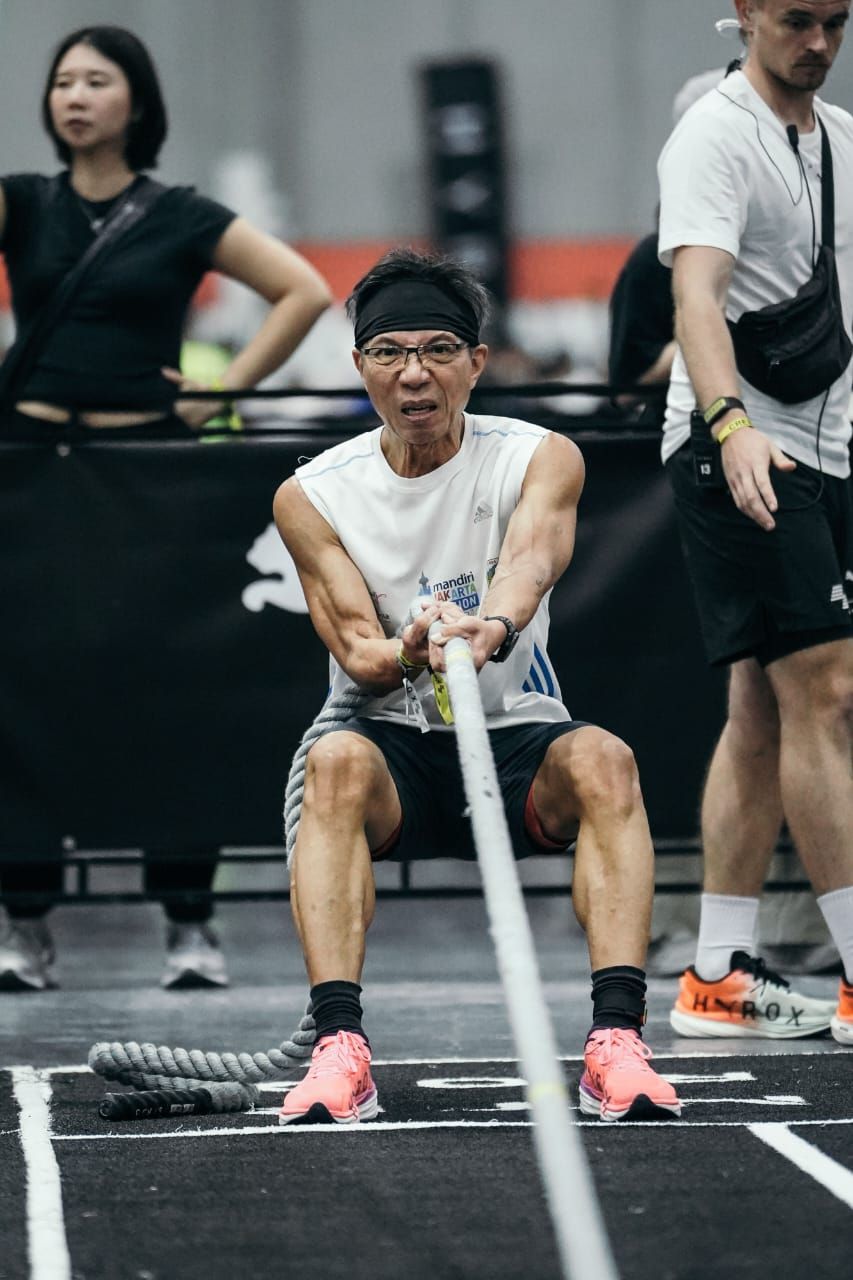
For Ironman, Tan spends between 50 and 70 hours training each month but only 25 to 35 hours for Hyrox.
“After six months, we found our muscular strength improved and our running pace became faster,” he adds. “And the Hyrox vibe and competition excite me.”
For Dr Jing Eng, Hyrox has brought emotional transformation as much as physical strength. “I am a happier, stronger person now and feel less lonely,” she says. “I always look forward to travelling around with my sisters for competitions.”
The sport has also widened their social circles and strengthened friendships within the fitness community.
“We encourage each other to stay positive and healthy,” she adds.
Jing Nee, meanwhile, admits the journey is far from pain-free.
Thanks to the Hyrox-specific training, she has to deal with knee pain, frozen shoulder, tennis elbow and backaches, but has learned how to manage recovery through Pilates, swimming and sports massage.
“But pain isn’t a stop sign,” she says. “It is a test of consistency and guts. I am getting stronger now.”
Nevertheless, Jing Nee believes that athleticism is not reserved only for the young and it has no age limit.
“My advice especially to senior women is to not be afraid to do weights or intense efforts.
Building strength and fitness takes time, but it is the key to longevity.”

More than a race
As the countdown to Stockholm continues, the four Malaysians know they will be competing alongside some of the world’s fittest athletes.
Yet none of them appear intimidated by the scale of the challenge.
For them, simply standing on the world stage already represents something larger than sport.
When asked what he is most proud of, Tan answers: “I am proud that years of consistent exercise and trust in the process of training have shown results.”
For him, the qualification was a moment of disbelief. He admits that he and his teammates often feel like ordinary athletes among others who are significantly younger and faster. Yet, the results speak for themselves.
For Dr Jing Eng, it is standing on the podium with her sister; while Jing Ching looks at where she’s standing now as proof that improvement does not stop with age.
She points out that her race timing improved dramatically from 1 hour 43 minutes in Singapore to 1 hour 34 minutes in Hong Kong.
“Qualifying for Worlds at 62 shows that progress does not stop with age,” says Jing Ching.
And for Jing Nee, pride comes not only from qualifying herself, but from seeing her sisters qualify too.
Beyond medals and race rankings, their journey carries a larger message – that strength can still be built after 60, that women do not become invisible with age, and that the human body is capable of far more than most people imagine.
In Stockholm, from June 18-21, these Malaysians will not merely be racing for themselves.
They will also be quietly rewriting what ageing can look like.