
Recently, Catherine Collins took her 11-year-old twins, Aria and Edison, to visit the Field Museum in Chicago. As they walked back to the car, Collins and her children noticed a woman across the street with a cardboard sign, asking for change. Edison asked his mother a question that stopped her in her tracks.
“He was very emotional, and he said: ‘Mum, why does that woman need money? And why are her kids with her?’” said Collins, 38, who co-hosts Five Year You, a podcast about personal development.
The question brought up important issues about wealth and structural inequality, social class differences and privilege – all topics she wasn’t sure how to explain to a child.
“When we got home, we had a conversation about how not everybody has the same resources, not everybody has the same access to things, not everybody has a home,” Collins said.
“I hoped that I answered in the right way, but I think it would be a disservice to the kids for me to think that I have all the right answers.”
Signs of inequality are everywhere. Children notice these signs, and many parents are figuring out how to navigate conversations when their children have questions. Some encourage their children to ask more questions, use family movie nights to have conversations and rely on parenting books for ways to talk about the topics.
Once, when her children complained about piano lessons, Collins used the moment to explain to them that music lessons were a privilege. Now, they have a general understanding of the concept.
“I think privilege means you get to live in a nice neighbourhood, you get to go to a nice school, you get to wear nice clothes,” Collins’ daughter, Aria, said in an interview.
Her brother, Edison, added: “Sometimes walking around the city of Chicago, you see people on the streets with cardboard signs. That’s when I feel more privileged.”
One way to help children understand complicated topics is to use developmentally appropriate language that they can understand. Collins has used a metaphor she learned from another mother.
Every person receives a different deck of cards in life, she explained, and it’s up to us to decide how to use it. Some people use their decks to help others with lesser decks.
“Adults know about social, economic, cultural issues, but kids don’t understand all that yet,” she said. “So the deck of cards helps them understand.”
Encouraging more questions
Nir Eyal moved his family to Singapore in 2020 from the San Francisco Bay Area. During a trip to see Angkor Wat in Cambodia, his 14-year-old daughter noticed two young boys fishing in a polluted stream.
“I remember my daughter asking: ‘What’s going on?’” he said. Eyal didn’t want to give his daughter the impression that he had all the answers.
“I’m not sure the average adult can explain homelessness very well,” said Eyal, 48, a behavioural designer and an author of Indistractable: How To Control Your Attention And Choose Your Life. Rather than offer his daughter his own interpretation of social class and privilege, Eyal encouraged her to ask more questions.
“I grew up in the traditional education system, where you’re told the answer before you even have the question,” he said. “I don’t think that sparks curiosity, and as a parent, I’ve learned that my role is not educator but facilitator.”
He encouraged his daughter to enrol in Good Economics for Hard Times, a free Massachusetts Institute of Technology course taught by economists Abhijit Banerjee and Esther Duflo.
In 2019, Banerjee, Duflo and Michael Kremer won the Nobel in economic science for their “experimental approach to alleviating global poverty.”
Rather than relying on economic theory to influence policies and programmes, they tested these policies as “interventions” in real-world settings. Their work revealed that many widely held assumptions and stereotypes about what causes and cures poverty fall apart once they are put to the test.
Eyal took the class with his daughter and learned a lot in the process. “She was 15 when she took the class,” he said. “It’s not anything a 15-year-old couldn’t handle.”
Differences in approach
Emily Guy Birken made it a point to have discussions about social and economic differences with her children after reading NurtureShock: New Thinking About Children by Ashley Merryman and Po Bronson.
Birken said she had learned that, while children were like sponges in terms of taking in new information, they were often unskilled at interpreting that information.
“So kids will take in the fact that we don’t talk about race, and then they put their own interpretation on it,” said Birken, 46, who lives in Wauwatosa, Wisconsin. Some research from the University of Michigan suggests that not having these conversations with children can reinforce implicit bias, make them more likely to act on stereotypes and limit their ability to empathise with others.
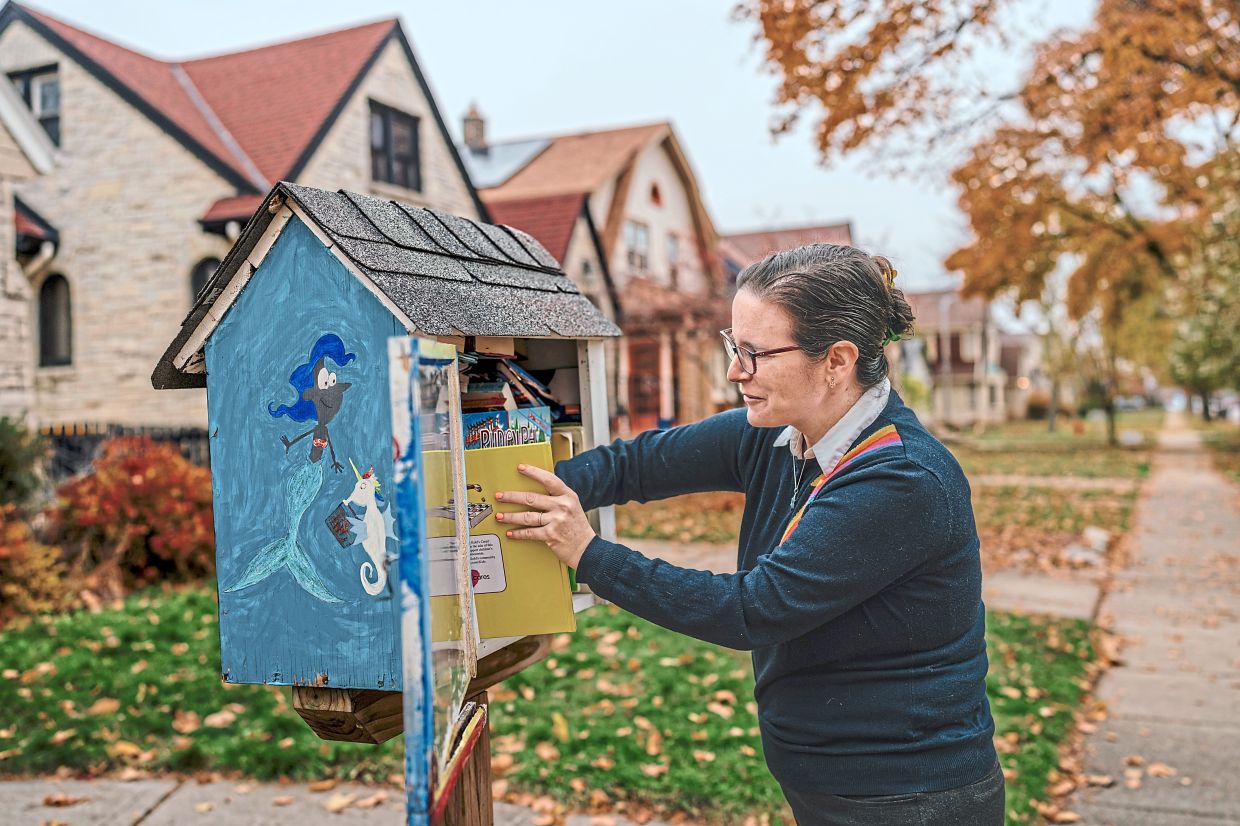
Birken, a freelance writer and daughter of a financial planner, has been open with her children about money and what it means to have privilege. But she also shows them how privilege can be used to help others.
“There’s a large unhoused population in Milwaukee near where we live, which is really worrisome with our winters,” she said. When Birken and her husband moved there in 2016, their children were five and two years old, and they made a family activity of putting together donation bags to pass out to people.
“We explained to the kids openly, in age-appropriate ways, that there are things we can do to help others, even if it’s easier to just ignore it and drive past,” she said.
This became a problem, however, when Birken befriended Don, a man who appeared to be in his 60s and had come to her door asking if he could rake leaves.
“We got to be friendly, and he was not doing well,” she said. “Over time, I probably gave him about US$600 (RM2,477). My husband was not really OK with it.”
One day, when Birken wasn’t home, Don came by, and her younger son answered the door. Unsure what to do, he called his mother, who rushed home to manage the situation.
Later, when her husband learned what had happened, he urged her to draw a line with Don and stop giving him money.
Birken agreed, but the exchange revealed a difference in approach: She had encouraged her children to respond with sympathy, whereas her husband emphasised the importance of setting firm boundaries.
It’s inevitable that these kinds of differences will arise. A presentation from Thrive Initiative, a parenting programme affiliated with Pennsylvania State University, suggests that children benefit from parents who are aware of their differences and have open conversations about how to handle them.
Birkin has also used family movie nights to have discussions about money and inequality.
“We just recently watched Ferris Bueller’s Day Off,” Birkin said. “My kids hated it because of the way Ferris treated Cameron and how privileged he is – people collecting money for him when he doesn’t need it, that sort of thing.”
She and her husband asked their children how much money they thought Ferris spent on his day off, what they would do with that money and what they didn’t like about the film. “It was interesting watching it through my son’s eyes,” she said.
Ever since Collins’ twins could talk, she has encouraged them to share something they’re grateful for every day. Her daughter recently initiated the gratitude conversation at dinner.
“It delighted me,” Collins said. “It shows me that these lessons, habits and conversations do sink in and become a part of the fibre of who they are.” – ©2025 The New York Times Company
The article originally appears in https://www.nytimes.com/2025/11/23/business/parents-kids-social-inequality.html The New York Times.