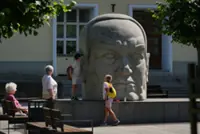
An etching of a glassblower hanging behind a rural bar in Estonia has become an unlikely national emblem, brought to light as students start cataloguing artwork in a country whose fraught history many try to forget.
The simple piece, completed in 1963 by graphic artist Olev Soans, is one of hundreds of Soviet-era artworks - including murals, mosaics, frescoes and stained glass - that remain throughout the country, as a worn-down but persistent symbol of the country's occupied past.
While the NATO and EU member country has sought to distance itself from the Soviet period since regaining independence in 1991, many of these communist-era artworks were made by Estonian artists, prompting a re-evaluation of their meaning.
"It's a part of history for us that the Soviet Union was here and occupied us," said Siiri-Liis Huttunen, one of the project's coordinators.
"Life didn't stop, and the artists also worked and did their studies during that time, which is also a collective heritage of ours," she added.
Commissioned by Estonia's Board of Heritage, and organised by the Estonian Academy of Arts and Tallinn University, the months-long project aims to map the country's Soviet-era monumental-decorative art, providing the first-ever overview of its presence and value.
'Not at fault'
Since Russia's full-scale invasion of Ukraine in 2022, Tallinn has been a staunch ally of Kyiv, amid fears it may be Moscow's next target.
The NATO eastern flank country shares a 294km border (183 miles) with Russia. It has experienced numerous drone incursions into its territory and probes by Russian fighter jets into its airspace, repeatedly prompting the alliance's intervention.
Along with its Baltic neighbours Latvia and Lithuania, Estonia is actively removing symbols of Soviet domination - including military monuments and Red Army graves - from its landscape.
But for younger generations born after the USSR's collapse, art from the country's 51-year occupation is an opportunity to reframe history and highlight the creative contributions of Estonian artists.
The artists "are not at fault for being born during Soviet time," Huttunen said.
In their pursuit of art, students engaged in the project travel across the country - scouring schools, former factories, abandoned collective farms, or old townhouses for signs of history and identity.
Many artworks from the time period have been destroyed as the buildings housing them were demolished, requiring those engaged in the project to scour through archives and newspapers, and speak to locals at the sites of their visits.
By compiling data on what remains, the country's heritage board will determine "which are valuable enough to preserve, and which need urgent preservation," said Hilkka Hiiop, rector of Estonia's Academy of Arts.
'Non-ideological'
The project does not include military artworks containing Soviet-era political symbols.
Many such works have already been removed from buildings or covered "to ensure that the occupying regime is not glorified in today's public space," said Reesi Sild, a Cultural Heritage adviser at Estonia's Ministry of Culture.
A working group coordinated by the government has recommended that around 240 "ideologically charged" monuments be removed or altered to be more neutral.
But determining what counts as "ideological" art is not always a straightforward process, Estonians say.
Industrial motifs ubiquitous in socialist realist art ever-present in the former Soviet bloc themselves reflect the "ideology behind everything" including "the five-year plans and work as a central theme," said Maria Leemet, a doctoral student and project coordinator on-site.
Even in works created in what seems like typical Soviet style, some students say signs of resistance - which managed to elude censorship undetected - linger beneath the surface.
"I don't know if it's just me, but maybe the hat looks even more like a traditional Estonian folk hat," Martin Danilas, 23, student at Tallinn University, said in front of the glassblower work. - AFP