A TOWERING bamboo installation inspired by Penang’s rich multicultural identity has taken centre stage as one of the signature public artworks for this year’s George Town Festival (GTF).
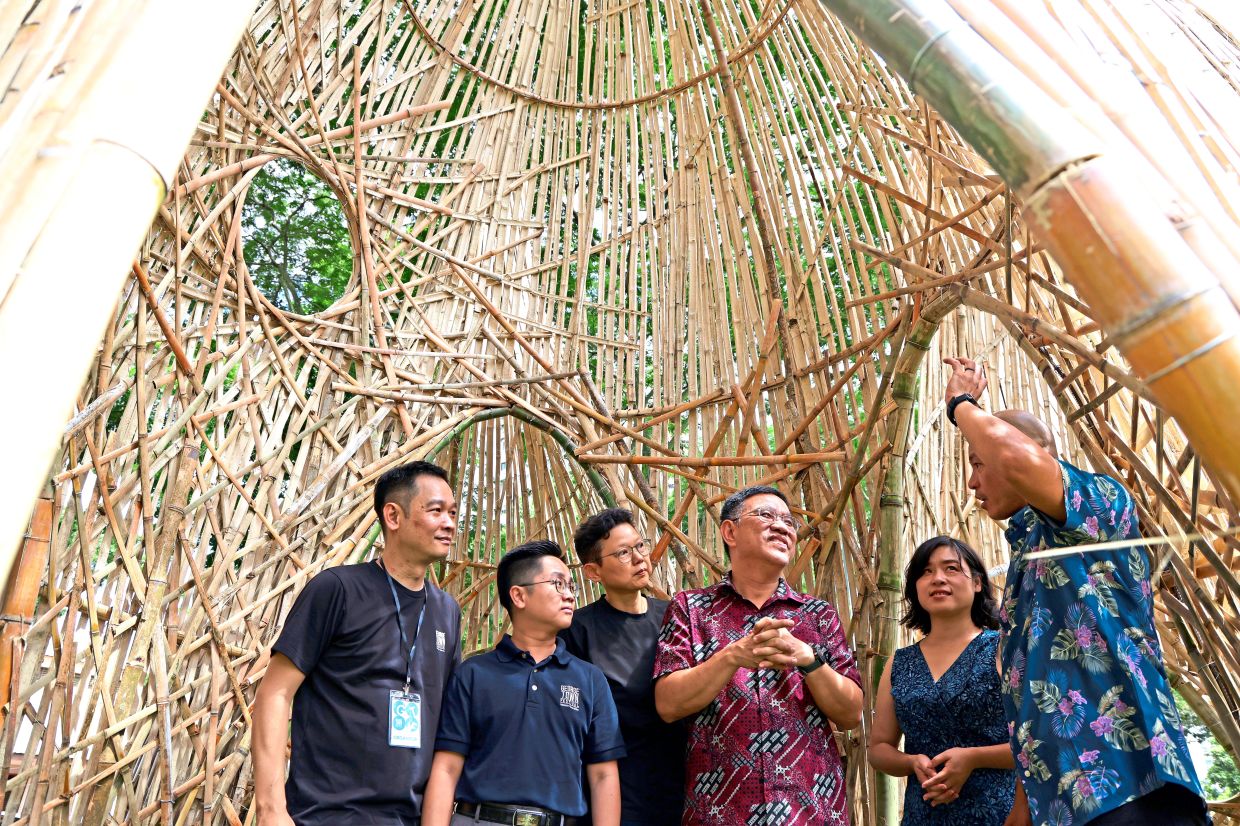
Measuring 7.5m long, 5m wide and 6.5m tall, the structure titled “Converge” by Taiwanese environmental artist Lee Kuei-chih has transformed the field at Taman Kejiranan Macallum into an interactive space where nature, community and culture intersect.
Constructed from about 250 bamboo poles harvested in Balik Pulau, the installation will be open daily until Aug 31, extending beyond the ongoing festival which ends on Aug 9.
Presented under the festival’s “Isle to Isle” series in partnership with the Taipei Economic and Cultural Office in Malaysia, “Converge” reflects Penang as a place where diverse ethnicities, religions, languages and cultures coexist while retaining their own identities.
“I feel that many different cultures converge here.
“It is not just about culture, but people living together harmoniously. That inspired this artwork,” said Lee.
He likened Penang’s communities to different seeds gathering in one place and eventually growing together, which inspired the title.
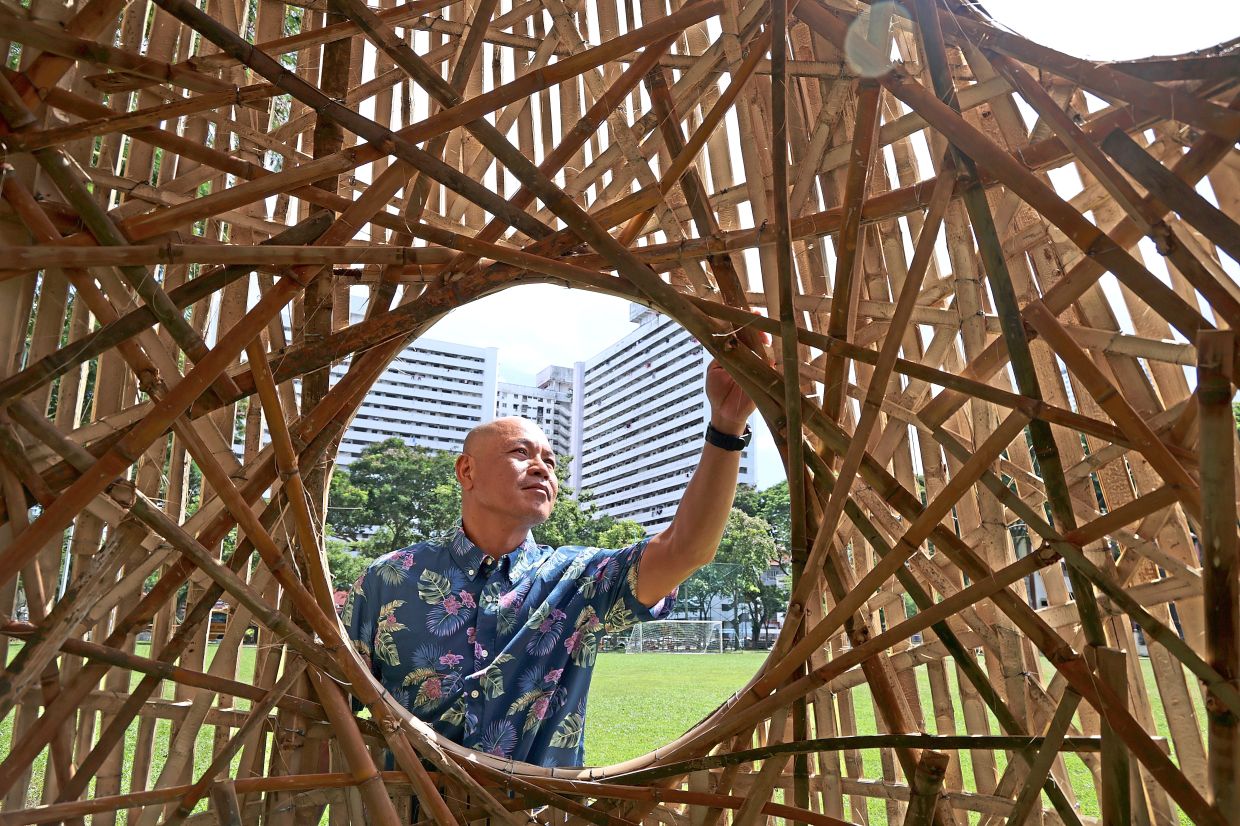
The artist said using bamboo sourced from Balik Pulau was a deliberate decision after researching the island’s natural resources during his first visit in January.
“I wanted to use local materials to tell a local story,” he added.
The team harvested about 250 bamboo poles, each measuring around 4m long, before splitting them into strips and
weaving them into five interconnected sculptural forms over a month-long construction period.
Rather than creating a sculpture to be viewed from afar, Lee envisioned an artwork people could enter and experience.
“Sculpture is not just an object. It should allow light and wind to pass through it, becoming part of the environment, the people and even time itself,” he said.
He encouraged visitors to walk through the installation, adding that it symbolised people arriving from different directions before meeting in a shared space.
While visitors are welcome to touch the bamboo structure, they are advised not to climb, run around or damage the artwork.
As an environmental artist whose works are created in natural settings around the world, Lee said every outdoor project was shaped by its surroundings, from the climate and landscape to the local community.
Sustainability was also built into the project, he said. After the exhibition ends, the bamboo will naturally decompose while the steel reinforcement and wire used inside can be recycled to reduce waste.
State tourism and creative economy committee chairman Wong Hon Wai said the installation reflected GTF’s commitment to bringing art into everyday public spaces.
“We initially considered the Esplanade to showcase this installation, but due to constraints on the display period, we chose the present venue instead.
“Here, we can leave it for a month and bring it closer to the community,” he said.
Hon Wai said the neighbourhood setting allowed residents to encounter art naturally in their daily lives, reinforcing the festival’s goal of making the arts accessible beyond conventional theatres and galleries.
He noted that the installation offers different experiences throughout the day, with specially designed lighting illuminating the structure after dark.
“The experience changes with the light, the wind and even the rain.
“People can come in the morning, afternoon or evening and discover something different each time,” he said.
Like George Town’s iconic street murals, Hon Wai said “Converge” continued the festival’s tradition of creating memorable public artworks while introducing audiences to new artistic expressions through natural materials.
Also present were Pengkalan Kota assemblyman Wong Yuee Harng, George Town World Heritage Incorporated (GTWHI) general manager Dr Ang Ming Chee, GTWHI communications and collaborations department manager Vick Quah, GTF director Jack Wong and Taipei Economic and Cultural Office in Malaysia cultural division director Kate Wen Yu-chen.