An artist and academic renowned in abstract art, Hamidi Hadi channels the chaos of the external world onto his canvases, exploring the possibilities of form and colour.
In recent works, his focus has turned to mood. For his 10th solo exhibition, the artist shifts inward, embarking on a quieter, more personal journey.
The result is Tracing Stillness (Menjejak Hening), a new series at Wei-Ling Gallery in Kuala Lumpur, showing through March 28.
Like the contemplative nature of the holy month, it captures Hamidi’s search for calm and quiet reflection.
“In my practice, I’m drawn to painting nature – the beauty of flora and fauna – and exploring our connection to it. At the same time, like many artists, I cannot turn away from the realities of human suffering in the world.
“My previous exhibition was a way to express that heightened state of stress and pressure, while also showing solidarity and empathy,” says Hamidi, 55, in a recent interview at the gallery.
In April 2024, he presented Trembling In Silence, a stormy exhibition that grappled with the uncertainty and unrest of troubled times.
Born in Selangor, Hamidi’s current series Tracing Stillness, explores the other side of the emotional scale.
“I knew I could not stay in that state of mind. In Perak, I have a spot by the river near a rainforest where I go to paint. Even surrounded by peace, there’s still a sense of unrest, knowing that elsewhere in the world, the opposite is happening.
“This reflects the journey I’m on, and you can see traces of it in this exhibition,” said Hamidi, who is based in Seri Iskandar in Perak, where he also teaches art at UiTM.
For his studio sanctuary, Hamidi built a space in Padang Rengas, near Kuala Kangsar, designing an intimate workspace that allows him to stay immersed in nature.
Reflecting the process
For over two decades, Hamidi has developed a practice rooted in surface density, exploring a variety of mediums – from enamel and aluminum paint to canvas, used paper, and a world of dots and blots.
In his new exhibition, 13 paintings reveal a “controlled deconstruction,” and Hamidi, slipping into his art teacher persona, was both informative and full of anecdotes as he guided the tour through the gallery.
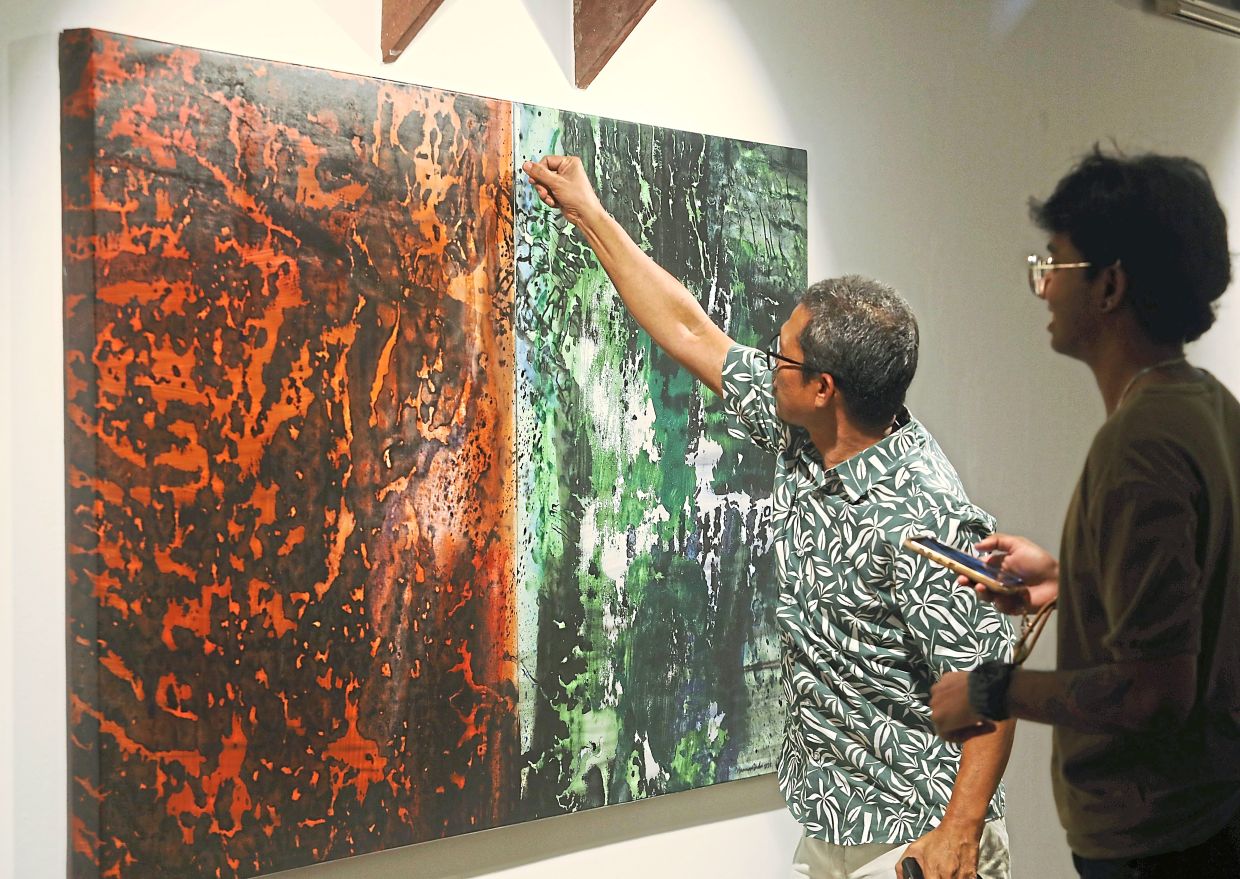
“Most of my work reflects the process itself. I lay the canvas on the floor to get a 360° view, giving me freedom to move and let the art flow. When adding layers, I often leave them to dry and harden before peeling them back to reveal what lies beneath,” he said.
This tension between holding on and letting go resonates in every new piece, with titles such as Menjejak Hening Yang Menahan, Still, Skeleton Of The Surface, and Breathing, where white and sky blue seem to offer serenity.
Here, peeling is more than a technique – it becomes a metaphor for releasing burdens, an attempt by the artist to step back and recalibrate.
“One of the challenges artists face is knowing when to let go, to recognise that a work is complete. The peeling process is difficult – not just because of the material’s strength or the potential for mistakes, but also the emotional tension of ‘damaging’ a piece.
“To me, it’s a reminder of the human impulse to hold on tightly to worldly possessions,” said Hamidi.
This approach is evident in Menjejak Hening: Yang Menahan. The triptych, executed in Chinese ink and enamel on canvas, presents two soft, distinct spaces divided by a central seam loaded with tension.
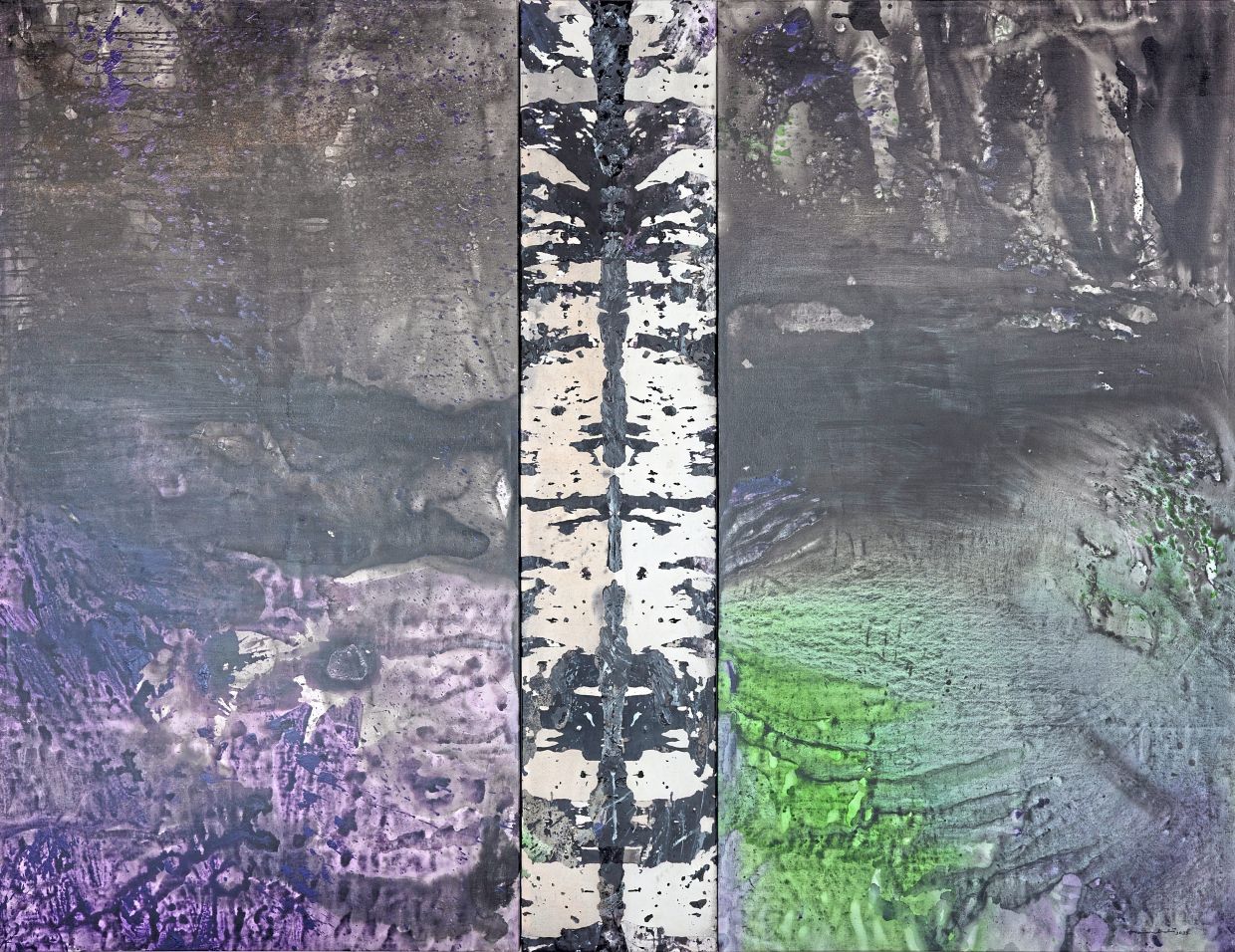
“These are two spaces that are polar opposites yet part of the same motif. Both are soft and subtle, reflecting the vast emotions a person holds. In the middle, a structure separates them, almost like a spine.”
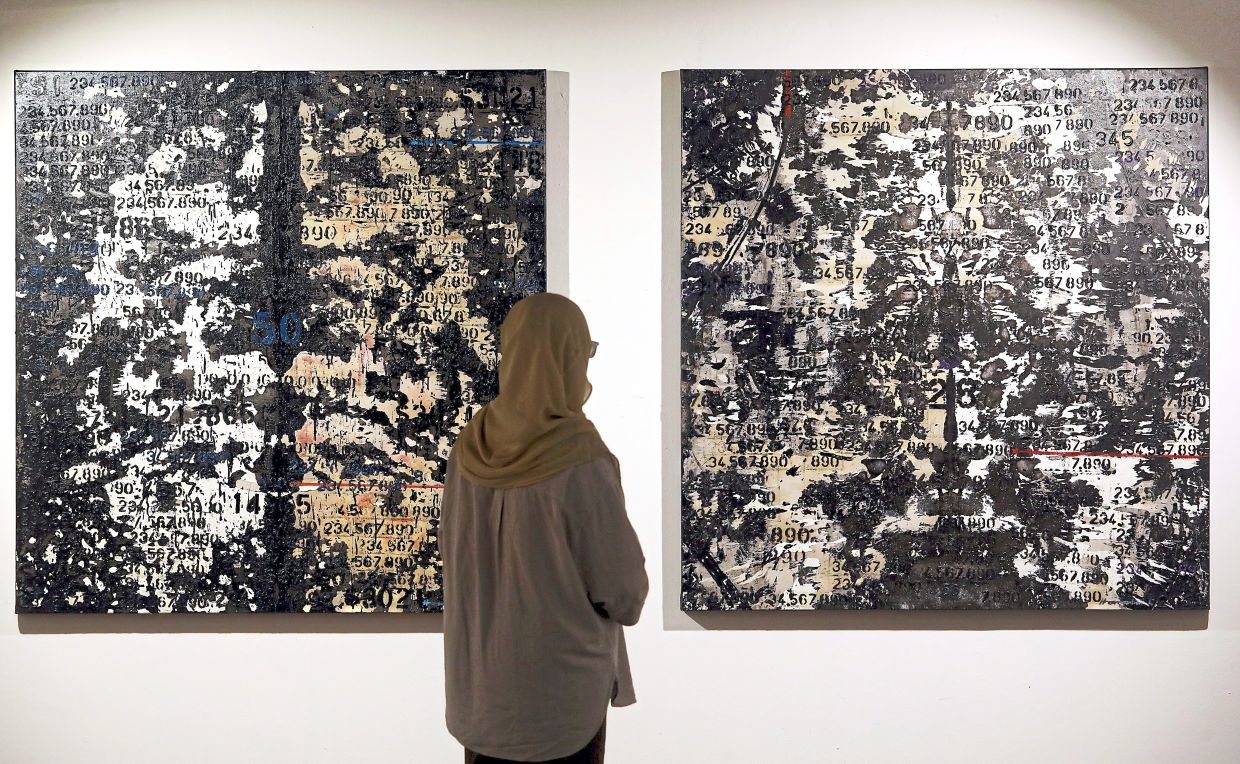
In contrast, the diptych series Untitled (Fracture No. 1) and Untitled (Skeleton 2) reveal the peeling process in its rawest form, with the upper layers forcibly pulled back to expose the work’s skeletal structure beneath.
“It was never my intention to make it look like a Rorschach inkblot. I was inspired by primary school art lessons, where we’d fold a painted piece of paper in half to create symmetrical patterns, like a butterfly. The difference here is that canvases cannot be folded, and the peeling requires patience and delicacy,” said Hamidi.
Across the gallery, Untitled (Fracture No. 4) reveals a more complex rupture, with faint numerical markings adding depth and dimension to the canvas.
“Starting a painting is a bit like writing a script, there’s a narrative I want to share. It’s a dialogue I have with the canvas. For example, the numbers I stencil are just symbols – bank balances, charts, stock graphs – but it’s the human emotion, the catharsis of the moment, that remains the focus,” he said.
A place to return home
As his exhibition continues at Wei-Ling Gallery – a space that has been like a second home, hosting nine of his solo shows since 2007’s Alun – Hamidi is set to return to his roots this weekend. His first solo, Indelible Markings, was shown at Townhouse Gallery in 2005, which later became Wei-Ling Gallery.
He carries this sense of calm with him as he spends the upcoming Hari Raya festivities reconnecting with family – first in his hometown of Kampung Jenderam Hilir in Dengkil, Selangor and then at his wife’s family home in Kuala Rompin, Pahang.
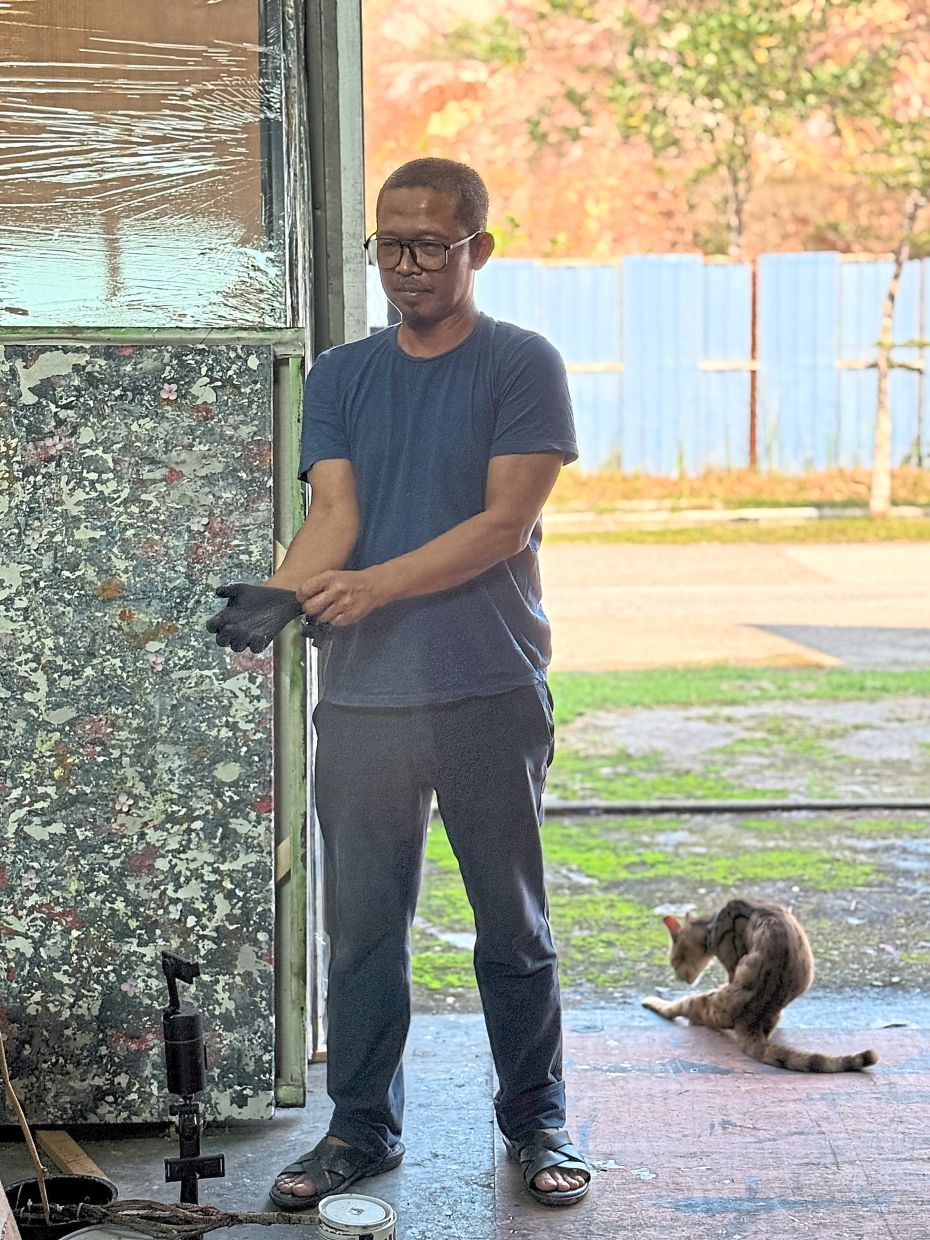
“I enjoy spending time with family and friends. They often ask about my experiments with new materials, and since they don’t have an art background, their questions can spark fresh ideas and unexpected results,” he said.
Adding to this domestic peace is his constant companion in the studio, his cat.
“Ten years ago, my nephew gave me a Bengal cat, whom I call ‘Buncil’. It’s the first cat I’ve had like this, and he spends a lot of time with me while I paint,” said Hamidi.
Reflecting on his journey and contrasting it with the intensity of his past work, Hamidi expresses deep gratitude for the environment he calls home.
“The longest I’ve been away was while studying at Wolverhampton University (in England) in 2001-2002. It made me realise how lucky I was to grow up in Malaysia – with its greenery and weather. Back in England, we stayed indoors in the cold.
"I missed hanging out at the mamak with a hot teh tarik and roti canai," he concluded with a grin.
Hamidi Hadi’s Tracing Stillness (Menjejak Hening) is on view at Wei-Ling Gallery in KL until March 28, by appointment. More info here.