Rissim Contemporary gallery’s walls have recently been washed in white, giving stark contrast to the monochromatic artworks of Kuching-born, Petaling Jaya-based artist Paul Nickson Atia, which are on display.
In his third solo exhibition in Kuala Lumpur, after Jari Berlari (2019) and Form(s) Of Prayer(s) (2020), Paul once again embraces grids, which “will tempt viewers to engage by counting squares, comparing patterns and imagining configurations” say the curatorial notes penned by Amanda Ariawan and Yap Sau Bin.
One’s curiosity is indeed piqued the moment you enter the space. At first glance, the title of the exhibition – Counting Silence, Filling Space, Weaving Conversation (CSFSWC) – seems a mouthful and perhaps, over-ambitious.
“This series of artworks is actually a subset for a bigger project called Perhimpunan (or Assembly), which I had to put on hold because of the pandemic,” says the 30-year-old affable artist during a recent interview at the gallery in Bangsar, Kuala Lumpur.
Paul, who prefers to go with his first name, points to a wall in the gallery with eight paintings, and explains: “These were the preliminary eight that I made somewhere in the second half of 2020 during the pandemic, and then I put everything on hold because I started teaching again at Taylor’s University.
“I thought that I would be able to teach in the day and do work at night but it was just not possible. Instead, I found myself making notes, exploring and expanding the essence of the work in writing form. I began to read a lot too and got fixated on the idea of autonomy,” he adds.
CSFSWC took Paul approximately five months to finish, factoring in the pandemic situation. The exhibition is showing at Rissim Contemporary until Aug 7.
“At the end of 2021, I went back to Kuching, Sarawak for Christmas as I hadn’t been home for close to two years.”
When he returned to PJ, where he’s been living for the last 12 years, Paul formally began working on this series.
Conversations with curators
CSFSWC has three main pillars which Paul and his curators dwell on – time, modularity and autonomy.
“Our conversations, which form much of the curatorial notes, touch on how time was a factor, and also concern, during the making of this series; as well as how modularity came into the picture and reflects my training as an architect. Most importantly for me, was the concept of autonomy, which relates to the philosophical questions that I asked myself during this time,” says Paul says.
“What constitutes the painting? Can paintings be something other than paintings, like say an object or an installation? Can they continue to evolve after the artist has put his brush down?”
Paul, Amanda and Yap suggest three ways of looking at the CSFSWC series, or conceptually frame this exhibition. The first, Counting Silence, is very much about Paul’s encounter with the work itself.
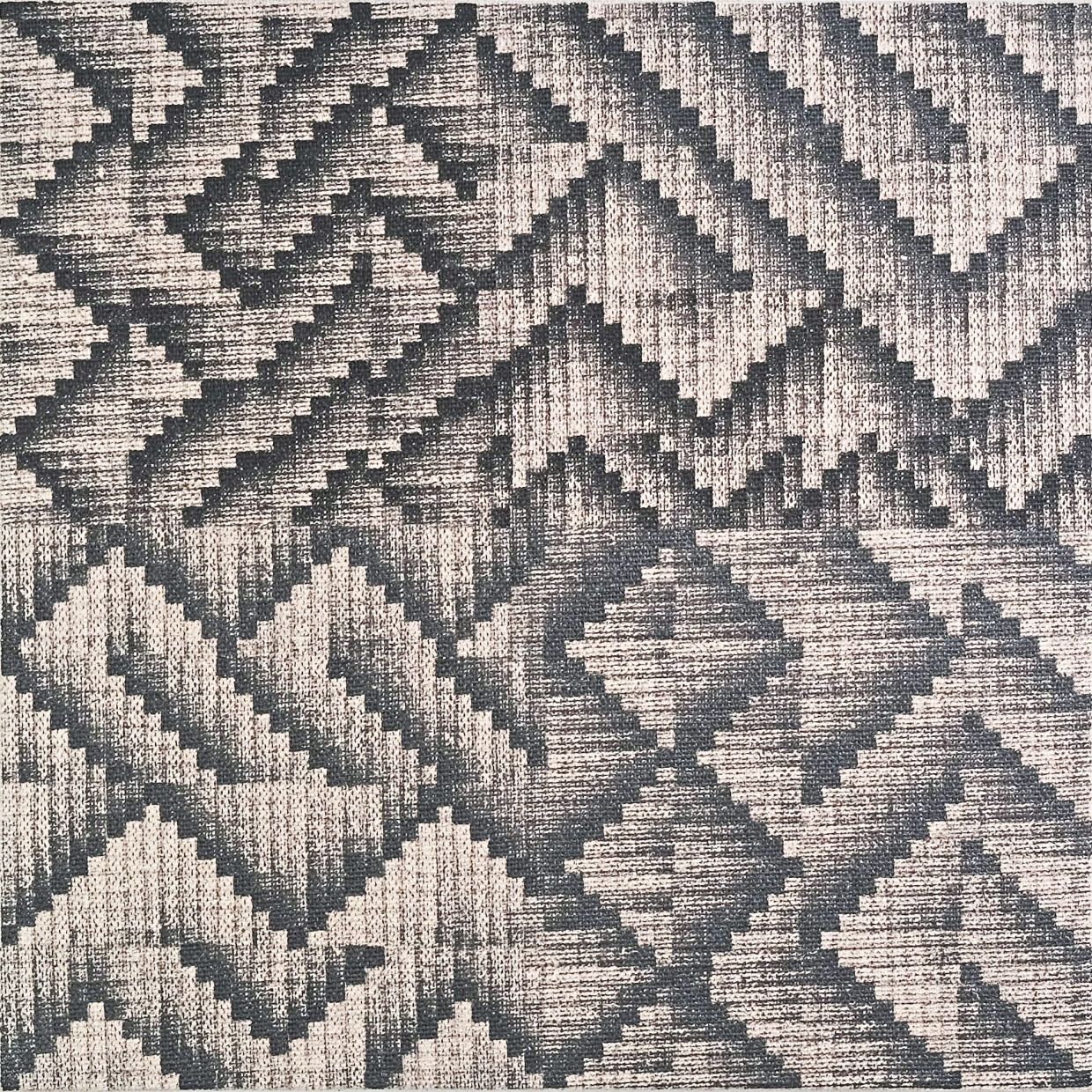
“When I first started doing these paintings, I was just painting to fill up boxes. There wasn’t really anything to look at except for something a little bit more elemental – black and white, left and right patterns, and gradients. The work became ritualistic in the sense that I kept on using the same method all the way up till the 103rd piece.”
Interestingly, Paul adds that there was no way of empirically knowing if he was near completion, unlike if he had been painting a figure or object. So, how did he know when to stop?
“When I got to the 50th or 60th piece, I began wondering when this was going to end. The curators were approaching the writing with a durational concept, and suggested that I do the same. This made sense; it gave me a clearer perspective.”
Paul then gave himself a deadline and completed 103 tiles (along with the preliminary eight), each made up of 3,600 tiny squares, equating to a total of more than 360,000 squares.
Filling Space, in the title, refers to the first eight in the series, which Paul says, were really about finding order and a methodology for him to figure out how execute the series.
“While initially I was filling up the whole space, by the third block, I slowly began to introduce composition, so the patterns are a little bit more apparent,” he explains as we walk through the gallery.
“I started dividing 30x30cm canvases into sections, defining quadrants, creating modular pieces.”
When you visit the gallery, you’ll also find randomly placed pencil writings on the walls. Paul explains: “These are from real conversations I had with my curators. They started asking me all sorts of questions.”
The artist felt it was really important to engage with the curators this way.
“They were critical about how the works should be presented. And they were able to capture the essence of things that I could not express. I really appreciate that in the curatorial text. It was good to speak with them. It made me think of the clarification or justification of how to frame these paintings as one body of work.”
Indeed, the curatorial text is very much a part of this body of work and it unfolds like a treasure map to reveal numerous ideas from the Bauhaus concept and Gestalt Theory to Ikea hacks and Star Trek’s Jean-Luc Picard’s life philosophies.
The curators’ conversation with the artist was what led to “modularity” and “autonomy”, Paul says.
“When I first started, this was not apparent. But as we chit-chatted, these ideas came into play. Could modularity be a strategic way to exercise autonomy? If you want to look at the paintings as a whole, it gives you a sense of scale; but if you want to be a little more associative about it, you can start making references to something easily recognisable. It’s that kind of interplay that I was interested to explore.”
Seasons and scale
At the Rissim gallery, you’ll find another wall with 30 paintings, presented in clusters of five.
“We wanted to reflect on the idea that these paintings were almost seasonal. You may see similarities between a cluster or two. I numbered my paintings as I did them and they are displayed in chronological order – Counting Silence No.1 to Counting Silence No. 103. You can see the colour intensity of the Chinese ink (that I mix myself) changing, every four to five paintings or so. Occasionally I would leave the paint out to dry to give it a different effect. I enjoy observing those kind of quirks here and there. It gives a certain character to each painting,” shares the artist, revealing that the work got quite intense.
The eight preliminary works and the 30 paintings that make up the clusters are presented in a more conventional way of viewing – at eye level, in single file – highlighting the individuality of each painting. Then things take a turn when the questions of autonomy and Weaving Conversations are tackled.
“If I produced 100 pieces, for instance, would they be considered one huge painting or would that dilute the autonomy of each painting? I began experimenting with those ideas here.”
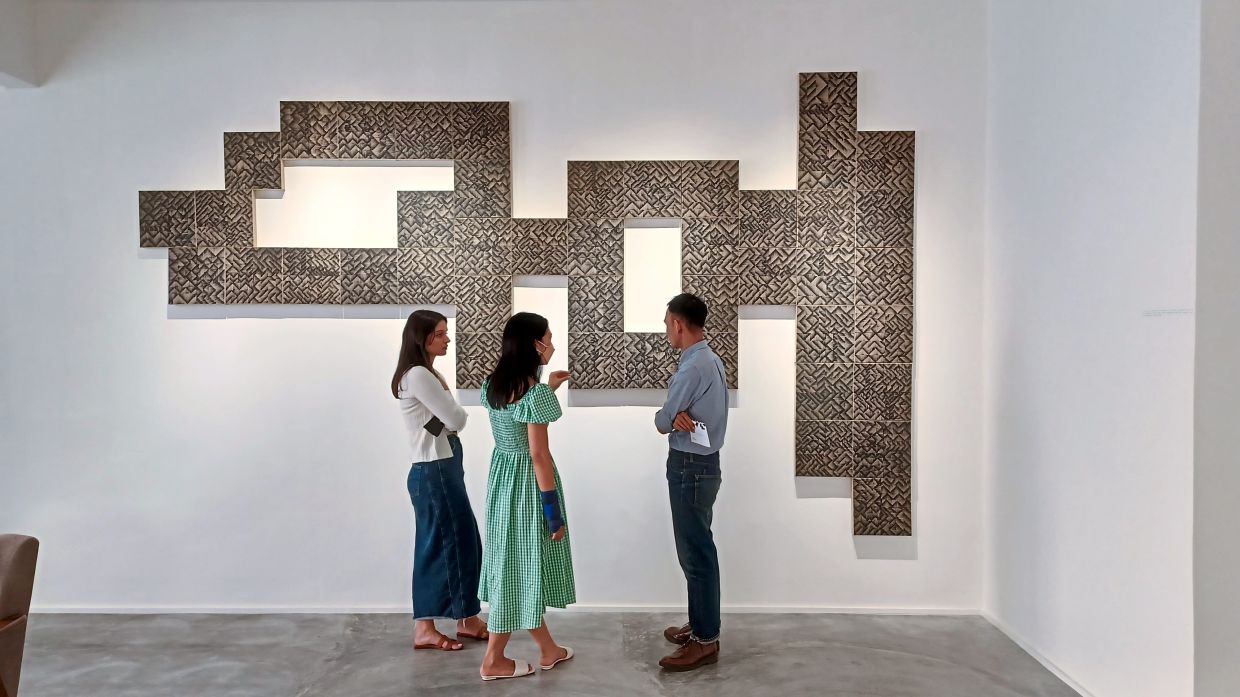
As such, the third aspect of the exhibition is presented in a slightly different format, with a series of varied configurations.
“Some of these start from the floor, or are in response to a beam in the hall; most formations were derived from my sketches of the Perhimpunan project, which was meant to feature installations and sculptures, and revolve around the politics of a house or community.”
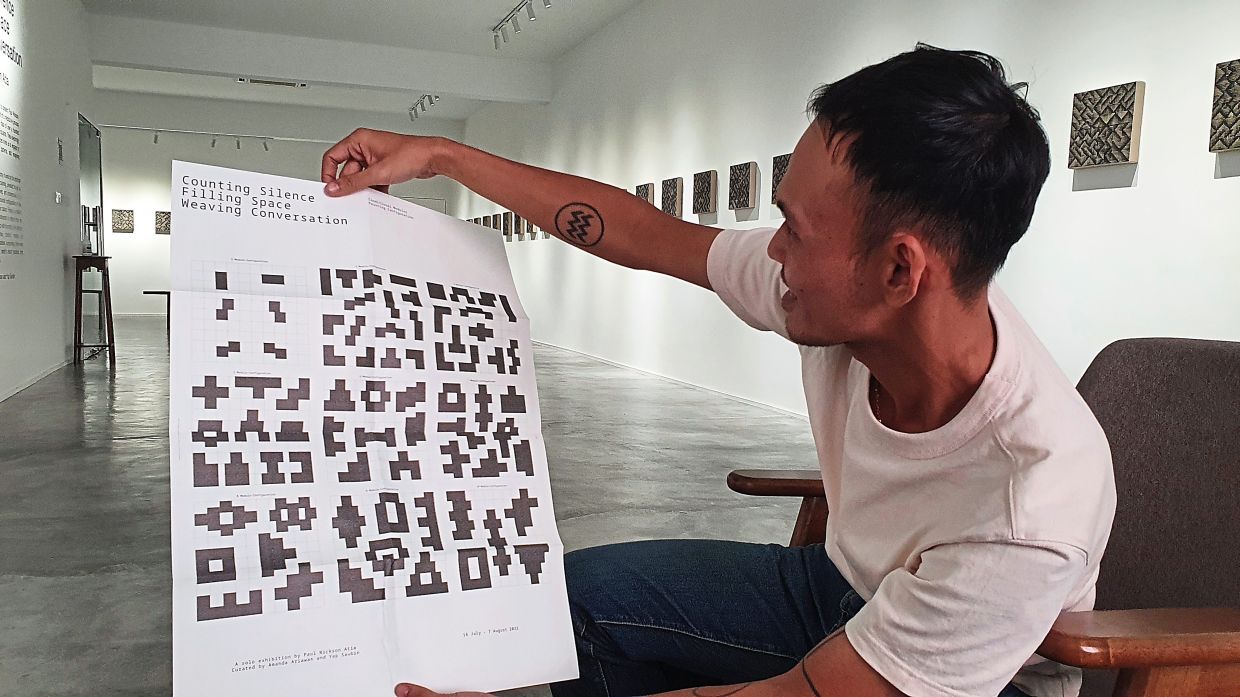
In fact, the curatorial booklet comes with suggestions of 10 configuration modules which a collector could “play” with.
It’s no wonder Paul likes the idea of Ikea furniture and Lego bricks: “They are all made the same, and then you can do almost anything with them.”
There are two ways to inform your understanding of design, the artist says, either by creative association or creative innovation. “Some people may look at this,” he says pointing at a module on the wall, “and think it looks like a cloud or a cactus (association), while others will more readily notice the details, the rhythms or sequence (innovation).”
Did Paul mean for CSFSWC to have some sort of message behind it?
“Not really,” he says. “I have come to realise that I have been always very introspective about my work. It is deeply personal, and I am always looking inward instead of projecting it outward.”
Bidayuh heritage, architectural mind
You’ll sometimes see Paul referred to as Atia which he doesn’t mind at all. Atia is his mother’s name. “Paul Nickson anak Atia” is the common form of naming to trace one’s lineage in Bidayuh culture.
Brought up by his single mum to embrace his talents, Paul says heritage is important to him, and he hopes to explore it in his future Perhimpunan work: “I want to deep dive into the socio-culture aspects of being a native Sarawakian Bidayuh.”
The plan was to do research and go on a trip around Borneo in 2020 but due to the pandemic, things came to a halt. He ended up going back to part-time teaching instead, but hopes to pick up the project where he left off.
“I’m currently at Rimbun Dahan for three months and I’m looking at this arts residency as a thinking space, a testing ground or a pilot site for me to develop Perhimpunan further. I want to formalise my methods, and test my hypotheses before I make a start.”
Paul wants to be careful about how he approaches the subject of being Dayak as it is something very important and dear to him.
“I don’t want to simply jump in and start riding on it. I want to be critical and careful about how I approach it.”
How exactly did Paul end up becoming an artist? After completing his bachelor’s degree in architecture at Universiti Malaya, Paul went on to practice at PORT25, a local architecture firm. Then he worked as a part time lecturer at Taylor’s University School of Building Design from 2015-2017 before branching out into paintings and drawings.
Why? “Can I say because I used to hang out with my artist friends too much?” he laughingly offers, then says more seriously, “Architectural thinking is what makes me more aware of my surroundings. You can still be an architect even if you’re not building.”
Paul says that he is the first in his family who is in the creative or artistic industry.
“But my late grandpa and my uncles are all builders and craftsmen ... I guess they are a little more utilitarian in that sense. One of my uncles makes statues and props that people use during Gawai, so I guess I was exposed to that sort of craft since I was really young.”
Paul also works on some architectural projects on a freelance basis; for example he is currently designing a church in Kampung Sungai Pinang Bau, his village in Kuching. He also loves teaching and sharing knowledge, revealing that his long-term dream is to build an alternative school in Kuching that teaches design, art and critical thinking.
“I look at art and architecture as a way to bridge different aspects of communities, be they social, cultural or political. This is what I am truly interested in.”
More info here.
Already a subscriber? Log in
Get 20% OFF The Star Digital Access
Cancel anytime. Ad-free. Unlimited access with perks.