If you happened to be in Taman Melawati in Kuala Lumpur late last month, you might have seen a lorry carrying artworks from the collection of the late Rahime Harun (1954-2008), former National Art Gallery director-general, art administrator, collector and artist/writer.
If you had lingered, you would have seen this same truck making its rounds around the neighbourhood several times, but with a different set of paintings each time, including Ahmad Zakii Anwar’s The Dancers (1994), Ismail Zain’s My Friend Vincent (1988), Bhanu Achan’s Alam (1992) and Lim Joo Sun's Chinese Wedding (1988).
This parade of selected artworks was no transport exercise. It was a performative work by Five Art Centre member Mark Teh, titled Melawati - This Place: Displays: Displace.
It was part of A.P. Art Gallery’s current Object Matters: Emancipating The Collection Of Rahime Harun curatorial research project in Kuala Lumpur, which examines the discourse on art collection, and the significance of "object" in a collection.
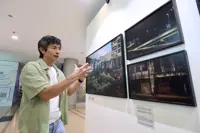
Besides the opening of the late A.P. Art Gallery founder Rahime’s collection room for public viewing, Object Matters displays a range of archival materials and documents that illustrate the arc of discourse on art collection, as well as works by invited artists – including Teh (performance director, educator and researcher) – that are instigated by Penang-born Rahime’s collection.
Due to the movement control order (MCO), the gallery is currently closed but the exhibition can be viewed online here.
As a "public touring exhibition", This Place: Displays: Displace pushed the limits of displaying artwork from a private collection.
It was Teh’s response to not as much the art pieces, as it was about the space the collection is in, the way it is being stored and displayed, and the possibility of playfully intervening.

To that end, a number of people who worked in the building were invited to select two objects of their choice from the space: one that they would like to display in their own home, and another that they would like to send out of the building to “visit” Taman Melawati.
These artworks were then displayed on either side of a lorry, with two cameras affixed to livestream the event on Facebook and Instagram. A route of around 3.7km was mapped out, and Teh and the exhibition team made this trip seven times that day, between 10am to 1.30pm, with new works on display each time.
“We didn’t stop for people to look at the works, but we were driving extremely slowly (15 to 25km/h) and so they could see the artworks from the sidewalks and from their cars. As you can imagine, there was a certain element of risk involved in this project as we are in the middle of an Emergency and an MCO. The idea wasn’t so much to replicate a gallery exhibition experience, but to take some things which are contained in a private collection which has not been seen for many years, and to share it publicly, ” says Teh.
This performative element of this project is a one-off, in that you either caught it or not, when they were making their rounds on the road.
But there are traces of this action left in photos and videos, both a documentation of Display and Displace(ment), as it is with how the empty walls and spaces left by the removed works have been photographed and displayed in the gallery space.
In coming up with this project, Teh drew on his initial impression of This Place, that is, the three-storey shophouse building at Taman Melawati, where the majority of Rahime’s art collection, personal library and assorted artefacts are stored.

“My first, vivid impression upon stepping onto the third floor where the Rahime Harun collection is stored, was one of intensity and density, created by the sheer volume and arrangement of artworks and objects in the space," says Teh.
"The displays filled up all walls, corners and rooms, with little space between one object and another, from floor to ceiling – creating a visual sense of horror vacui, an incredible erasure of empty space. The existing displays suggested a configuration that was for personal - rather than public - contemplation. This Place was after all, a home, ” he adds.
Object Matters, which opened on Jan 7, is curated by Roopesh Sitharan, who explains how the focus here is shifted from existing discourses on art collection that builds or participates in art history and/or discusses the profile of ownership that contributes toward the commodified value of the collection, to looking at the collection in terms of individual objects that can be reactivated or made relevant in an innovative, creative and critical way.
“The topic itself is not new, as in choosing the topic of 'collection' for exhibition making. There are many such exhibitions done before. Arguably the idea of being able to sell – or be collected – is seen as a yardstick for success among local artists. So the idea of 'collection' is a reality one needs to confront when choosing to participate in the local art industry as it is seen as the final destination for an artwork and pinnacle of achievement for an artist, ” says Roopesh.

Among other topics, the project ponders on what happens after an artwork ends up in a collection, and importantly, to seek what sort of contribution a collection can make to the local scene or society, other than just gaining monetary value over time.
“I believe these are important questions to ask because it could potentially open up various ways of engagement in which we can relate to an art collection, other than the reduced sense of collected objects with some significant narratives it might carry that is discussed only by the art community. It is a difficult task to ask such questions as it opens up something personal for scrutiny, ” he adds.
As such, Object Matters utilises an existing collection and examines how new works and responses to this collection can reach audiences outside its existing circle.
It is a process that Roopesh describes as refreshing; specifically, in seeing and experiencing how an art object in a collection can gain new life, relevance and importance that could contribute towards building new knowledge.
“I hope visitors will take away from this exhibition that an art collection is not only something personal, intimate and secretive but also has various, unexplored potentials waiting to be unleashed and experienced that could benefit the public, ” says Roopesh.
In the Pursuing A Dream - From The Collection of Rahime Harun catalogue from 1995, Rahime had written, “All the artworks in my collection would be meaningless if they were kept in my storeroom and not shared”.
Object Matters has certainly found creative and unconventional ways to share them.
Already a subscriber? Log in
Get 20% OFF The Star Digital Access
Cancel anytime. Ad-free. Unlimited access with perks.