BEFORE diving into discussions on low-carbon cities, I used to think sustainability was mostly about recycling, reducing plastic use or protecting forests. I did not realise how deeply it is connected to the way our cities are built and how we live daily.
It was Urbanice Malaysia chief executive officer Norliza Hashim who made me realise that sustainability is hardly just an environmental issue, but is also a lifestyle, an economic strategy and a responsibility shared by everyone.
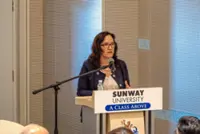
In her talk at the Asia ESG Summit 2025 titled “Building Low Carbon and Sustainable Cities towards a Better Quality of Life in Cities and Nations”, Norliza stressed a truth that many of us are now facing – urbanisation is happening faster than we can handle it in a sustainable way.
The reality of urbanisation
One thing that truly surprised me was how urbanisation is shaping Malaysia’s sustainability challenges. With nearly 80% of Malaysians living in cities, the pressure on the environment is immense.
I used to think cities were symbols of progress and convenience, but now I see that they also contribute heavily to carbon emissions through transportation, housing and industrial activities.
Norliza showed us the National Coastal Zone Physical Plan, which was a wake-up call. The map illustrated how rising sea levels and erosion are already affecting our shores. This taught me that if cites are not planned carefully, they can harm both people and the planet.

From what I learnt, low-carbon cities are not just about reducing emissions, but they are also about creating a better quality of life. I was fascinated to learn that 154 of the 169 UN Sustainable Development Goals (SDGs) targets are actually related to carbon measures, meaning climate issues are completely tied to our national development.
For example, improving public transportation cuts carbon emissions and also reduces traffic congestion and stress.
This connection between sustainability and well-being made the concept feel much more personal to me. It is no longer just about saving the earth, but about improving how we live every day.
Challenge of implementation
However, I also noticed that Malaysia is still facing challenges in achieving its sustainability goals. Despite ongoing efforts, the country has only reached about 49% of its SDG targets, according to Norliza.
This made me realise that progress is not just about having plans, but about consistent implementation. One key issue Norliza highlighted was the lack of coordination between federal, state, and local governments.
The data shows a clear gap. Norliza mentioned that while about 75% of city councils are making progress, district councils are only at 50% to 55%. In my opinion, this is one of the biggest barriers. Sustainability cannot succeed if efforts are fragmented. It requires strong collaboration across all levels of governance.
Framework and technology
The introduction of the Low Carbon Cities Framework (LCCF) stood out to me as a practical solution. According to Norliza, it is key to ensuring vertical alignment between local planning and national climate goals. By synchronising how state and municipal governments measure their carbon footprints, we move away from fragmented efforts and toward a unified strategy for tackling the climate crisis.
I think tools like this are important because they turn ideas into measurable actions.
Similarly, the Malaysia SDG Cities Programme launched by Urbanice, which involves 156 local governments, shows that there is effort in aligning the whole country. Without clear indicators and tracking systems, sustainability can easily become just a concept rather than something real.
Another aspect that caught my attention was the role of technology. Norliza said that technology should no longer be optional. Smart technologies, such as energy monitoring systems and efficient transportation networks, can significantly reduce carbon emissions.
This made me reflect on how important it is for my generation to be equipped with digital skills. The future workforce will need to understand sustainability and know how to use technology to implement it.
Changing mindsets and habits
At the same time, I believe technology alone is not enough. There must also be awareness and willingness among people to change their habits.
For instance, Norliza mentioned that urban ministries have actually banned certain unsustainable installations, like cove heating, for the past four years because of their environmental impact.
This shows that building low-carbon cities is both a technical and a behavioural challenge. Communities must be involved so that sustainability becomes part of everyday life.
What impacted me the most was the idea that sustainability is a shared responsibility. As Norliza puts it, it is not just the job of authorities. It is everyone’s job. Businesses, students and ordinary citizens all have a role to play. As a student, this made me reflect on my own responsibilities.
I used to think that contributing to sustainability meant doing small actions like recycling, but now I realise it also involves being aware, making informed choices and even influencing others.
Reflecting on the future
Looking ahead, I feel both hopeful and concerned. Hopeful because Malaysia has frameworks, programmes and growing awareness, but concerned because progress is still slow and challenges like policy inconsistency remain.
As we move through the 12th Malaysia Plan and into the 13th Malaysia Plan economic phases, I believe universities also have a role to play by integrating sustainability into education, so students are better prepared to face real-world environmental challenges.
In conclusion, learning about low-carbon cities has changed my perspective completely. It has made me realise that building a sustainable future requires not only policies and technology but also mindset changes and collective action. As part of the younger generation, I now see that I am not just observing this transition – I am part of it.
The Star Journalism Apprenticeship Programme offers hands-on experience and mentorship for aspiring journalists. Interested students can apply at brats@thestar.com.my.