

IT is actually quite surprising what you can get with a simple prompt with audio, said Matthias Gelber.
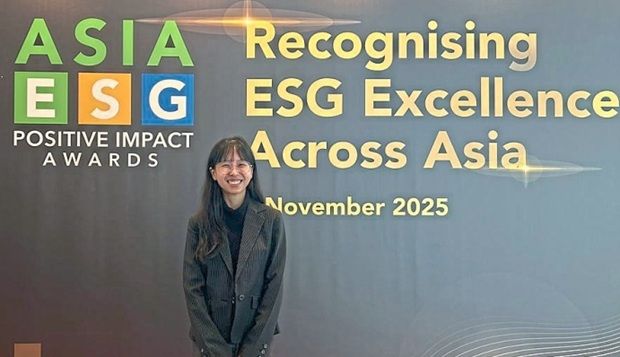
When the international ESG expert spoke at the Asia ESG Summit 2025, his words elicited a curious mix of relatability and skepticism. Contradictory, I know, but bear with me.
Until that morning, my use of artificial intelligence (AI) was limited to refining sentence structures and engaging in questionable “counselling” sessions, asking, “Am I crazy for feeling this way about...?”
Even social media feeds reinforce this practical and entertainment-based usage with mutuals posting AI-generated caricatures of themselves.
Initially, AI sounded daunting and futuristic. I imagined humanoid robots and sci-fi takeovers.
That perception shifted at university, where I discovered the dopamine rush of instant gratification when using AI.
It felt less like a machine and more like texting a friend who is perpetually on your side. However, because it never seemed to disagree, I adopted a cynical rule: AI equals unreliable.
After all, it was created by humans, and humans naturally make mistakes. AI, I thought, was merely a tool that generated hallucinated facts to please its user.
I was, therefore, genuinely curious to see how Gelber would challenge my belief that AI was too fickle to handle something as grave as the fate of our planet.
Beyond the carbon cycle
As Gelber’s interactive session began, delegates shared how they utilised AI in their respective fields, ranging from language processing to market forecasting.
From them, I learnt of applications I had never considered possible, such as studyiing overseas carbon taxes models.
Then, a sobering realisation struck: I barely understood what decarbonisation really meant. In school, I had learnt about the carbon cycle and its movement through the atmosphere.
Yet, instead of learning how to eliminate decades of accumulated emissions, I was fed textbook platitudes about carpooling or recycling to reduce carbon footprint.
Don’t get me wrong—individual steps matter—but what of the bigger picture? If AI can help navigate our personal lives, corporations ought to use it to tackle the massive emissions we cannot fix alone.
AI could be the guiding hand to shape a net zero future through roadmaps containing implementable ideas and rigorous progress reports.
Accelerator, not autopilot
During the session, Gelber conducted a live demonstration. Using a simple, 30-second audio prompt on ChatGPT Pro, he generated a decarbonisation report for a local property developer using publicly available data.
Watching weeks of data-sifting condensed into a few minutes was a wake-up call; it proved just how low the barrier to entry has become for sustainability reporting with AI.
While the speed was impressive, Gelber stressed that human oversight remains non-negotiable. AI acts as a consultant, but it lacks the intuition and wit that humans possess.
This leads back to my initial prejudice: if I dismiss a tool as unreliable while being too lazy to verify its results, the fault lies with me.
We must work alongside technology; as it simplifies complex concepts, we remain responsible for the precision of our prompts and the factual integrity of the output.
The data behind the change
Using Sime Darby Property as a case study, the AI-generated report brought the numbers into sharp focus.
While Scope 1 emissions were low, Scope 2—driven by electricity—accounted for a staggering 90% of operational emissions.
Scope 3 remained the most complex, involving indirect factors such as supply chains and construction materials.
To address this, the AI outlined clear targets: a 40% reduction by 2030, aiming for net zero by 2050.
It suggested green power procurements, solar installations, and smart heating, ventilation and air conditioning (HVAC) systems.
This data is merely the first step, but it equips corporations with a practical “where and how” to mitigate their impact.
When giants shift, it directly improves lives for you, me and our families.
Getting with the times means recognising that while corporations drive the change, we must use this technology to demand action beyond our individual capacity.
Walking the path together
Upon reflection, I realised this information is not just a suggestion; it is a practical solution. As a student, the climate crisis can feel like a heavy burden passed down without a manual.
Yet, AI offers hope that we have the tools to adapt and perhaps even reverse the damage, all while expanding our own knowledge.
As AI advances, corporations must seize the opportunity, allowing us as individuals to follow suit.
If we all move in tandem, I believe we could see measurable shifts, from targets on a screen to tangible, on-ground progress.
We have the data and the tools. The only remaining variable is will. Gelber showed me that change can start with a “simple prompt.”
If AI can map the path to net zero, what excuse is left for not walking it?
The Star Journalism Apprenticeship Programme offers hands-on experience and mentorship for aspiring journalists. Interested students can apply at brats@thestar.com.my.