
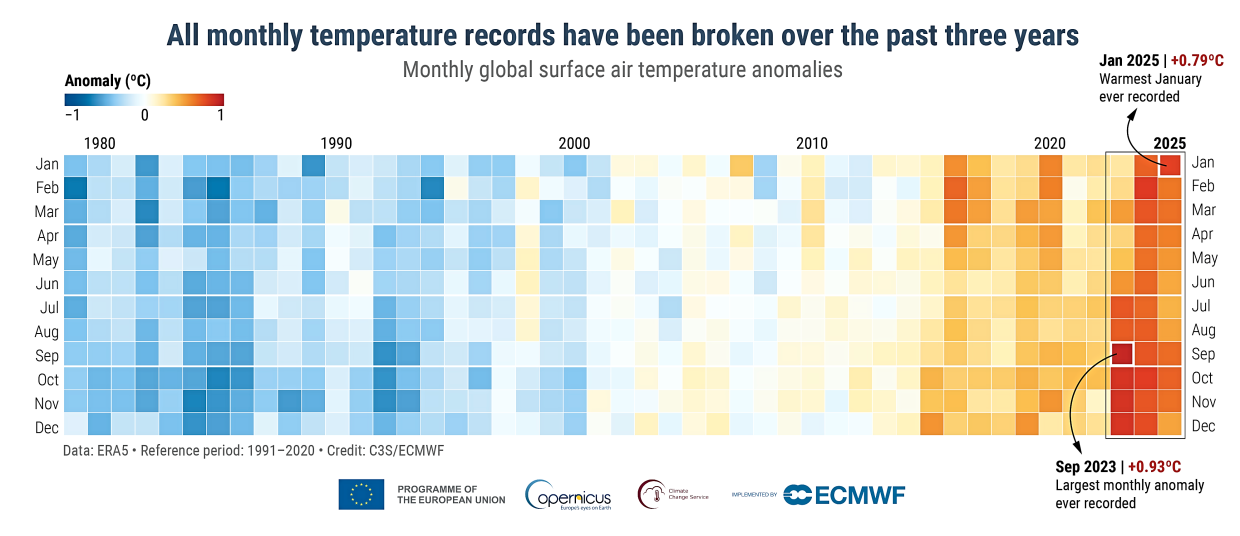
The Earth has now experienced 11 consecutive years of record warmth, European Union (EU) scientists confirmed, with 2025 ranked as the third hottest year.
The warmest year on record was 2024. With this current rate, the Paris Agreement’s limit of 1.5ºC for global warming could be breached by 2030—over a decade earlier than predicted.
“It is inevitable that we’ll pass the threshold,” said Copernicus Climate Change Service (C3S) director Dr Carlo Buontempo. “And it’s up to us to decide how we want to deal with the enhanced and increased higher risk that we’ll face as a consequence of this.”
He was speaking in an online press conference ahead of the release of the findings by the European Centre for Medium-Range Weather Forecasts (ECMWF), which operates C3S and Copernicus Atmosphere Monitoring Service on behalf of the European Commission.
The global surface air temperature in 2025 was 1.47ºC higher than the pre-industrial level, following 1.6ºC in 2024. The year 2025 was only marginally cooler (0.01ºC) than 2023.
The heat is largely the result of the build-up of greenhouse gases in the atmosphere, caused by emissions and reduced uptake of carbon dioxide by natural sinks, ECMWF said.
Global sea-surface temperature was also third warmest after 2024 and 2023, it added, associated with an El Nino event and other variability factors, amplified by climate change.
The release of ECMWF’s findings coincided with the global temperature announcements from other organisations involved in climate monitoring, including NASA, the UK Met Office and the World Meteorological Organisation (WMO).
WMO’s consolidated analysis of eight datasets confirmed that 2025 had continued the streak of “extraordinary global temperatures”. Two of these datasets ranked 2025 as the second warmest year on record, while the other six ranked it as the third warmest.
The datasets are based on measurements from weather stations, ships, buoys and satellites using slightly differing methodologies, hence the minor variations in their figures and rankings.
More days with ‘strong heat stress’
Although 2025 as a whole did not break the temperature record, January 2025 was the warmest January ever recorded. Annual surface air temperatures were above the 1991-2020 average across 91% of the globe.
The rise in global temperatures has widespread effects on the environment. When the atmosphere heats up, it holds more moisture, increasing the intensity of rainfall and the risk of flooding, said Dr Samantha Burgess, strategic climate lead at C3S. Similar patterns occur with heatwaves.
“Climate change is effectively a threat multiplier, where an
individual event may not be directly attributed to climate change because we’ve always had flooding events and heatwaves, but they are often made worse because of that long-term climate change signal,” she said.
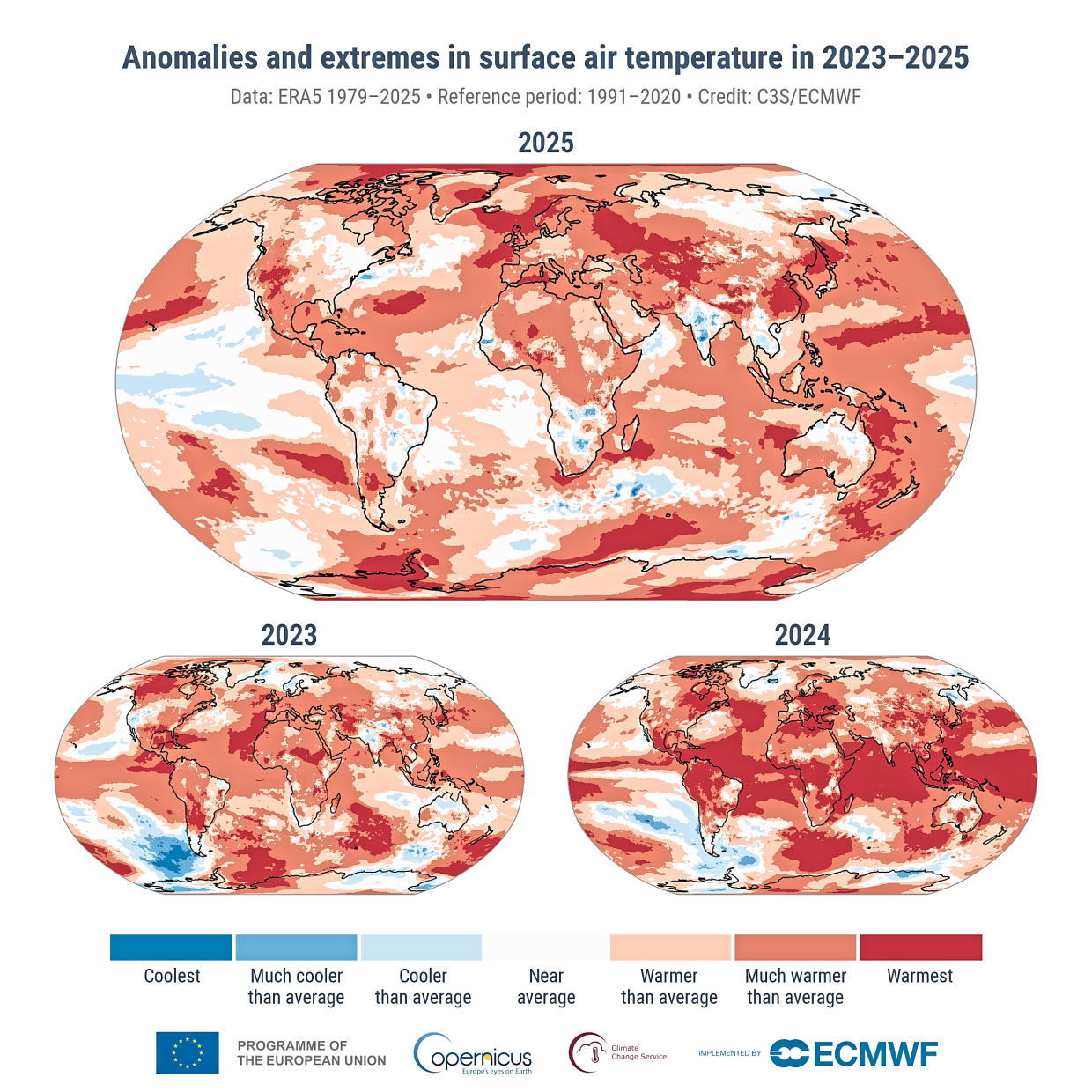
Showing a map of temperature anomalies relative to the 1991-2020 baseline, Burgess pointed out that there are more red warmer regions and fewer blue colder regions. “In 2025, there are places which experienced a relatively cool year by chance. One cold area does not mean climate change is not real. The global context is what matters.”
Higher temperatures in the polar regions were also observed in 2025. In particular, Antarctica had its warmest year on record.
“No global climate highlights would be complete without talking about sea ice. Sea ice extent at both poles remained lower than average for virtually the whole of 2025. In March, the Arctic reached its seasonal maximum, but this peak was the lowest on record,” Burgess elaborated.
She acknowledged that these long-term trends are not how society experiences climate change, but rather through extreme weather events. In 2025, floods, extreme heatwaves, droughts and wildfires had had significant impacts on human health, ecosystems and infrastructure.
The consequences of rising global temperatures are felt particularly during heatwaves, which are made more intense and more likely by continued global warming, she added.
Throughout 2025, half of the globe experienced more days than average with at least “strong heat stress”, when temperatures feel like 32ºC or above. Some regions, such as most of Australia, parts of Northern Africa and the Arabian Peninsula saw more extreme heat stress days than average, Burgess said.
“Extreme heat stress is equivalent to a feels-like temperature of more than 46ºC, at which point it is critical to take action to avoid health risks such as heat stroke.”
The non-linearity in temperature—2025 does not have to be warmer than 2024 despite the long-term trend—”is really why so many people are fascinated by the weather”, Burgess said.
“Our weather is incredibly dynamic, and even though we’ve got this long-term warming, what happens around the world is utterly dependent on the weather systems that we experience.”
2026 predictions
There is a chance of the globe entering a new El Nino phase in 2026, said Buontempo.
El Nino tends to have a warming effect on global temperatures, superimposed on long-term human-caused global warming, whereas La Nina tends to have the opposite effect. “It’s still to be seen, but even without El Nino, chances are we are likely to see higher than usual temperatures,” he added.
Burgess predicted 2026 to be among the five warmest years. “Maybe it will be comparable to 2025, but it really remains to be seen what happens with natural variability over the coming months,” she said.
She explained that an average temperature rise of 1.5ºC over a three-year period does not mean that the Paris Agreement has been breached, as the accord refers to long-term warming above 1.5ºC.
“The Paris Agreement and international action are to get to net zero as quickly as possible to reduce emissions and to reduce global warming.
“We know that there is significant ecosystem disruption (when temperature rises above 1.5ºC), as well as intensification and increased frequency of extreme events.”