
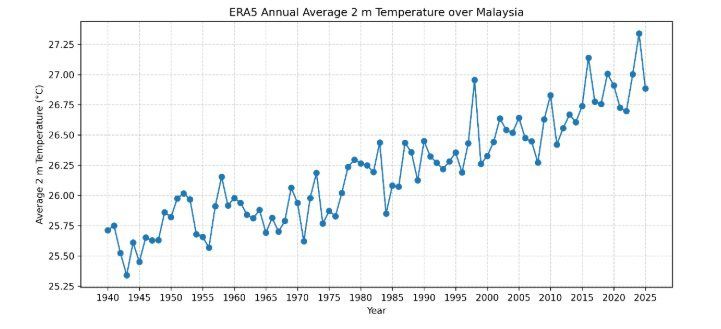
A closer look at the Copernicus ERA5 dataset revealed that Malaysia also experienced a high surface temperature in 2025, Universiti Kebangsaan Malaysia’s Institute of Climate Change senior lecturer and research fellow Dr Maggie Ooi Chel Gee told StarESG.
This puts 2025 in the top tier—or more specifically, top seven—of temperature records since 1940, she said.
“Notably, the highest increments are recorded near the west coast of Peninsular Malaysia.
“The global temperature rise is mainly contributed by emissions from human activities, which knows no boundary, hence the heating trend in Malaysia would be coherent with the global situation,” Dr Ooi explained.
ERA5 is a global climate and weather reanalysis dataset provided by the Copernicus Climate Change Service (C3S) and European Centre for Medium-Range Weather Forecasts (ECMWF).
In November, an unprecedented intensification of tropical depression into Tropical Storm Senyar occurred over the Straits of Malacca, causing severe floods in the region.
It is difficult to identify whether climate change is indeed the cause of a specific weather event, Dr Ooi noted, adding that multiple factors including climate change conditions, development plan and infrastructure have to be considered.
Nonetheless, historical data collected by the Emergency Events Database EM-DAT showed a rise in the frequencies of natural weather disasters around the globe and in Malaysia over the last six to seven years, she said.
The time is now for all at individual, community, corporate and institutional levels to reduce our contributions to climate change, Dr Ooi stressed.
Nationally, the third iteration of the National Determined Contributions have anticipated the peak of greenhouse gas (GHG) emissions between 2029 and 2034.
“Several sectors, such as energy, industrial processes and product use, are targeted for the GHG reduction plan to cut emissions by 15 million to 30 million tonnes of carbon dioxide equivalent by 2035 from the peak level.
“Through the pledge, domestic policies such as energy transition, transport decarbonisation, phasing out coal and fossil fuel, have been and will be implemented phase-by-phase.”
Dr Ooi emphasised that climate change develops over decades; therefore, the effectiveness of our actions will only become evident in the long term.
“Hence, our persistence in taking action and our adaptability to change are crucial to protecting ourselves from the further impacts of climate change,” she said.