THE news out of Singapore this week shows why energy security remains one of the top concerns for governments since the Middle East conflict broke out in late February.
Oil giant Saudi Aramco signed a memorandum of understanding with Singapore’s Energy Market Authority and JTC Corp to store up to nine million barrels of crude oil and condensate in Singapore’s Jurong Rock Caverns.
As sea lanes have become risky chokepoints for Aramco, Singapore offers a safe location to store crude and supply clients in the region, complementing its storage facilities in major buyer markets such as Japan and South Korea.
For the Singapore government, the deal helps strengthen energy security, with the country likely to be given the first right to buy from the stored reserves.
The timing couldn’t be more telling as Indonesia cut pipeline gas exports to the island republic by about 31 million standard cu ft per day and redirected the gas for its own domestic needs.
Singapore is now reportedly considering nuclear energy as part of its energy mix.
The two developments highlight the energy security concerns that importing and exporting countries must consider at a time when the expansion of artificial intelligence (AI) infrastructure is driving up energy demand.
Holding strategic reserves has become a priority for many countries that can afford to do so. Against this backdrop, Dialog Group Bhd is in a sweet spot, according to an oil company executive, as it offers exposure to both storage and supply.
“Dialog’s tank storage business has become more attractive and important due to the energy security concerns. Its assets are in a safe location and offer excess to regional markets.
“Its existing capacity is almost fully taken up and the one million cb m of new capacity that is coming onstream in a couple of years would attract clients.
“There is also upside from its very conservative upstream business, which is gaining traction after having ventured into it over a decade ago,” the chief executive officer of a Bursa Malaysia-listed oil and gas support services provider tells StarBiz 7.
Equity analysts also view Dialog as an increasingly attractive, multi-engine energy infrastructure provider, that effectively combines defensive, recurring midstream cash flows with expanding upstream marginal oilfield operations.
AmInvestment Bank believes the group is entering a structurally cleaner earnings cycle.
Its net profit rose 95.4% year-on-year in financial year 2026 (FY26) to RM593.6mil as revenue grew 15.3% to RM2.88bil.
In a nutshell, two primary catalysts will shape Dialog’s growth trajectory: the accelerated monetisation of its upstream production portfolio and the repricing of storage rates across its midstream assets.
Dialog’s core midstream operations serve as the valuation anchor, generating over 50% of group net profit, although the business mix is shifting towards a greater upstream contribution.
Hong Leong Investment Bank (HLIB) Research noted that incremental production from the Cendramas and Baram Junior Cluster fields, both of which are due to commence production in the second quarter of FY27 (2Q27), is projected to lift the upstream earnings contribution to 30% to 40%, from 25% in FY26.
This would help offset any moderation in crude oil prices and natural declines at existing fields. The group has expanded its upstream ventures into Indonesia and Thailand.
Dialog has taken the final investment decision on its US$81mil Raja Cluster project.
The cluster contains six million barrels of proven and probable resources across three fields.
First oil is projected within two years, with an earnings contribution likely from FY29.
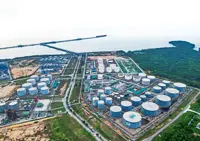
Dialog is the second-largest terminal owner-operator in the Asia-Pacific region, with a total operating storage capacity of 5.5 million cb m. Dialog’s midstream assets are backed by extensive marine infrastructure, comprising seven marine berths at Dialog Terminals Langsat (DTL), five at Kertih and 20 at Pengerang Deepwater Terminal (PDT). This segment continues to expand.
Following a recent site visit, HLIB Research noted that vessel movements at PDT had risen fourfold, from 532 vessels in FY19 to 2,159 in FY25.
The tree berths at PDT now handle an average of seven to eight vessels daily.
The research house also noted that construction of the additional 614,000 cb m of tank capacity at PDT 5 is progressing well and remains on track for completion and commissioning by mid-2028.
The new capacity is dedicated to storing refined petroleum products and biofuels for BP Singapore Pte Ltd under a 10-year agreement.
Several expansion projects are expected to progressively come onstream, including the 150,000 cb m DTL 3 renewable fuel storage expansion, scheduled to commence operations in 1Q27 as well as the liquefied natural gas-driven air separation unit facility in 2Q27.
Aramco’s exit from its joint-venture investment in Pengerang has little impact on Dialog, whose tank utilisation remains above 90%, with customer take-up secured under long-term take-or-pay agreements with global energy firms.
HLIB Research added that the business enjoys stable storage rates of S$6 to S$6.50 per cb m per month. With contracts renewing on six- to 12-month cycles, analysts anticipate a 5% storage rate uplift to S$6.70 per cb m.
They estimate that every 10% rate increase would lift Dialog’s earnings by 3%.
Dialog still holds some 660 acres of land, capable of supporting an additional four to five million cb m of storage capacity.
Dialog is expected to release its 1Q27 results in the third week of November, but early positioning by investors has helped its stock price rise some 10% since early October to RM2.10 at last look.
HLIB Research has a “buy” call on Dialog, with a target price of RM2.49 a share.
It favours the group’s diversified and resilient business model, with stable recurring income from tank terminals complemented by upstream exposure to stronger crude oil prices.
Analysts also say that, unlike in previous industry cycles when upstream gains were eroded by cost inflation in the group’s downstream engineering, procurement, construction and commissioning (EPCC) segment, Dialog’s current operating setup features secured EPCC raw material costs, high terminal utilisation and expanding exposure to sustainable biofuel storage.
Ongoing projects, in turn, provide earnings visibility for the downstream EPCC business.
Its contribution to group earnings is likely to fall to about 15% in FY27 and beyond as the upstream segment grows.
Already a subscriber? Log in
Get 20% OFF The Star Digital Access
Cancel anytime. Ad-free. Unlimited access with perks.