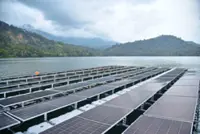
HANOI: Amid increasingly unpredictable global energy prices, intensifying extreme weather and mounting pressure to reduce emissions, Vietnam’s industrial parks are facing the challenge of securing sufficient electricity for production while also controlling costs and moving toward energy independence.
Rooftop solar power, especially when combined with battery energy storage systems (Bess), is emerging as a strategic solution, paving the way for a greener, more flexible and more sustainable industrial park model.
According to energy experts, businesses can save between 20% and 40% on electricity costs by adopting rooftop solar power systems, with an average payback period of around four to six years, while system lifespans can extend from 25 to 30 years.
This helps stabilise long-term production costs amid fluctuating electricity prices.
Practical implementation in several major industrial parks has already demonstrated clear benefits.
A rooftop solar power system with a total capacity of approximately 90MW peaks has been in operation at Thang Long Industrial Park in Hanoi since 2021, helping many businesses reduce electricity costs while also meeting increasingly stringent sustainability and emissions reduction standards required by international partners.
Assistant general director of Thang Long Industrial Park Lisa Iguchi said the deployment stemmed from the practical needs of factories, especially in the electronics sector, as well as environmental responsibility and sustainable development requirements.
“The use of renewable energy not only delivers economic benefits, but also enhances competitiveness within the global supply chain,” she said.
Similarly, at Amata Industrial Park in Dong Nai Province, the ecological industrial park model associated with renewable energy is also being strongly promoted.
Many foreign direct investments enterprises in the park have invested in rooftop solar systems to meet increasingly strict environmental, social and governance standards. Rooftop solar power has a major advantage because its highest electricity output occurs during the daytime, exactly when industrial park production loads peak.
This synchronisation allows businesses to significantly reduce the amount of electricity purchased from the grid, especially during peak hours.
However, Dr Nguyen Huy Hoach from the scientific council of Vietnam Energy Magazine told the Ha Noi Moi newspaper that solar power still has an inherent limitation due to its intermittent generation pattern.
This means its economic efficiency cannot be fully maximised without complementary solutions, according to Hoach.
For this reason, Bess is increasingly seen as the missing piece needed to complete the energy independence equation.
When combined with rooftop solar systems, Bess allows excess daytime electricity to be stored and used during periods with higher electricity prices, helping businesses reduce costs and optimise energy use. — Viet Nam News/ANN