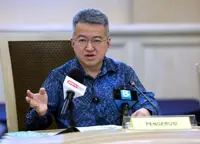
SINGAPORE: One of the pioneers of modern artificial intelligence (AI) has raised US$1.03bil (S$1.3bil) for his start-up AMI Labs in a seed funding round supported by Singapore’s investment company Temasek and Shopee owner Sea Ltd.
The fundraising announced on March 10 will support the development of advanced machine intelligence – where AI models are primarily trained with visuals to learn representations of the real world.
AMI Labs said in a statement that its models will be trained in a way “similar to the mental models humans use to reason and guide action”.
“These systems predict how situations evolve and how actions lead to consequences, so that they can plan sequences of actions under real-world constraints with an emphasis on safety and reliability,” the firm said.
Large language models, widely used by businesses and individuals, and powering platforms like ChatGPT, draw on large amounts of data to respond to prompts.
Advanced machine intelligence, in comparison, will be “safer and, in a way, more controllable”, AMI Labs executive chairman Dr Yann LeCun said in an interview with The Straits Times (ST).
He said: “We already have prototypes that basically have some level of common sense.
“If we show the prototypes a video where something impossible occurs, like someone throws a ball and the ball turns into a cube or disappears, the system tells us this is impossible. That puts us on a good trajectory (for progress).”
LeCun, who was formerly the chief AI scientist at Meta until his exit from the tech giant at the end of 2025, is recognised as one of the three “godfathers of AI”.
This came after he received the Turing Award, often referred to as the “Nobel Prize of computing”, alongside Dr Geoffrey Hinton and Dr Yoshua Bengio in 2018.
LeCun said the Singapore investment received from funders Temasek and Sea was important for his venture.
“Singapore is a very important location for us.
“We have quite a lot of links in Singapore, and partners here and in Asia generally. The talent pool is great, too,” he said.
The funding round, which valued the start-up at US$3.5bil, was co-led by companies including San Francisco-headquartered venture capital firm Cathay Innovation and Bezos Expeditions, the family office of Amazon founder Jeff Bezos.
Among its supporters are American businessman and television personality Mark Cuban and US chip giant Nvidia.
The funds will also be put towards long-term research and hiring.
AMI Labs is headquartered in Paris, where LeCun was born and raised before he moved to the United States and attained dual citizenship there.
The start-up has offices in New York, Montreal and Singapore.
The Singapore office currently has four staff based at the WeWork office in Robinson Road.
There are plans to grow its headcount to 20 in the coming year, ST understands.
The first phase of expansion of the Singapore office will focus on research and development, and building AI infrastructure together with the global team.
In the next phase, there will be focus on transferring the technology to industrial partners and real-world applications.
LeCun said he sees many applications for the world model for AI, which understands the dynamics of the real world, that AMI Labs is developing. This includes it being used in robots on a factory floor, which can be tasked to accomplish an objective.
Unlike some voices in the AI world, he believes the “fantasy that AI systems are going to replace us because they are smarter is just false”, and is something that can be prevented by design.
LeCun said: “We are limited by the power of hardware at the moment, and our algorithms still need to make progress.
“But in principle, I don’t see any limits to the development of AI in the long term.
“We have systems that at some point will be as smart as humans. But again, they will be under our control.
“They’ll do our bidding.”
Asked about studies showing that AI could potentially replace jobs, LeCun said he sees the technology only “automating certain tasks” and making workers more efficient.
“That’s the history of technology. There is nothing qualitatively different about AI.
“Our relationship to AI systems would be similar to all of us being the boss of a team of AI assistants that will solve problems and accomplish tasks for us.”
Governments around the world, including in Singapore, have moved to help their citizens realise the potential of AI, while introducing safeguards for the technology.
At the recent budget, it was announced that a National AI Council chaired by Prime Minister Lawrence Wong will be created to help Singapore harness AI as a strategic advantage.
Singaporeans who undergo selected training courses will also get six months of free access to premium AI tools, to encourage people to experiment and familiarise themselves with AI.
LeCun said the government is right to focus on education, as the definition of being AI-literate is continuously changing.
He also stressed the importance of resources for public research, adding that “Singapore has been doing very well in that respect, in terms of having a good ecosystem”.
He also believes that AI should not be regulated at the research and development stage as it is not “intrinsically dangerous”, and regulation should be saved for AI products.
World models for AI are in themselves not new.
Google’s DeepMind Genie 3, for instance, is a world model that uses text descriptions to generate photorealistic environments.
Meanwhile, Meta’s V-JEPA 2, launched by the Facebook owner when LeCun was still with the firm in June 2025, was trained on video and enables understanding and prediction.
But although the world model is rising in popularity within the research community, LeCun acknowledged that it has yet to catch on with the industry.
He sees this changing as more research is conducted and published.
“We look forward to collaborating with universities, including in Singapore, on various research projects.
“A big chunk of the research activity will be open,” LeCun said.
“We plan to publish our research and open-source models, to really create a community.” — The Straits Times/ANN