




All efforts need to be focused on search and rescue for survivors and treating the injured, President Xi Jinping instructed on Friday morning, after a 7.0-magnitude earthquake killed 16 and injured 65 in China’s Tibet autonomous region overnight.
“The disaster-hit area is located in a high-altitude region with cold weather. It is imperative to closely monitor seismic activity and weather changes and implement rescue operations accordingly, while preventing secondary disasters,” he said, according to state news agency Xinhua.
Xi added that emergency rescue supplies needed to be allocated and those affected in the disaster should be settled properly, while damaged infrastructure should be repaired as soon as possible.
The weather in the region is minus 5 degrees Celsius (23 Fahrenheit), with a small chance of snow.
Premier Li Qiang also instructed the Ministry of Emergency Management and the China Earthquake Administration to continue monitoring the region for any aftershocks.
An emergency team has been sent to the scene, while the local government has organised relief efforts and settled those affected.
More than 300 soldiers and more than 20 vehicles from the Tibet Military Command and the armed police were mobilised to the affected area during the night, state broadcaster CCTV reported.
The earthquake hit Baqing county, a mountainous area about 400km (250 miles) northeast of the capital Lhasa, at around 10.33pm on Thursday, according to Xinhua. More than 300 houses collapsed and around 20 livestock sheds were damaged.
A CCTV reporter said that after driving eight hours to the disaster area, he saw rocks across the highways, 20cm-wide (7 inch) cracks in rock walls and houses entirely destroyed.
As he headed to the village, he also saw trucks delivering disaster relief supplies.

One survivor told CCTV he felt a “strong tremble, almost like hundreds of yaks running together”.
After being shaken awake, he heard wardrobes and timber pillars squeak in the room and realised it was an earthquake. He immediately grabbed his 80-year-old father and ran out the door, he said.
A level-2 emergency response was activated in the area immediately after the earthquake, while the first batch of relief supplies – including 1,000 prefabricated houses, 3,239 tents, 2,821 folding beds, 200 stoves and four generators – arrived on Friday morning, Xinhua said.
The report said 12,489 people had been evacuated, while grid-based searches, emergency rescue operations and disaster assessment were carried out.
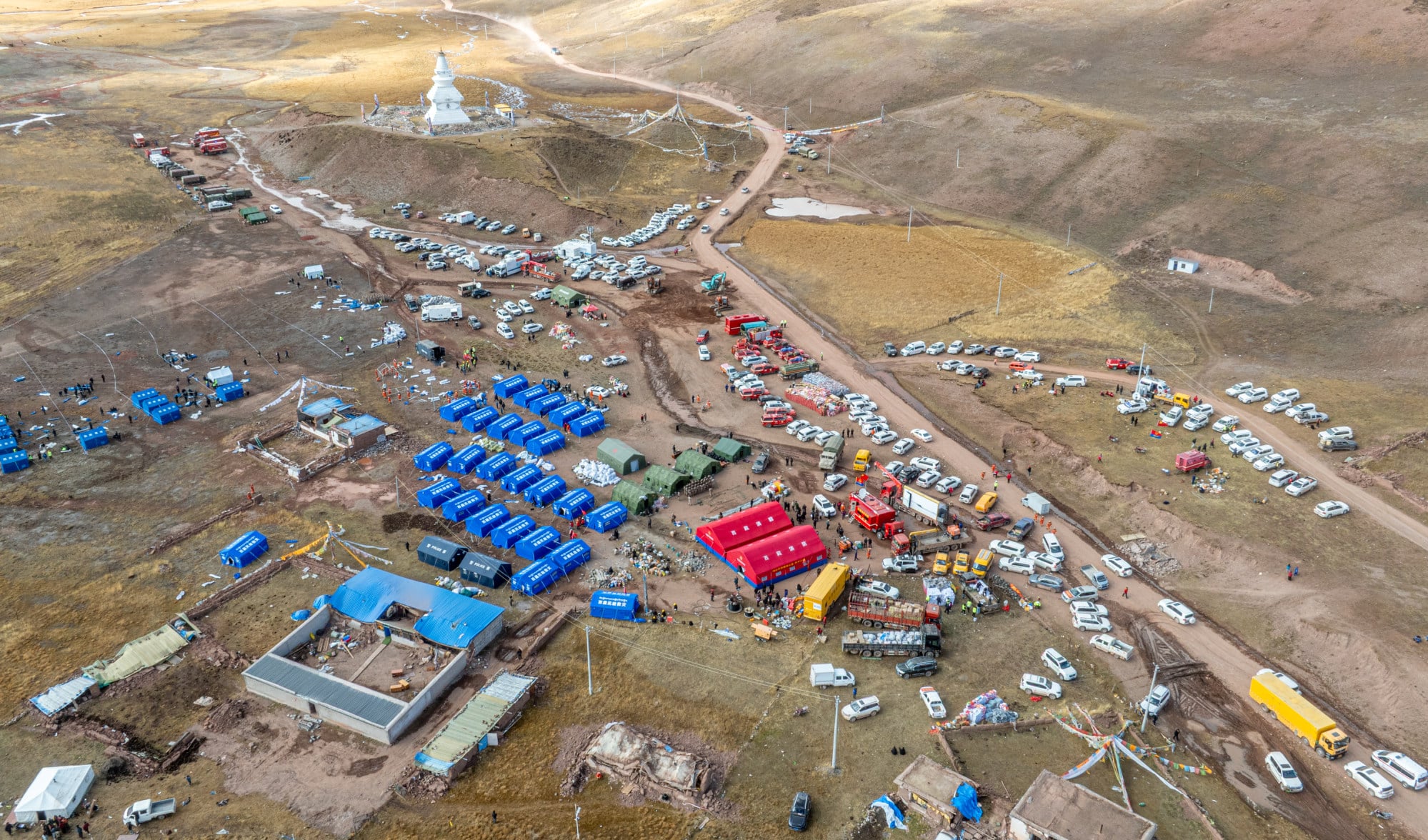
The finance and emergency management ministries have jointly allocated 50 million yuan (US$7.49 million) to the disaster-hit region, according to CCTV. A team of 10 from the Tibet division of Sichuan’s West China Hospital has arrived with a mobile CT scanner, ambulances and emergency medicines.
The China Earthquake Networks Centre (CENC) said that as of Friday morning, it had recorded 413 aftershocks in the region, with the biggest measuring magnitude 4.3.
By the afternoon, local authorities had launched round-the-clock monitoring and emergency repairs at key sites, including mountains, reservoirs, power stations, rivers, old buildings and telecommunications stations, the Nagqu city government said.
Electricity and communications facilities in the disaster-hit areas were being gradually restored, while monitoring stations had been issuing timely aftershock and weather warnings, a spokesman said.
He also said that public security and transport authorities had inspected 12 roads covering more than 1,700km as well as 201 bridges, identifying potential hazards and clearing rocks at intersections.

The earthquake was the result of pressure on the Tibetan plateau caused by the continuing collision between the Indian and Eurasian tectonic plates, a CENC analyst told People’s Daily.
Six earthquakes of magnitude 7.0 or above have been reported since 1900 in the Qiangtang block, which includes Baqing county. The most recent one took place in 2021 in Biru county, about 103km from Baqing, the report said.
Based on historical seismicity levels and regional geographical structure, earthquakes might still happen in the region and its vicinity in the coming days, it added.
Bao Xuewei, a researcher at the school of Earth sciences at Zhejiang University, told Zhejiang Daily that the hypocentre – or starting point in the Earth’s crust – of this earthquake was only 10km deep, classifying it as a typical shallow-focus earthquake.
Such quakes generate stronger surface waves, which cause buildings to sway from side to side, raising the risk of damage. -- SOUTH CHINA MORNING POST


