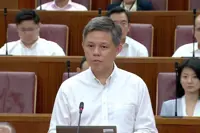
SINGAPORE: There will be no immediate increase from S$1.1 million to S$1.8 million for an MR4 minister, and most at that entry-level grade are expected to be paid about S$1.35 million by the end of the current term, Coordinating Minister for Public Services Chan Chun Sing said in Parliament on Thursday (Sept 10).
“S$1.8 million is not what every minister will be paid,” he stressed.
It is a reference point, not an entitlement or the actual salary of every minister, he said.
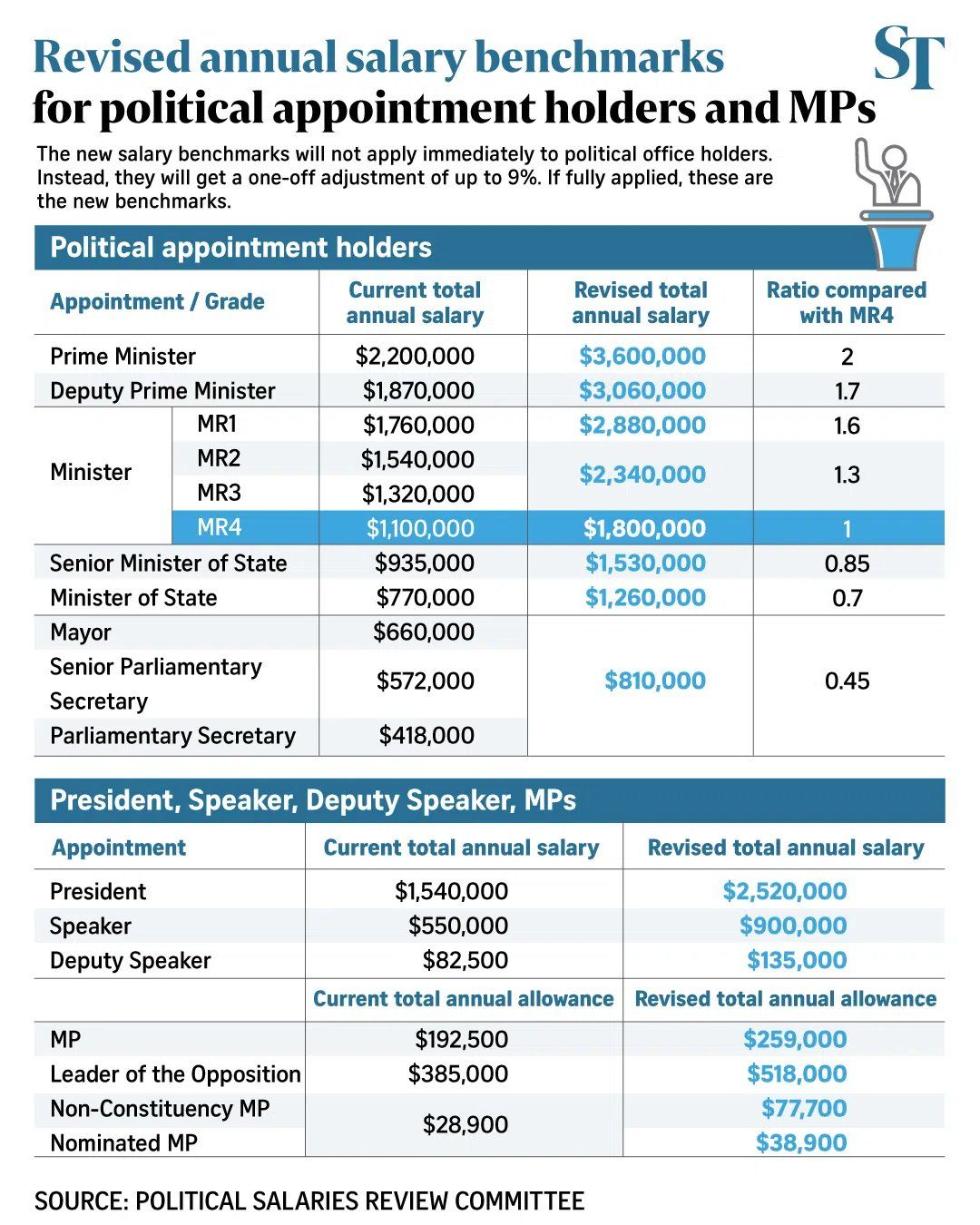
A one-off adjustment in October will be capped at 9 per cent and will depend on individual circumstances like performance and the person’s last salary adjustment.
So, a minister currently at $1.1 million will receive no more than about $1.2 million, with subsequent adjustments depending on performance and responsibilities, he pointed out.
Most MR4 ministers are expected to be at the lower end of the new salary range by the end of the term, at about $1.35 million.
“To put into context, this is equivalent to an average of 0.6 per cent per annum over the last 15 years.”
But Chan said the issue was ultimately not about what ministers would earn or how much MPs would receive in allowances, but about Singapore’s future and the system needed to build its next generation of leaders.
“Beyond all the numbers, beyond all the formulas, it is about building a system to give future generations a better chance to assemble a strong team to take Singapore forward, come what may,” he said.
What was needed, he said, was a diverse team comprising younger members with fresh energy, ideas and perspective, and who could develop over time to build the trust and bond with fellow Singaporeans.
The team would also include experienced colleagues with judgment who could take on more significant responsibilities and had room to grow, as well as established individuals with deep experience who could contribute substantially from day one.
“Finding that combination is hard enough. We should not make it harder, not just for this Government, but for any government, by narrowing the field even before the selection begins,” he said.
“The wider the pool, the more choices we have, the greater our chances of finding and composing the team that Singapore deserves.”
Chan, who is also Defence Minister, was speaking after MPs debated the ministerial statements on the Government’s response to the 2026 review of salaries for political appointment holders and MPs, delivered on Sept 8.
The widened ranges were intended to cater to the three archetypes: new entrant, experienced contributor and established individual with unique qualities.
A new political appointment holder would typically enter nearer the lower end of the range, while only those with substantially more experience may be appointed at a higher point, Chan said.
Graphic of revised annual salary benchmarks for Singapore political appointment holders and MPS.
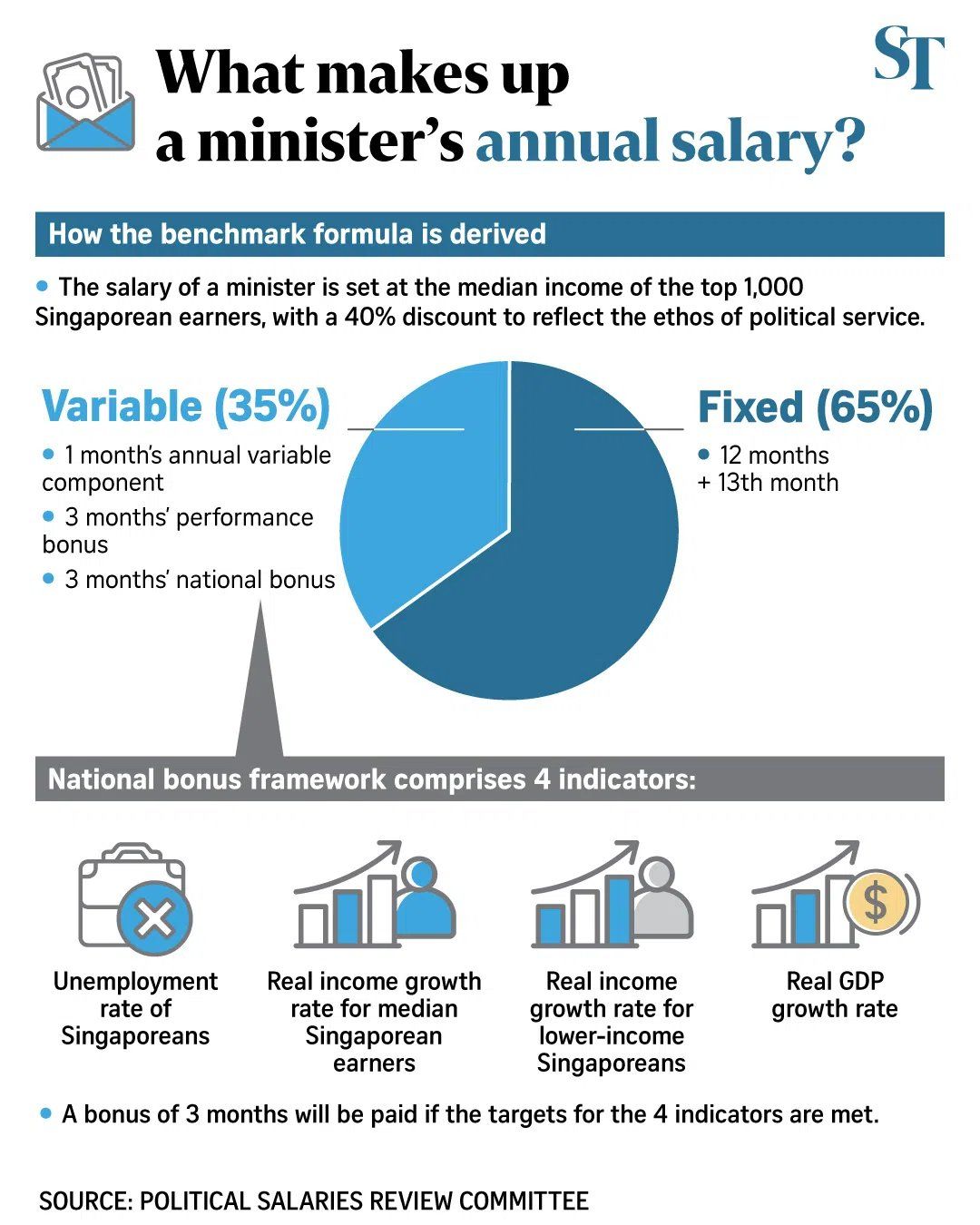
The annual salary benchmarks are also not guaranteed sums. About 65 per cent of the annual salary is fixed, while about 35 per cent is variable and depends on personal and national performance.
In strong years, when national bonus targets are far exceeded, the actual bonus may exceed the norm, while in weaker years, a minister could receive zero bonus.
“That variability is by design. It is what makes the framework accountable and not misleading,” Chan said.
Since 2011, the national bonus payout has ranged from 0.75 months in low years to 5.6 months in better years.
Beyond the salary adjustments, Chan said the Government would take up or further study several suggestions raised in the review and by MPs.
It will accept the committee’s recommendation to study the use of quality-of-life indicators in assessing national performance.
Chan said the Government wanted to see how it could broaden the indicators, but these would need to be based on data that could be collected consistently. Some factors were qualitative rather than quantitative, while others involved multi-year rather than single-year results, he said.
“Some important things in life cannot be measured, and we must be careful not to make important only what we can measure,” he said.
Graphic of what makes a Singapore minister’s annual salary.
The Public Service Division will study the issue before coming back with a proposal on what is feasible.
The Government also agreed to examine a standalone benchmark for MPs and mayors.
Chan said it was not intuitive for the MP allowance to be a fraction of the MR4 benchmark.
He stressed that it was an allowance and not a salary, as Singapore’s system generally regarded it as useful for MPs to have full-time jobs elsewhere so that they could represent diverse perspectives from their different backgrounds.
“We will study this, and we will talk to various stakeholders to try and see what can be a better benchmark,” he said.
The Government will also look at updating allowances for legislative and secretariat assistance.
No change was made in the current exercise as it was not within the terms of reference for the political salaries review, Chan said, adding that relevant agencies would be tasked to look at updating them as necessary.
He also said assessing the performance of the Government on a multi-year basis, instead of year by year, as a fair idea. But there were practical questions, including how many years should be assessed and what would happen if there was a change of government.
The time taken for results also differed between ministries, he said. At the Ministry of Defence, some projects he worked on 20 years ago were only now coming on stream, he pointed out.
“So we are fully cognisant of the challenges of using a single-year measure, but we are also cognisant of the challenges of using a multi-year assessment matrix, and we will have to find that balance,” Chan said.
On the financial impact of the salary changes, he said that assuming the maximum 9 per cent adjustment, overall spending on political appointment holder salaries is expected to remain below 0.05 per cent of government expenditure and below 0.01 per cent of gross domestic product.
Even with the new benchmarks fully implemented, Singapore would still spend less as a percentage of government expenditure and GDP than it did in 2011, he added.
Chan also said that financial compensation could not be the number one consideration for political service.
Someone considering stepping forward would first have to consider the public scrutiny, loss of privacy, electoral uncertainty, public expectations and the potential of failure, he said.
“But for anyone considering this, the most important factor is this, and that is the burden of responsibility to get it right for Singapore and Singaporeans.
“This is not a business venture; it is about the lives and livelihoods of Singaporeans. If a business fails, we can start a new one. But if Singapore fails, we are finished.” - The Straits Times/ANN