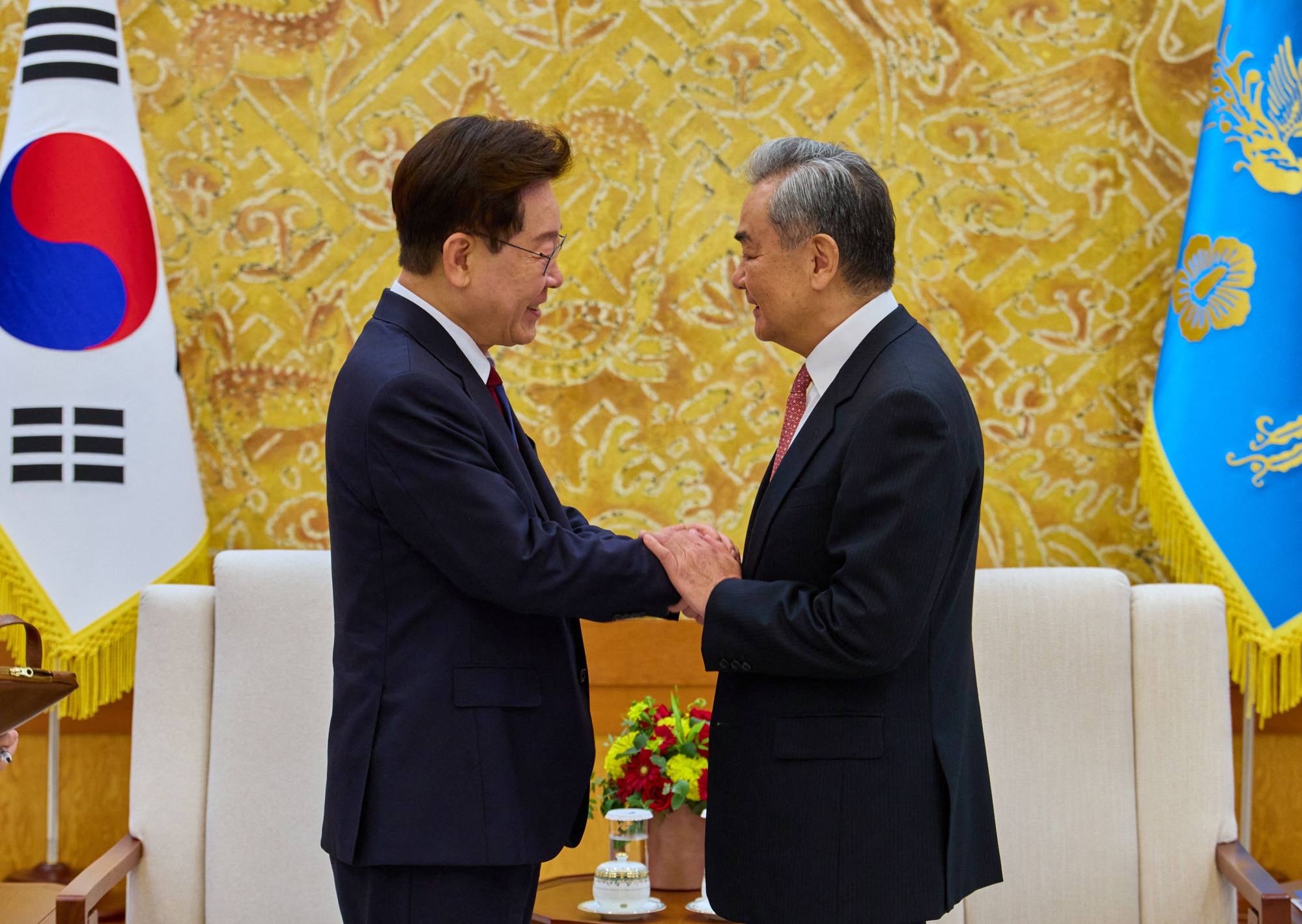
China’s top diplomat, Wang Yi, concluded his visit to South Korea on Friday, but declined to back Seoul’s push for multiparty peace talks involving the North.
His two‑day trip, which followed President Xi Jinping’s first visit to Pyongyang in seven years in June, coincided with US President Donald Trump’s decision to scale back joint military exercises with South Korea and call for further talks with the North.
North Korea, however, responded with more than 10 short-range ballistic missile launches on Thursday, prompting the South’s presidential office to convene an emergency security meeting.
During the visit, both sides said bilateral ties had “fully recovered” after years of strain, citing recent exchanges between their leaders and renewed cooperation on trade, technology and people-to-people exchanges.
But Wang, who visited the country last year with Xi and was making his first solo trip in five years, delivered a pointed message to President Lee Jae Myung and other senior officials.
He urged them to pursue “genuine strategic autonomy”, avoid “bloc confrontation or taking sides”, and develop relations with Beijing and Washington “in a mutually compatible manner”, according to the foreign ministry in Beijing.
Chinese statements notably omitted any reference to “denuclearisation” on the Korean peninsula even though South Korean officials urged Beijing to help restart talks with the North.
Instead, Wang told South Korean National Security Adviser Wi Sung-lac that the United States should abandon its “hostile policy” towards the North.
He did not endorse Lee’s recent call for multiparty talks, saying only that Beijing hoped the two Koreas could “move towards peaceful coexistence” and achieve “enduring peace and stability”.
Choo Jae‑woo, a professor of China studies at Kyung Hee University, said the visit had been a setback for the South Koreans.
“Wang Yi’s visit to Seoul this time dealt a low blow to the South Korean government, though officials unfortunately do not see it that way,” he said.
He said that Seoul had taken Wang’s words selectively, “using them to its own advantage, often out of context”.
“South Korea only appreciates the word ‘peace settlement’ from Wang Yi as it aligns with its policy framework for North Korea ... But the reality is the prospect for the US and North Korean dialogue is bleak because the premise will not be met.”
Choo added that Wang had indicated that Beijing was now ready to embrace North Korean leader Kim Jong-un’s two-state policy.
Wang also issued a mild warning over Seoul’s alliance with Washington and pursuit of nuclear-powered submarines, which Choo said “aligns with Kim’s two-states concept”.
He added that it also marked a “turning point in China’s policy” because “perpetual peace implies rejecting unification and entrenching permanent division”.
Taken together, he argued, Wang’s visit “effectively undermined prospects for any dialogue among South Korea, North Korea and the US”.
Shi Yinhong, a professor of international affairs at Renmin University in Beijing, offered a similar view.
“Beijing certainly wants to deepen alienation between the US and South Korea, but its indulgence of Pyongyang’s reckless nuclear and missile build-up, coupled with North Korea’s entrenched hostility, undermines any such effort,” he said.
Despite Seoul’s efforts to edge closer to Beijing under Lee, Shi said Washington and Seoul remained allies and tensions between them were “unlikely to persist beyond the Trump administration”.
“I do not see Beijing harbouring great expectations this time,” he said. “It expects others to change while leaving its own position essentially untouched. China will not take meaningful steps to facilitate these diplomatic manoeuvres, which are likely to falter quickly.”
Paik Woo-yeal, professor and deputy director of the Yonsei Institute of North Korean Studies in Seoul, said Wang’s visit had been “more ceremonial than substantive”.
“He agreed ... that bilateral ties had improved, but simply reiterated China’s basic strategic position on [South] Korea’s ‘strategic autonomy’ from the US, without addressing Seoul’s demand that Beijing exert more pressure [over the North’s nuclear programme],” Paik said.
He added that Wang’s comments had “served mainly to remind his Korean counterparts of China’s presence in the regional security architecture”.
Wang’s visit, he said, was likely to have been a disappointment to many in South Korea.
“If China truly intends to facilitate Trump’s revisionist approach to North Korea, the Korean peninsula and East Asia, it would need to act faster and more aggressively, including steps that would partly dismantle the emerging China-Russia-DPRK alignment,” he said, referring to the Democratic People’s Republic of Korea, the North’s official name.
“That scenario, however, looks like a long shot at present. As usual, China will wait and see.”
Beyond security, Wang also called for closer cooperation on artificial intelligence, green energy, the digital economy and advanced technology, as well as speeding up talks on widening their free-trade agreement.
In an op-ed in The Korea Times on Wednesday, Chinese ambassador to South Korea Dai Bing said economic ties between the two countries remained strong, and described competition and cooperation as “two sides of the same coin”. -- SOUTH CHINA MORNING POST