China may increasingly seek to use its dominance in the global electric vehicle industry as geopolitical leverage, giving Beijing greater influence over countries dependent on its technology and supply chains, according to analysts.
“With China, the strategy is different. It’s to overwhelm the industry, capture it, and use it ultimately as leverage,” said Michael Dunne, CEO of Dunne Insights, an auto advisory firm.
“When it comes to crunch time, they say, ‘Oh, by the way, we’re the source of all manufactured cars today. How about that?’” Dunne said during a discussion hosted by the Asia Society Policy Institute (ASPI).
“And you’re dependent on us for cars, and we want this and this and this from you on other political issues.”
China’s slowing domestic auto market has pushed its carmakers to expand overseas, with monthly vehicle exports surpassing one million for the first time in June and projected to reach around 12 million by year-end.
The global expansion of cheaper, high-quality Chinese electric and hybrid vehicles has sparked concerns in many countries over Beijing’s alleged “overcapacity”, which governments attribute to state subsidies – a charge China denies.
They are now weighing how to protect their domestic manufacturers, preserve industrial capacity and reduce strategic reliance on China.
US continues to limit Chinese carmakers’ access to its market
While Canada and parts of Europe have taken a more conditional approach by allowing Chinese investment in their auto sectors in the hope of encouraging “reverse technology transfer”, the US has adopted a more restrictive stance, using steep tariffs and regulatory curbs to limit Chinese carmakers’ access to its market.
“It’s a party state converting your car market into its leverage,” said Michael Kovrig, a former Canadian diplomat and senior advisor at the International Crisis Group.
“The EVs are the perfect instrument because they’re the biggest manufactured good in world trade.
“They’re simultaneously an energy asset, a data platform, the anchor of the battery, drone, robotics – the industrial base of the 21st century.”
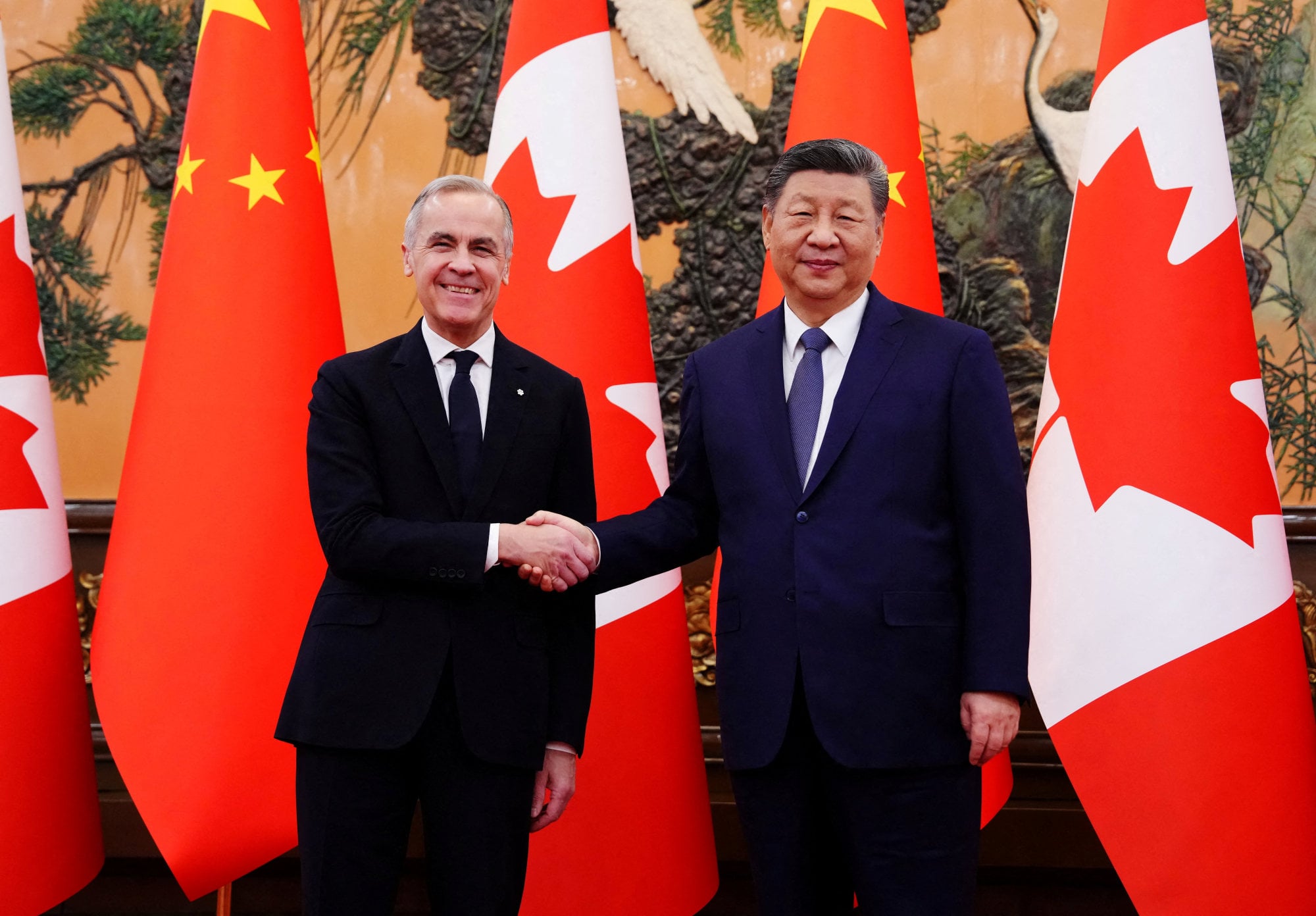
Speaking at the ASPI event, Kovrig also criticised Canada’s January deal with China, which dropped its 100 per cent tariff on up to 49,000 Chinese EVs a year in exchange for auto investment and tariff-free access for Canadian canola exports.
According to him, Beijing had already begun using EV access as leverage, pointing to Chinese Ambassador to Canada Wang Di’s warning in April that bilateral ties would suffer if Ottawa continued sending military vessels through the Taiwan Strait or allowed lawmakers to visit Taiwan.
Beijing sees Taiwan as part of China to be reunited by force if necessary. Most countries, including the US, do not recognise Taiwan as an independent state, but Washington is opposed to any attempt to take the self-governed island by force and is committed to supplying it with weapons.
Kovrig also alleged that Beijing was attempting to use “Canada as a back door to crack into the United States”, noting that “it’s possible the US may not even let Canadians who have bought a Chinese vehicle in Canada take that vehicle into the United States”.
Dunne echoed that assessment, arguing that the American car market remains the “ultimate target” for Chinese carmakers.
“The Chinese would more or less kill for access,” he added.
“What does it take for us to get in there? They’re working every conceivable angle at the same time that people in [Washington] DC are trying to fend them off.”
The US has kept tariffs above 120 per cent on Chinese vehicles and restricted EVs using China-linked software and hardware.
Last month, the Trump administration blocked Chinese-owned Polestar from selling new vehicles under a connected vehicle rule targeting foreign technology deemed a data security risk.
Congress has also pushed for stricter measures, with bipartisan lawmakers introducing several House and Senate bills aimed at restricting China-linked electric vehicles from the US market.
Beyond domestic measures, Washington is discussing with Canada and Mexico ways to keep Chinese EVs out of the North American market as part of the ongoing review of the United States-Mexico-Canada Agreement (USMCA) trade agreement.
Beijing denies its industrial overcapacity stems from state subsidies, weak domestic demand
China on Tuesday issued a position paper rejecting claims that its industrial overcapacity stems from state subsidies and weak domestic demand, saying that its manufacturing strength was instead driven by technological innovation, market competition and structural reforms.
“There is no necessary connection between industrial subsidies and overcapacity,” the commerce ministry said in the paper.
The document argued that governments widely use subsidies to support their own development goals, pointing to the US$750 billion Inflation Reduction Act passed by Washington in 2022, to spur domestic EV production.
“It is imperative that all countries make the pie of global development bigger and introduce subsidies and other industrial policies in a rational and compliant manner, rather than use them as a tool to constrain the development of others,” it added.
In early July, the Chinese embassy in Washington also defended Beijing’s EV policies and criticised the US restrictions.
“Advocating protectionism and establishing trade barriers in the name of ‘fair competition’ and ‘national security’ goes against the principles of market economy and WTO [World Trade Organization] rules,” embassy spokesperson Liu Chang told the South China Morning Post.
“Electric vehicle [manufacturing] is a globalised industry. Only division of labour and cooperation can bring mutual benefits, and only fair competition can bring technological progress.”
Dunne, however, contended that the option of a reverse “technology transfer” is a “great idea on paper” but remains impractical, especially for the US market.
“One, the Chinese will be very careful, call it stingy, about handing over any technology,” he said.
“Secondly, I’m not convinced that American companies in joint ventures would know how to secure the technology in the same ways that the Chinese were able to do.”
“We don’t know how to play the game.”
To address the issue, Kovrig argued that “tariffs alone” will not be enough and advocated cooperation among Western countries on drafting common policies on software security, investment screening and rules of origin requirements.
“I think a grand coalition unity is unlikely, but rather functional convergence,” he said.
Already a subscriber? Log in
Get 20% OFF The Star Digital Access
Cancel anytime. Ad-free. Unlimited access with perks.