
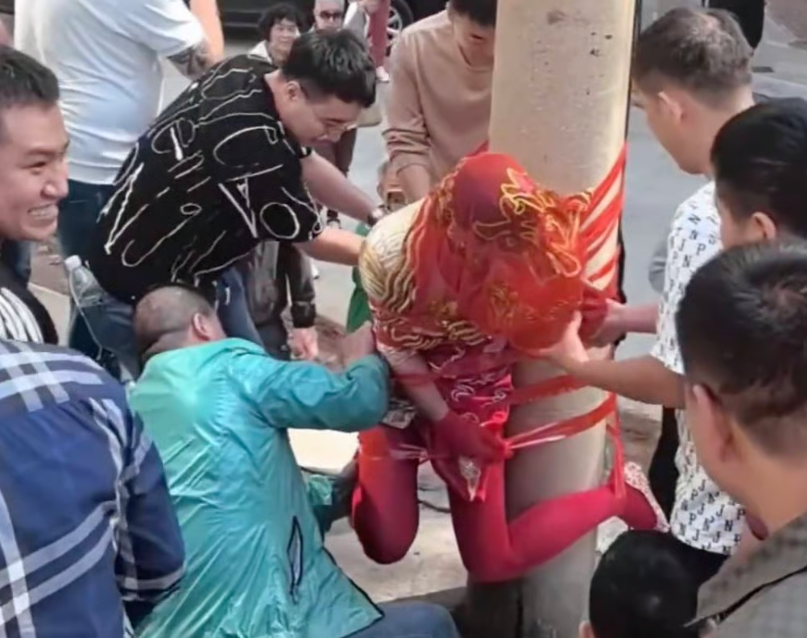
A court in Ruyang county, in Henan province, released its verdict on the case to the public in early July, aiming to raise awareness of the controversial wedding revelry, news portal gmw.cn reported.
As part of nuptial ceremonies, wedding hazing, called hun nao in Chinese, dates back thousands of years, originally being intended to create a fun atmosphere and to expel evil spirits.
Still popular in many parts of the country, it has drawn widespread criticism in recent years after the ritual has sometimes devolved into humiliation and even violence.
Newlywed couples and bridesmaids are the main targets of the teasing.
On Oct 4, 2023, the woman, surnamed Zhang, was invited to the wedding as a bridesmaid of the bride Li, who was her friend, and the groom.
At one point, Zhang and about 10 men, most of whom were groomsmen, were left alone in the wedding room.
For an undisclosed reason, Zhang hid in a cabinet. But one of the groomsmen, named as Wang Moubing in the court verdict, dragged her out and pushed her onto the bed.
It was he who suggested the other men toss Zhang into the air by holding the corners of a bedsheet.
The first time, they threw her up and caught her. But the second time, they failed to catch her, causing Zhang to fall onto the floor.
During this game, the groom’s aunt who passed the room reminded them not to let the joke go too far. Her advice fell on deaf ears.
One of the men in the room, surnamed Hu, who did not join in with the hazing, carried Zhang downstairs before an ambulance arrived.
Zhang was diagnosed with a lumbar vertebral fracture at a hospital where she received treatment for 18 days.
In August 2024, Zhang was assessed to be in the ninth grade of disability – a serious level – by a forensic judicial institution.
She took the married couple and nine people involved in the hazing to court, demanding compensation of 270,000 yuan (US$40,000).
The court ruled that the couple should be held responsible for Zhang’s injury because they, as the wedding organisers, were aware of the wedding hazing but did not stop the activity in time.
Wang Moubing was found to be at fault since he had dragged Zhang out of the cabinet and suggested performing the dangerous prank on her.
The other eight people bore joint and several liability because they could not provide evidence to show that they did not take part in the hazing, said the court.
The court reached a verdict, ordering them to pay a total of 230,000 yuan (US$34,000) to Zhang.
In particular, the couple were to pay 40 per cent of the amount, or 90,000 yuan; Wang was to pay around 50,000 yuan; and the other eight participants were to pay a combined 90,000 yuan.
Wedding hazing with serious or even fatal consequences often makes headlines in China.
In 2018, a bridegroom in Guizhou province, in southwestern China, suffered multiple injuries after being hit by a car on an expressway while escaping from the wedding ritual.
Earlier this year, a bridegroom, also in Guizhou, broke his leg while trying to escape from the revelry. He sued the pranksters and a court ordered them to pay 50,000 yuan in compensation. - South China Morning Post