
Robots are beginning to reshape everyday life in China as the country accelerates its embrace of embodied artificial intelligence, handling tasks from cleaning homes and directing traffic to repairing equipment in hazardous factory settings.
Embodied AI refers to AI embedded in physical machines, such as robots, that can sense their environment, make decisions and act in the real world.
A cleaning service that launched in March on 58.com, a Chinese classifieds platform, pairs a human cleaner with a wheeled robot and an on-site engineer, according to the Chinese newspaper Economic Observer.
The robot, from Shenzhen-based start-up X Square Robot, stands roughly 1.5 metres tall and has mechanical arms with gripping claws. The embodied AI company is backed by tech giants including ByteDance, Meituan, Xiaomi and Alibaba Group Holding, owner of the South China Morning Post.
Each session runs three hours and costs 149 yuan (US$22), the same price as a standard human-only session, according to the report, citing an online comment. The robot handles repetitive tasks such as wiping tables and cleaning floors, while the human cleaner tackles harder-to-reach spots, scraping grease from crevices and removing mould from tile grout. One cleaner paired with a robot said the machine could handle about 30 per cent of the workload, according to the Economic Observer’s report.
Wang Qian, founder and CEO of X Square Robot, said deploying robots in domestic settings allowed the company to collect real-world data, according to the report.
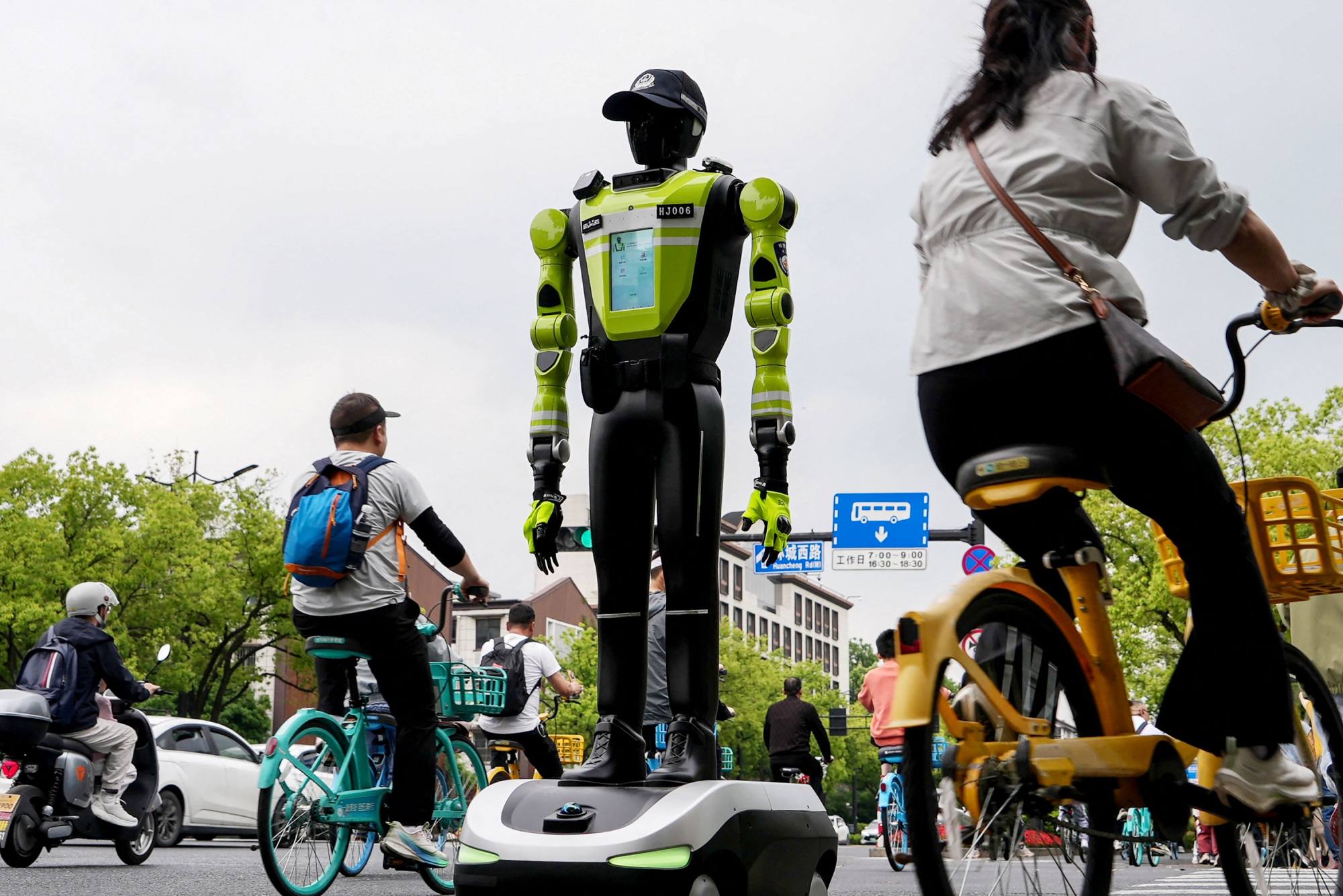
The push into homes is part of a broader roll-out of robots across public life. Fifteen AI-powered traffic robots began operating in Hangzhou’s West Lake area on the first day of the May Day holiday, according to the Hangzhou Traffic Police’s official WeChat account.
The humanoid robots, dressed in yellow vests and mounted on wheeled bases, are fully integrated with large language models. Stationed at key intersections along major city roads, they work alongside human police officers to answer tourist inquiries, warn pedestrians and cyclists against traffic violations and direct traffic flow. The police did not disclose the robots’ supplier.
As robotics technology improves, machines are also pushing into heavy industry, taking over dangerous jobs that once depended on veteran human workers’ experience, judgment and ability to adapt on the spot.
Beijing-based Wattman, for instance, had deployed industrial robots in steel manufacturing plants to inspect and patch molten steel vessels between pours while they were still at a high temperature, according to Huxiu, a Chinese tech media outlet.
The rapid spread of robots across sectors reflects a broader national ambition. China has deemed AI integration a key driver of future growth, and the country’s AI Plus initiative, first announced in 2024, aims to embed AI into 90 per cent of the economy by 2030. -- SOUTH CHINA MORNING POST