
The Hong Kong Journalists Association has lost a judicial challenge against a government decision to restrict reporters’ access to its vehicle registry, despite a ruling by the city’s top court that journalism is a valid reason for use.
The High Court on Friday ruled against the press union over the policy introduced in early 2024, following the Court of Final Appeal’s decision that a freelance producer was entitled to access Transport Department records while making a documentary critical of police action during the 2019 anti-government protests.
Mr Justice Russell Coleman acknowledged that the case was of public importance and had a significant impact on the use of vehicle particulars for bona fide investigative journalism.
He found, however, that the policy was not unlawful and that authorities’ handling of media applications was not so unreasonable as to amount to a public law error.
The association expressed disappointment at the outcome, noting that most applications by reporters had been rejected without detailed justifications being provided.
“The present arrangement in effect tilts towards the protection of vehicle owners’ privacy without allowing inspection for bona fide investigative journalism,” it said.
But it welcomed the judge’s recognition of the association’s “standing to represent the interests of journalists”, and his comment that an appropriate degree of trust in reporters should be given when considering granting a request.
The association did not rule out the possibility of an appeal.
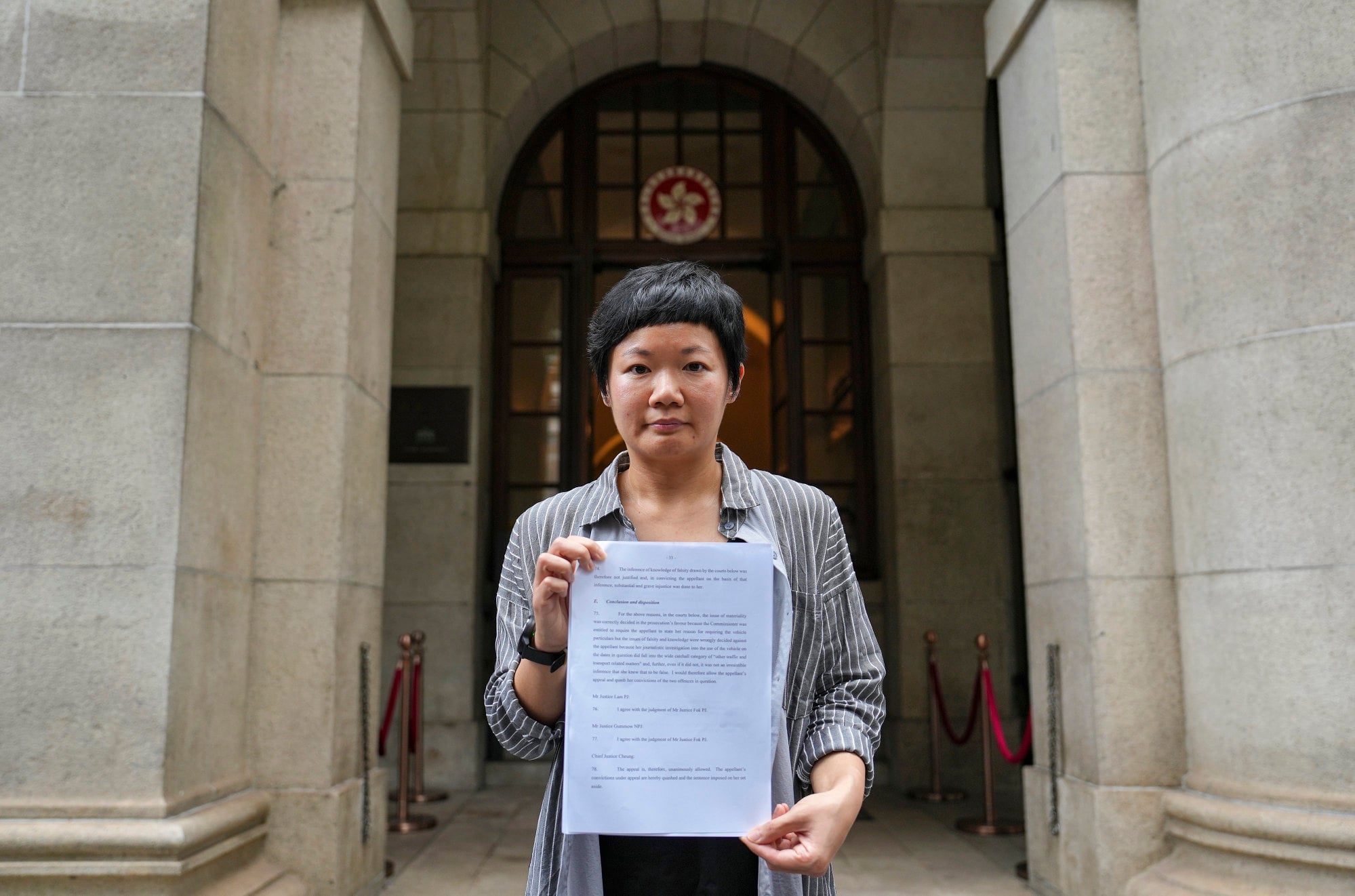
In June 2023, the Court of Final Appeal cleared veteran journalist Bao Choy Yuk-ling of making false statements in connection with her use of the vehicle registration database.
She had selected “other traffic and transport-related matters” as the purpose of her searches, as journalism was not among the options listed on the online application form. She was fined HK$6,000 (US$767) in April 2021, after a trial.
The Transport Department introduced new information request rules in January 2024, requiring journalists to submit written applications before they can access the personal information of vehicle owners for professional purposes.
Instant access is now limited to people whose requests fall under seven categories, including insurance claims, legal proceedings involving vehicles and their sale and purchase.
The revised policy also allows car owners to be notified whenever someone other than themselves applies for access to their personal particulars.
As of July 2024, 16 written requests were made on grounds of public interest, 13 of which were for journalistic purposes. All were either rejected or withdrawn.
The department had previously taken between three months and nearly half a year to process requests from media outlets, including HK01, Ming Pao, Now TV and The Collective.
The only successful bid by a reporter, in September 2024, concerned 12 vehicles suspected of non-compliance with the government’s vehicle hiring service contracts.
That reporter obtained the first registration dates of the vehicles in question, but when he subsequently applied for their full particulars in a separate application, the department refused, citing “factual uncertainty” regarding their relevance to the public interest.
The association argued that the current policy was incompatible with the needs of journalistic professionals, as it hindered timely news reporting and risked tipping off car owners about possible investigations.
The government maintained that the transport commissioner had a duty to act as a gatekeeper for the personal data held in the registry and that journalists were not entitled to access private information.
In his written judgment, Coleman said the new regime was not a blanket refusal of all journalistic applications but required more detail and justification before such requests could be granted.
He found that a system allowing journalists automatic access to information in the database would impose an unacceptably harsh burden on vehicle owners and severely affect their rights to privacy.
“Where the consequences of granting a journalistic application include not only the disclosure, but possible widespread dissemination of an individual’s private information, it can be envisioned that these applications need to be carefully scrutinised,” Coleman said.
He also rejected the argument that disclosing an applicant’s personal data to car owners under the new notification system was irrational.
While journalists should expect a reasonable delay for their applications to be assessed, Coleman said a genuine request by the press should be handled “with some alacrity” and should not become a process “involving many weeks”. -- SOUTH CHINA MORNING POST