
BY MOVING to a dual 5G network model, Malaysia has pivoted towards flexibility and resilience to drive long-term economic growth.
This policy opens the market to competition, buffers it from geopolitical impacts and keeps the nation’s digital infrastructure compatible with both Western and Chinese technology ecosystems.
Technology and advisory firm ABI Research states that this is a move that enhances Malaysia’s attractiveness for foreign direct investment.
ABI Research Asia-Pacific and Advisory Services vice-president Jake Saunders explores how this strategy functions and why it is critical for the nation’s trade future.
The information and findings are based on ABI Research’s 5G Impact Assessment – Malaysia report published in February, titled 5G Is Accelerating Digital Transformation, AI Adoption & Integration in Malaysia.
Why is digital infrastructure nowritical to Malaysia’s future as a trading nation?
Saunders: Malaysia has long been a key trading hub linking East and West. Today, that role is evolving. Trade is no longer just about physical goods; it increasingly depends on digital systems such as connectivity, cloud platforms and data flows.
To remain competitive, Malaysia must strengthen its digital infrastructure to support how goods, services and capital move across borders. This will determine its ability to attract investment, drive innovation and scale new industries in a more digital global economy.
What role does 5G play in this transformation?
Saunders: 5G is the foundation of modern digital economies. It enables faster, more reliable and highly responsive connectivity required for real-time supply chains, industrial automation and mission-critical services.
Use cases include video streaming, fixed wireless access, machine vision, robotics and cloud-based services, among others.
5G also supports the growth of artificial intelligence (AI), which depends on processing large volumes of data quickly and efficiently. Together, 5G and AI create a multiplier effect by unlocking new business models, improving productivity and enabling higher-value economic activities.
5G-enabled AI delivers real-time, high-speed connectivity to support consumer applications such as content generation and augmenting problem-solving bottlenecks in supply chain logistics and resource management.

What is changing in the global technology landscape?
Saunders: Investment in the information and communication technology (ICT) and AI sectors are accelerating.
Reuters reported that, as of 2024, nearly US$1.6 trillion has been invested in AI technology.
ABI Research’s findings revealed that in 2024, total AI-enabled software-alone investments were at US$54bil. By 2028, these investments are expected to reach US$238bil.
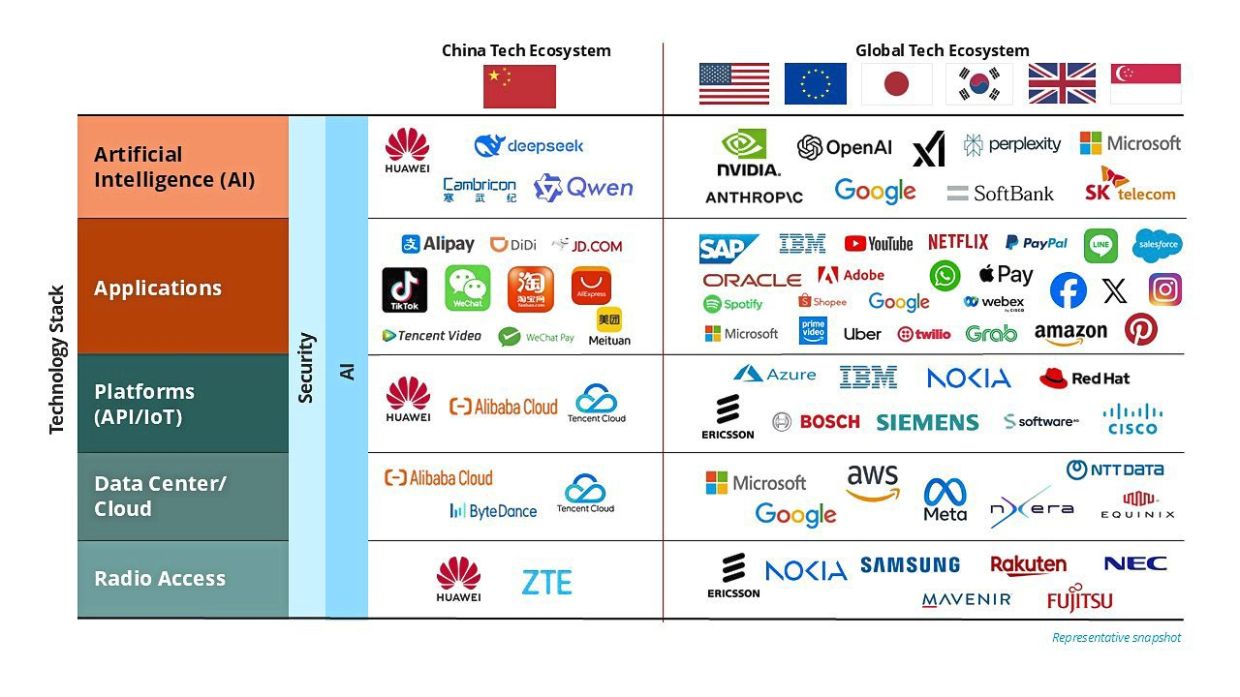
However, the global technology environment is evolving into two major ecosystems: one aligned with global standards and platforms and another driven by China-based technologies.
These ecosystems differ across infrastructure, cloud, data governance and AI development.
For many countries, this creates a strategic challenge because relying on just one ecosystem can limit access to innovation, markets and partnerships.
How is Malaysia responding to this shift?
Saunders: The Malaysian government is boosting investment in communications infrastructure and encouraging enterprises and society to adopt digital and AI strategies.
Malaysia’s own sovereign AI cloud complements private cloud and AI initiatives.
Furthermore, Malaysia has adopted a dual 5G network strategy that is aligned with the global ecosystem and driven by China’s ecosystem.
By maintaining two distinct network infrastructures, Malaysia reduces reliance on a single technology pathway while strengthening resilience and competition.
This approach allows the country to remain connected to both ecosystems at the infrastructure level, ensuring continuity and interoperability across different digital environments.
How does this benefit foreign investment?
Saunders: In today’s environment, geopolitical considerations increasingly influence investment decisions. Malaysia’s ability to support multiple technology ecosystems provides investors with flexibility.
As a result, foreign investment in Malaysia has been very robust. In the first nine months of 2025, total foreign investments increased by 47.5% year-on-year, reflecting commitments from the United States, Europe, China, Japan and regional partners.
Companies could operate within their preferred technology frameworks while benefitting from Malaysia’s connectivity, market access and regional position.
This broadens the pool of potential investors and strengthens the nation’s appeal as a long-term investment destination.
What does this mean for Malaysian businesses?
Saunders: For local companies, access to both ecosystems expands opportunities to innovate, partner and scale.
It allows businesses to tap into a wider range of technologies, platforms and supply chains, while reducing dependence on any single ecosystem. This encourages a more competitive and diverse digital economy.
“AI Tech” is not a single technology. It requires semiconductors, connectivity, software, services and investment to fully deliver.
The AI innovation ecosystem, and the software and hardware that underpins it, is rapidly evolving. Each South-East Asian economy will need to build a domestic foundation of AI services and locally integrated AI development.
Enabling access to global and China-based technology ecosystems ensures a competitive and diverse digital economy in Malaysia.
Does this approach improve national resilience?
Saunders: Yes. A dual-network model reduces exposure to supply chain disruptions, policy shifts or technological dependencies. It also allows Malaysia to remain neutral and adaptable in an increasingly complex global environment, where relying on a single ecosystem could create vulnerabilities.
Why are trust and governance important in this strategy?
Saunders: As economies become more digital, trust becomes critical. Investors and enterprises need confidence that networks are secure, policies are transparent and systems operate reliably.
Malaysia’s balanced approach of combining infrastructure investment with clear governance helps reinforce its credibility as a stable and trusted digital economy.
What broader impact does this strategy have beyond infrastructure?
Saunders: The benefits extend into areas such as healthcare, education, public services and urban development.
Access to advanced connectivity and multiple technology ecosystems enables new digital services, improves productivity and supports more inclusive growth across society.
ABI Research estimates the combined impact of AI and 5G could add tens of billions of dollars to Malaysia’s economy by the mid-2030s. Realising this potential, however, will require a sustained commitment to workforce development, infrastructure upgrades and close collaboration between government and industry.
What is the long-term vision for Malaysia?
Saunders: AI represents a vital engine of future economic growth, while 5G and fibre provide the platform that enables AI to scale across the Malaysian economy and society.
Next-generation 5G technologies have the potential to unlock higher-value use cases, particularly for industry and public services.
Malaysia is moving from being a “digital adopter” to becoming a “digital leader”.
By combining advanced connectivity, AI capabilities and a balanced approach to technology ecosystems, the country is positioning itself to capture the next phase of digital growth.
Malaysia’s strength lies in remaining open, connected and adaptable, which continues its historical role as a bridge between markets in an increasingly complex global economy.
Saunders heads ABI Research’s Asia-Pacific research division. With years of expertise in the technology market research business, he devotes particular attention to the Asia-Pacific market in relation to its mobile operator strategic positioning, infrastructure vendors, mobile device operators and chipset manufacturers.