Stepping up: Members of a China search and rescue team transferring a pregnant quake survivor from a collapsed building in Mandalay.
Day after day, Chinese rescue teams haul children and elderly people from collapsed buildings as cameras beam the thanks of grateful survivors around the world.
Russian medical teams show off field hospitals erected in a flash to tend the wounded.
Notably absent from the aftermath of the 7.7-magnitude earthquake in the poor South-East Asian nation – the uniquely skilled, well-equipped and swift search-and-rescue teams and disaster-response crews from the United States.
At least 15 Asian and Western government rescue teams have landed crews reaching hundreds of workers in size, alongside initial pledges of financial aid reaching tens of millions of dollars, as the death toll of the March 28 quake tops 3,300.
Cameras showed Vietnam’s team on arrival, marching square-shouldered to the rescue behind their country’s flag.
While Myanmar’s military junta and civil war have posed challenges, the US government has worked with local partners there previously to successfully provide aid for decades, including after deadly storms in 2008 and 2023, aid officials say.
The American government dwarfs other nations’ rescue capacity in experience, capacity and heavy machinery able to pull people alive from rubble.
But in Myanmar after the most recent quake, the US has distinguished itself for having no known presence on the ground beyond a three-member assessment team sent days after the quake.
“We all worried what would be the human impact of President Donald Trump’s dismantling of the six-decade-old US Agency for International Development,” said Lia Lindsey, a senior humanitarian policy adviser for Oxfam, which scrambled to provide tents, blankets and other aid to quake survivors.
Now, Lindsey said, “we’re seeing it in real time. We’re seeing it in increased suffering and increased death.”
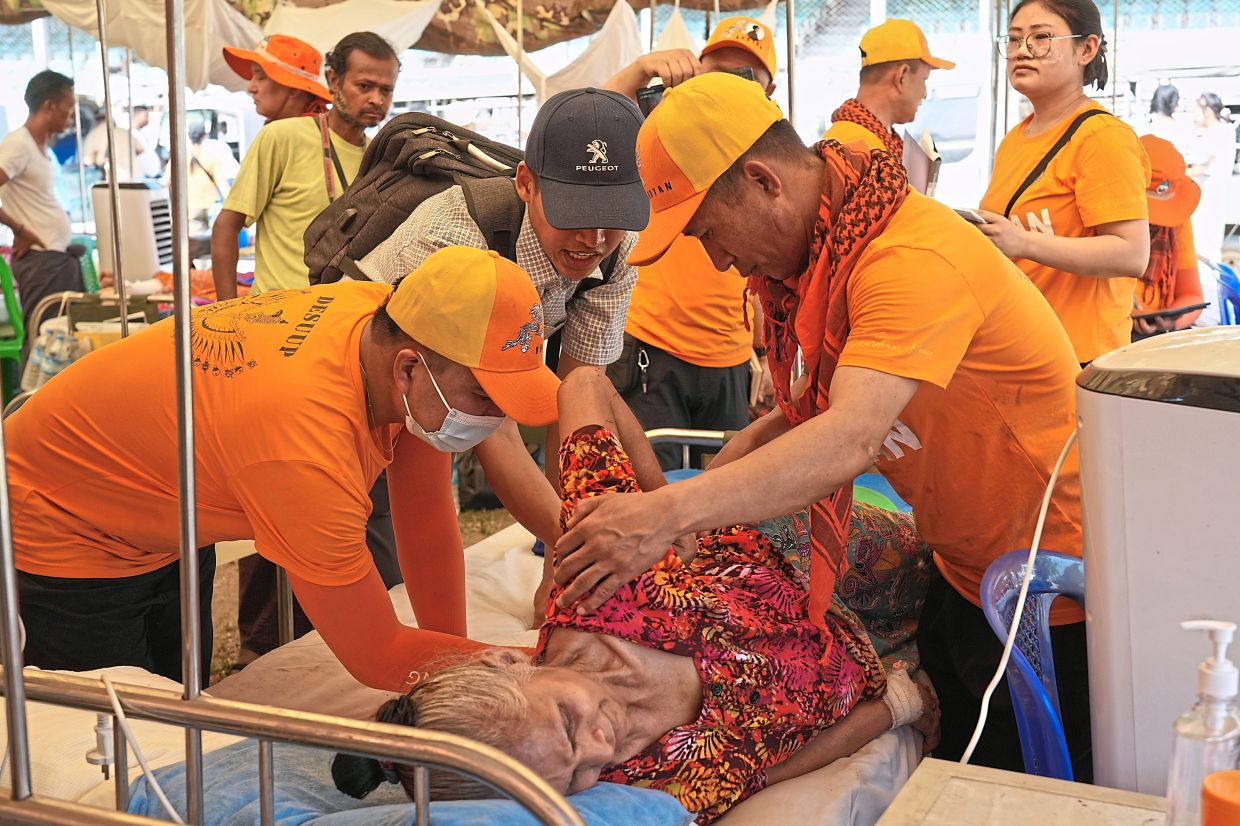 Bhutan medical volunteers treating a patient at their make-shift tent in Naypyidaw. — AP
The United States long saw its strategic interests and alliances served by its standing as the world’s top humanitarian donor.
Myanmar’s quake is as close to a no-show as the nation has had in recent memory at a major, accessible natural disaster.
Current and former senior private and government officials say the Myanmar disaster points to some of the results – for people in need on the ground, and for US standing in the world – of the Trump administration’s retreat from decades of US policy.
That approach held that Washington needs both the hard power of a strong military and the soft power of a robust aid and development programme to deter enemies, win and keep friends and steer events.
The two-and-a-half-month-old Trump administration, through Elon Musk’s Department of Government Efficiency teams, has frozen USAID funding, terminated thousands of contracts and is firing all but a handful of its staff globally.
It accuses the agency of waste and of advancing liberal causes.
The Myanmar quake is the first major natural disaster since that work started.
Days after the Myanmar quake, the US made its first announcement of help: It was sending a three-member assessment team of non-specialist advisers from a regional USAID office in Bangkok, Thailand.
Coincidentally, like hundreds of other USAID staffers around the world, the three had received layoff notices from the Trump administration on March 28 within hours of the quake, current and former USAID officials confirmed.
Washington also pledged US$2mil (RM8.8mil) in aid, and announced another US$7mil (RM31mil) on Friday. But there’s a much larger number at play.
That US$9mil (RM39.8mil) total is dwarfed by the roughly US$2bil (RM8.8bil) in payments for previously rendered services and goods that the Trump administration has owed nonprofit humanitarian groups and other contractors and government and non-government foreign partners, aid officials say.
Typically, the United States itself would have provided US$10mil to US$20mil (RM44.3mil to RM88.6mil) in the initial phase of response to a disaster like the Myanmar quake, with more later for long-term aid and rebuilding, said Sarah Charles, who ran disaster response and overall humanitarian affairs at USAID in the Biden administration.
Normally, the United States also would have had 20 to 25 specialised disaster workers on the ground in as few as 24 hours, she said.
That number would have jumped to 200 or more if USAID had flown in urban rescue teams from California and Virginia.
They deploy as self-contained units, with dog handlers and the capacity to feed and provide clean water to the teams, Charles said.
The Trump administration preserved contracts for the California and Virginia rescue teams under pressure from lawmakers.
But the contracts for their transport are believed among the thousands of USAID contracts that the administration cancelled.
That left the US no quick way to move search-and-rescue crews when disaster struck, Charles said.
At least 15 countries sent in dozens or hundreds of rescuers or aid workers, including Russia, China, India and the United Arab Emirates, according to Myanmar officials. — AP