




Beijing’s bold move to remove top generals accused of corruption reflects its strategic assessment that overhauling the armed forces is more urgent, and that the issue of Taiwan can wait, according to military analysts.
The investigation into China’s top commanders, Zhang Youxia and Liu Zhenli, has left the Central Military Commission (CMC), the country’s highest military command body, with just two members at present – President Xi Jinping, who is chairman of the CMC, and vice-chairman Zhang Shengmin, who oversees the anti-corruption drive within the military.
This has raised questions about the battle readiness of the world’s largest fighting force and Beijing’s ability to mount large-scale military operations, such as one targeting Taiwan.
However, most analysts interviewed by the South China Morning Post agreed that any disruption would be short-lived.
They said the shake-up reflected Beijing’s calculation that although cross-strait ties had deteriorated under the pro-independence Democratic Progressive Party in Taiwan, the risk of the island making a decisive move towards formal independence remained contained.
Meanwhile, under President Donald Trump, the United States appears keen on preserving the Taiwan Strait status quo while prioritising consolidation of its position in the western hemisphere.
This, analysts said, would provide Beijing with a window to eradicate corruption from its armed forces and tighten discipline and loyalty within the military.
While the anti-corruption campaign could cause short-term turbulence, it was expected to strengthen the People’s Liberation Army and reinforce Communist Party control over the long term, ultimately putting Beijing in a stronger position to pressure Taipei into negotiations, they said.
Beijing sees Taiwan as part of China to be reunited by force if necessary. Most countries, including the US, do not recognise Taiwan as an independent state, but Washington is opposed to any attempt to take the self-governed island by force and is committed to supplying it with weapons.
“For Beijing, the best strategy is to bide its time and build its strength until it becomes overwhelmingly powerful, to the point where it can deter the US and its allied forces from interfering in the Taiwan theatre,” said a mainland-based military expert who requested anonymity.
Beijing’s preparations and readiness for any armed conflict over the Taiwan Strait, he said, “will only have a short period of disruption. In the medium and longer run, [PLA modernisation] will speed up, not slow down.”
Military commentator and former PLA instructor Song Zhongping said that trying to resolve the Taiwan issue militarily without first tackling corruption and discipline problems “would only make the problem more difficult”.
The “no holds barred” anti-corruption campaign was designed precisely to “remove obstacles and bad elements holding back the military’s combat effectiveness”, he said.
“You have to get rid of the corruption problem first before tackling the Taiwan problem.”
The mainland military analyst who asked for anonymity stressed that absolute loyalty and discipline were vital in any large-scale confrontation, warning that internal betrayal could be fatal.
Disloyalty within Nicolas Maduro’s own ranks was largely responsible for the US success in abducting the former Venezuelan president, the analyst said.
“It will be like going into battle with a huge crack in your armour if we don’t fix this discipline and loyalty problem.”
Brian Hart, a defence analyst at the Washington-based Centre for Strategic and International Studies, said the investigations indicated that the Chinese leadership was confident in its risk assessment.
Xi appeared “not too worried about the turbulence caused by these purges”, Hart said, adding that the Chinese leadership believed that any short-term chaos was outweighed by the long-term benefits of ensuring military loyalty and rooting out corruption from the PLA and the defence industry.
“This does create challenges for the PLA in the short term. If you’re a leader deciding whether and how to use force, you want senior leaders and commanders in place who are loyal, experienced and effective in their roles,” Hart said.
But he argued that near-term disruption would not “hinder the PLA from acting because those decisions are made on the basis of political factors – not just military factors”.
Before moving against Zhang and Liu, Beijing had already targeted the frontline commander responsible for operations around Taiwan.
Lin Xiangyang, former chief of the Eastern Theatre Command, was placed under investigation and expelled from the party in October after months out of public view.
And yet, the PLA’s pressure tactics around Taiwan did not abate, with two large-scale drills held near the island last year, the same as in 2024 and 2023.
Overall, the PLA carried out about 6 per cent more aircraft sorties near Taiwan last year than in 2024, according to data compiled by the SCMP from publicly available sources.
In the days following the downfall of Zhang and Liu, there appeared to be no significant change in the number of PLA aircraft and vessels detected near Taiwan.
A Hong Kong-based military analyst who asked not to be named said newly appointed generals replacing those under investigation would “require merely one or two months to familiarise themselves with the command structure”.
In Taiwan, former navy captain Lu Li-shih argued that there was minimal loss of combat experience associated with Zhang and Liu, both veterans of the conflict with Vietnam in the late 1970s.
This was because those campaigns “were conducted under operational conditions entirely distinct from modern warfare”, Lu said.
“A military unit does not lose its combat effectiveness merely because one individual is absent. If that were the case, then the unit’s experience transmission would be problematic.”
Lu contended that whether Beijing ultimately resorted to military action against Taiwan had “less to do with the Central Military Commission and more to do with Taiwan itself” – a reference to Beijing’s assessment of whether pro-independence forces on the island crossed what it considers to be red lines.
Beijing’s determination to combat corruption within the military is believed to have been bolstered by what its leaders regard as a temporary US strategic refocus on the Middle East and the western hemisphere.
Moreover, relations between the two powers appear to have stabilised. At a closed-door session in Hong Kong last week, US ambassador to Beijing David Perdue said bilateral tensions had been “brought effectively under control”, describing the relationship as having “improved multidimensionally” since Xi’s meeting with Trump in South Korea in October.
Meanwhile, China is closely watching the situation in Ukraine, Venezuela and elsewhere for implications closer to home. According to the mainland military observer, the leadership is alarmed by how corruption and mismanagement in those wars have crippled combat capabilities and caused heavy losses.
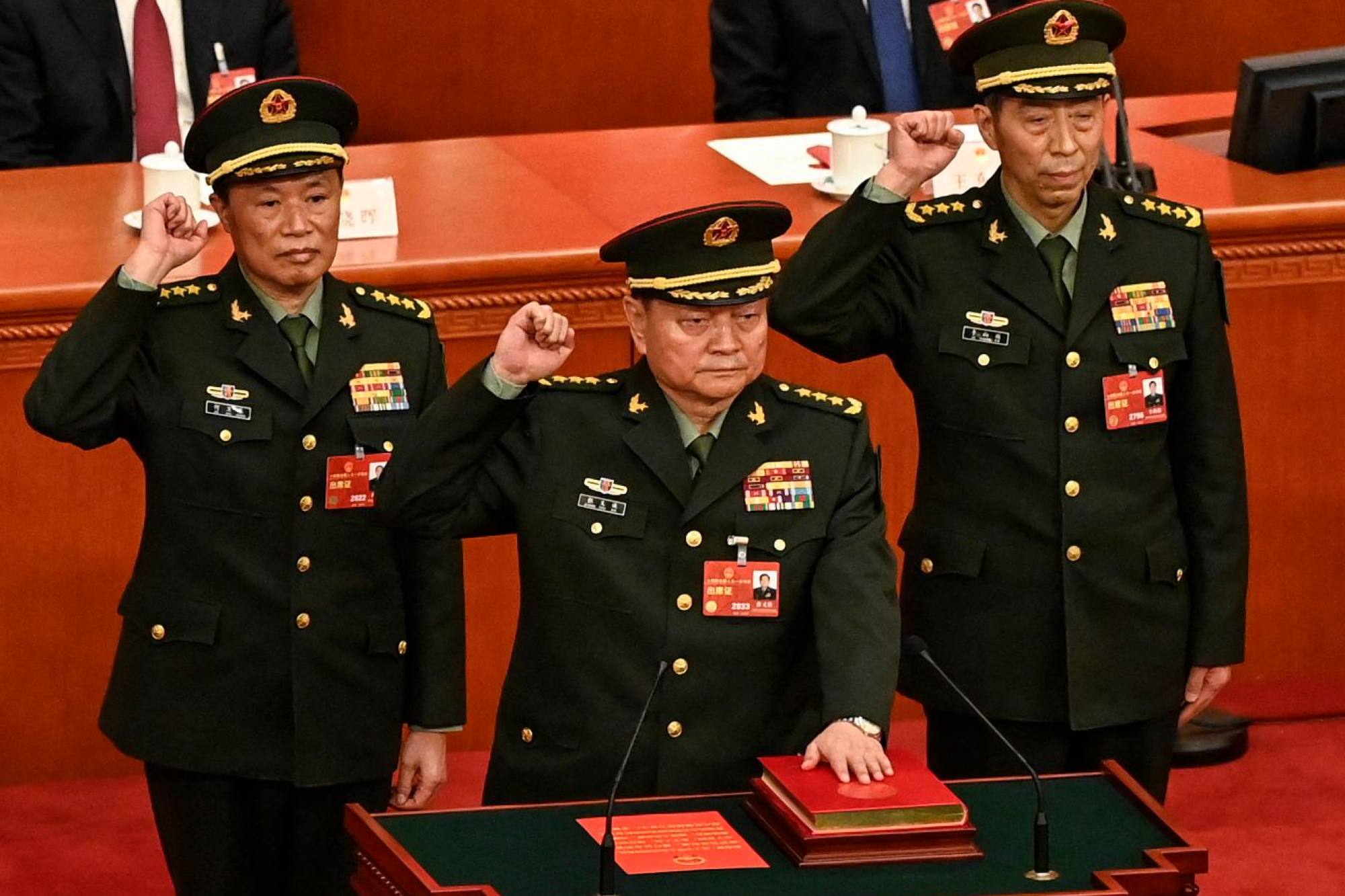
“Anyone who tries to disobey, or pay lip service, or tries to suck money from the war efforts must be dealt with mercilessly, regardless of who they are,” the observer said.
Although the precise reasons behind the investigations into Zhang and Liu’s remain unclear, an editorial in the official PLA Daily on January 24 – the day their downfall was made public – suggested that their alleged offences went beyond straightforward economic crimes.
The article accused the two men of having “trampled on and undermined the CMC chairman responsibility system”, a reference to the mechanism that gives Xi as CMC chairman full oversight of military decision-making and the final say on key matters.
Their behaviour, the editorial said, “fuelled political and corruption issues that affect the party’s absolute leadership over the military and endangered the party’s ruling foundation, seriously affecting the image and prestige of the CMC leadership team”.
It further accused the pair of having inflicted serious damage on efforts to strengthen political loyalty within the armed forces, corroded the PLA’s political environment and weakened overall combat readiness, ultimately severely affecting the party, the country and the military.
While the fall of Zhang and Liu drew global attention, China also announced investigations into several ministerial-level civilian officers last month. This comes as Beijing enters a year of personnel reshuffles ahead of next year’s party congress, usually a time of sweeping top-level changes.
The year 2027 will also mark the centenary of the founding of the PLA – the first of three landmark dates Xi has set for the Chinese military to modernise and reform itself.
The dual milestone is expected to make fighting corruption and restoring discipline Beijing’s overriding political priority.
At the same time, senior officials have repeatedly emphasised that peaceful reunification remains Beijing’s preferred option for resolving the Taiwan issue. -- SOUTH CHINA MORNING POST


