
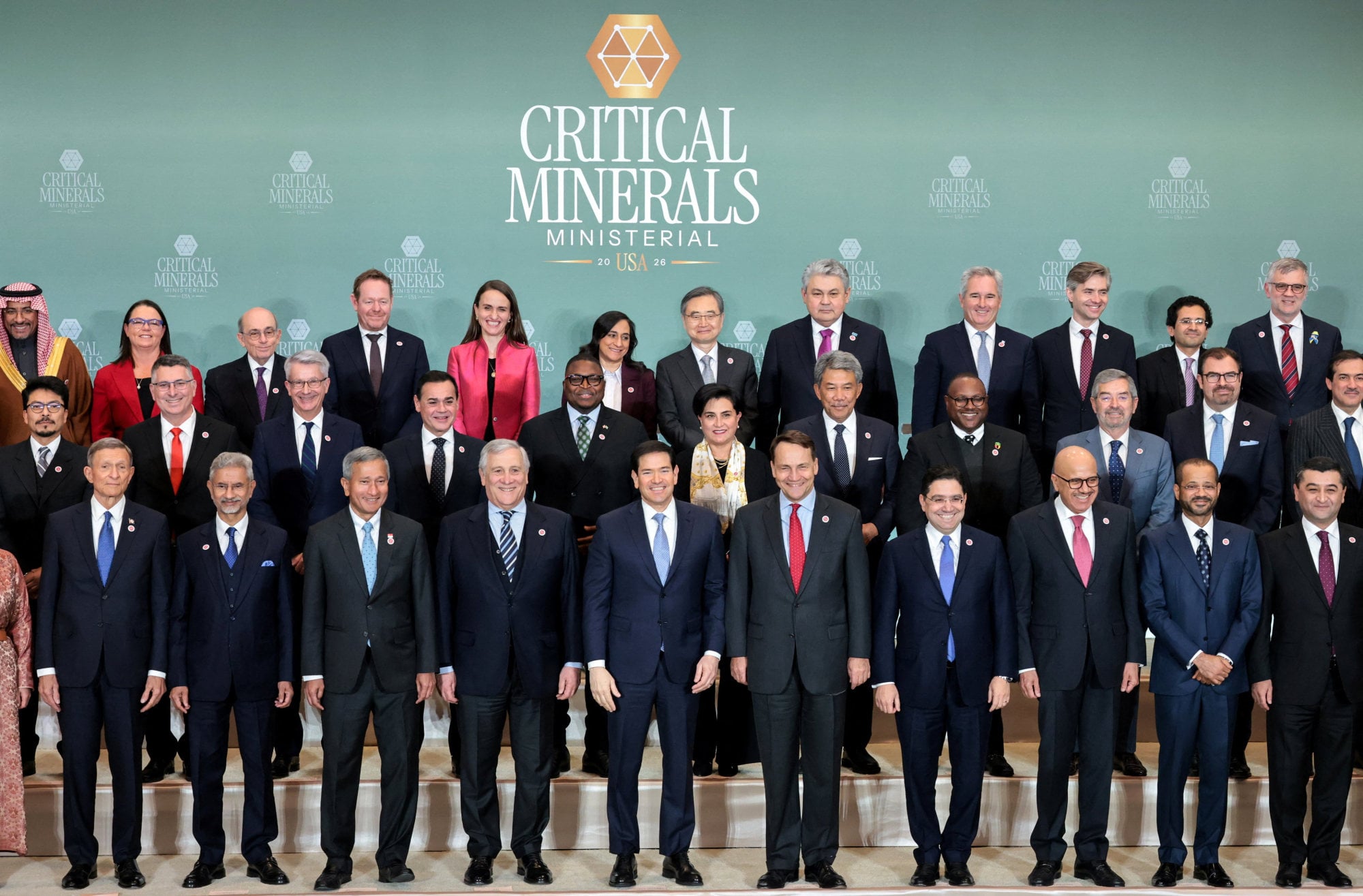
In a direct challenge to Beijing’s decades-long grip on the hi-tech economy, the United States on Wednesday sought to rally more than 50 countries and the European Union around a landmark framework to loosen China’s control over the global critical minerals trade.
“This morning, the Trump administration is proposing a concrete mechanism to return the global critical minerals market to a healthier, more competitive state,” US Vice-President J.D. Vance said in his opening remarks at the inaugural Critical Minerals Ministerial gathering in Washington.
“[The US is creating] a preferential trade zone for critical minerals protected from external disruptions through enforceable price floors.”
Describing the plan as the “Forum on Resource Geostrategic Engagement”, or Forge, Vance said the initiative would set “reference prices” for critical minerals at each stage of production and ensure “pricing that reflects real-world fair market value”.
Vance suggested that China has, for years, dumped low-cost materials to weaken potential competitors, noting that prices would act as a floor and that adjustable tariffs would prevent companies from flooding markets with cheap minerals.
He implored the participants to join in the effort. “To those of you still on the fence, I say ... let’s move together,” Vance said.
“I’m pleased that so many of you here today have already signed on to this plan; some of you have not. ... We hope that today’s discussions will encourage you to finalise those agreements as quickly as possible.”
Joining Vance, US Secretary of State Marco Rubio contended that “everyone here has a role to play, and that’s why we’re so grateful for you coming and being a part of this gathering that I hope will lead to not just more gatherings”.
Participants include India, South Korea, Australia, the European Union, Singapore and Malaysia.
As the meetings were held, the US Trade Representative (USTR) announced the joint intention between Japan, the US and the EU “to develop Action Plans for critical minerals supply chain resilience”.
“Through the development of these Action Plans, we will lay the groundwork for a binding plurilateral agreement on trade in critical minerals with like-minded partners,” USTR Jameison Greer said in a statement.
At the same time, the USTR announced the launch of the US-Mexico Action Plan on Critical Minerals, under which the two countries will coordinate trade policies to reduce vulnerabilities in critical mineral supply chains.
During the meetings, India, which recently reached a trade deal with the US, supported the Forge initiative.
Greer was scheduled to lead a session on price floors at the ministerial, with US Treasury Secretary Scott Bessent delivering the closing remarks.
On Tuesday, US Secretary of the Interior Doug Burgum expressed optimism for the goal of signing at least 11 bilateral agreements to create a “club of nations” backed by billions in American capital.
These pacts use US equity stakes, tariff exemptions and government-backed price floors to secure the raw materials for the AI and defence sectors.
The initiative follows the October 2025 US-Australia deal, which committed US$1 billion for the joint production of critical minerals. The US Export-Import Bank has indicated interest in roughly US$5 billion to catalyse these supply chains.
To stabilise markets, the framework proposes price floors or “standards-based systems” that ensure governments support domestic producers when mineral prices, such as lithium or cobalt, fall below a set threshold.
The US has also launched the US$12 billion civilian-focused Project Vault to create a strategic stockpile with fixed-price purchase agreements that guarantee demand for new mines, shielding them from market volatility.
Signatories will strengthen diplomatic and legal tools to prevent the sale of critical mineral assets to “adversarial” actors, using investment screening mechanisms to keep strategic mines in places such as the DRC or Malaysia out of Beijing’s reach.
They will also collaborate to map domestic and international resources and identify the next generation of supply. -- SOUTH CHINA MORNING POST