




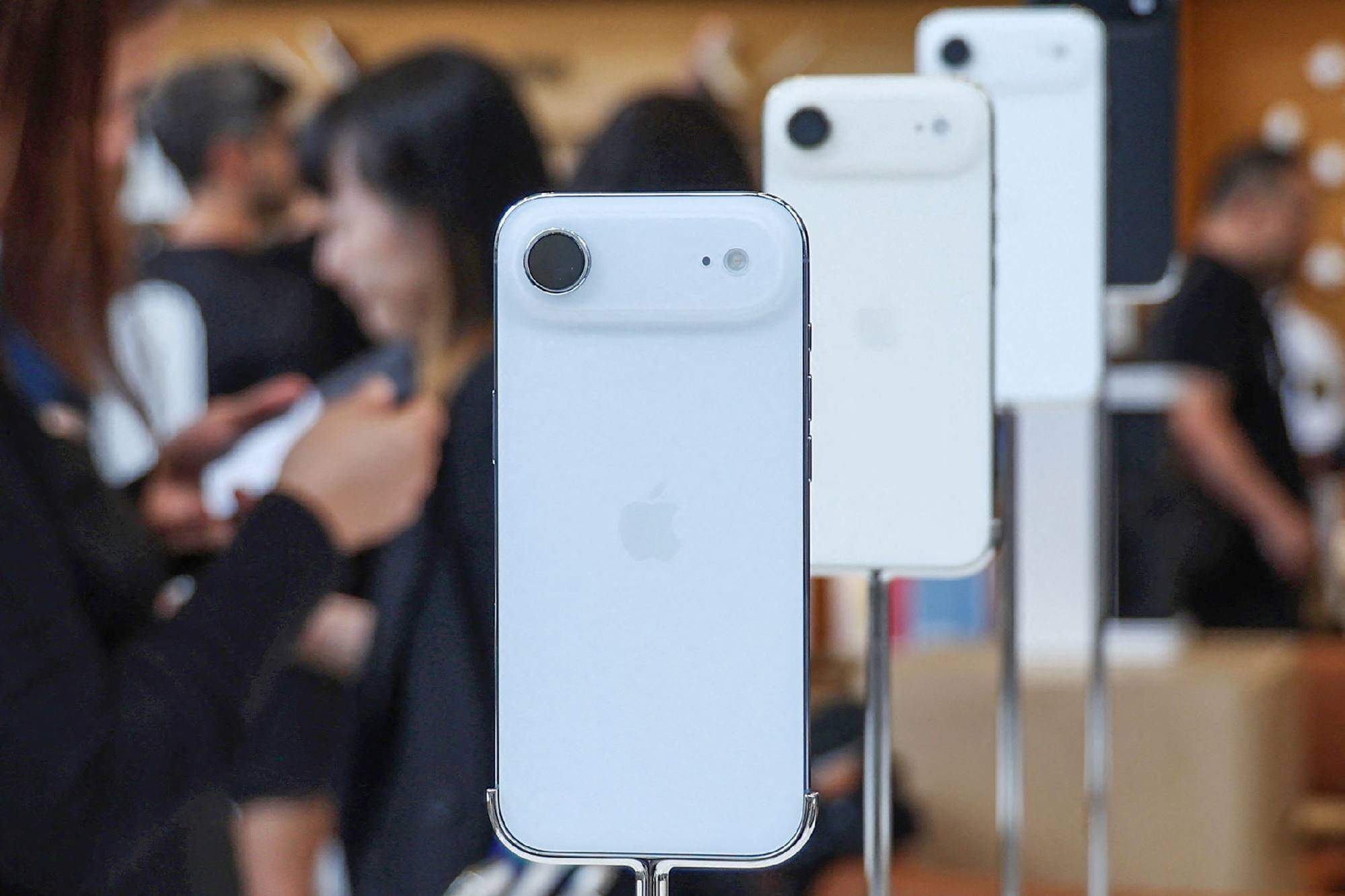
The launch of the iPhone Air as the first eSIM-supported smartphone sold in China marks a pivotal moment in the country’s telecoms history, as state-owned mobile carriers vie for dominance in a changing landscape.
Beijing approved “commercial trials” of the handset’s eSIM function by the country’s “Big Three” telecoms operators – China Unicom, China Mobile and China Telecom – last week, and the iPhone Air sold out within minutes of its release on Friday.
Domestic brands quickly followed suit. Oppo launched its Find X9 Pro with eSIM support on Thursday, and Huawei Technologies was expected to release a model “in the near future”, according to social media posts by China Telecom.
eSIMs, or embedded SIMs, are digital SIM cards that are built into devices. eSIMs can store multiple profiles, allowing users to switch between different mobile carriers or plans without the hassle of changing physical SIM cards.
The three major Chinese mobile service operators had adopted different approaches towards eSIM, according to Guo Tianxiang, research manager at consultancy IDC China.
China Unicom, which has the smallest number of mobile subscribers, was more proactive in rolling out eSIM services, hoping to enhance competitiveness with the technology. In contrast, China Mobile and China Telecom, which might see their years of investment in offline channels wasted if users can activate eSIMs entirely online, had been slower to embrace the technology.
China Unicom first conducted eSIM services for wearables in 2018, followed by the other two carriers in select cities. Nationwide services for all three were rolled out in 2020, covering wearables, tablets and other Internet-of-Things devices.
However, all three abruptly suspended the activation of new eSIM profiles in 2023, citing “system maintenance and upgrade”. Activations resumed alongside the iPhone Air launch.
Still, eSIM services in China remained in their infancy, according to Guo. The commercial trial licences came with limitations, such as the requirement to visit physical stores for activation, which undermined the primary convenience advantage of eSIM, he said.
Activation also required government-issued identification, in adherence to the country’s stringent real-name registration policies.

Mobile carriers have implemented additional security measures for their eSIM services.
While each iPhone Air can support two eSIM profiles, mainland-issued eSIM profiles are incompatible with devices bought outside the country. This discourages consumers from buying handsets overseas that come with a wider selection of software, such as Apple Intelligence.
Meanwhile, installing eSIMs from overseas carriers is not permitted in mainland China; iPhone Air owners can only do so while travelling abroad. Some users have resorted to foreign SIM cards to bypass the Great Firewall, China’s online censorship system that restricts access to certain foreign websites.
“As eSIMs typically require cloud-based infrastructure for remote provisioning, the Chinese government is wary of foreign control over such systems,” Voye, a company providing global roaming services, said in a report in January.
“Additionally, eSIMs would make it simpler for foreign mobile virtual network operators to operate in China.”
Despite their convenience, eSIMs also present opportunities for illegal activity.
“Through remote registration of many virtual numbers, criminals can easily circumvent the real-name verification processes associated with traditional physical SIM cards,” said Zeng Lingping, a digital security expert with the state-backed China Academy of Information and Communications Technology, in a report by state media Science Popularisation Times. – South China Morning Post


