
HEART valve disease is an often overlooked condition, yet it affects millions of people worldwide, particularly older adults.
One of the most serious forms is aortic stenosis, a condition in which the aortic valve becomes narrowed and restricts blood flow from the heart to the rest of the body. Left untreated, severe aortic stenosis can lead to heart failure and even death.
Pantai Hospital Kuala Lumpur consultant cardiologist Dr Yee Kok Meng informs that the condition is rather common.
“Worldwide, the incidence is about 7% in those above 65 years of age and as you grow older, the incidence increases. However, it is especially underdiagnosed in Malaysia.
“It frequently goes undetected because doctors may not actively screen for it, while many patients dismiss symptoms as a natural part of ageing.
“As a result, people often delay seeking care or intervention. Cost and affordability further influence whether patients pursue treatment.”
Over the past few years, transcatheter aortic valve implantation (TAVI) has emerged as a treatment option for aortic stenosis in Malaysia. The minimally invasive procedure offers a safer alternative to open-heart surgery for many patients.
Dr Yee explains that TAVI has been in clinical use in Europe and the United States for the past 10–15 years, with substantial accumulated experience.
“In this region, the number of TAVI procedures performed locally is significantly lower compared to our neighbours such as Thailand or Singapore.
“This difference is unlikely to be a reflection of lower disease incidence, but rather a result of underdiagnosis, as well as the tendency to accept symptoms in older patients as a natural consequence of ageing and a reluctance to pursue active intervention,” he observes.
Warning signs
The aortic valve sits between the heart’s main pumping chamber (the left ventricle) and the aorta, the large artery that delivers oxygen-rich blood to the body.
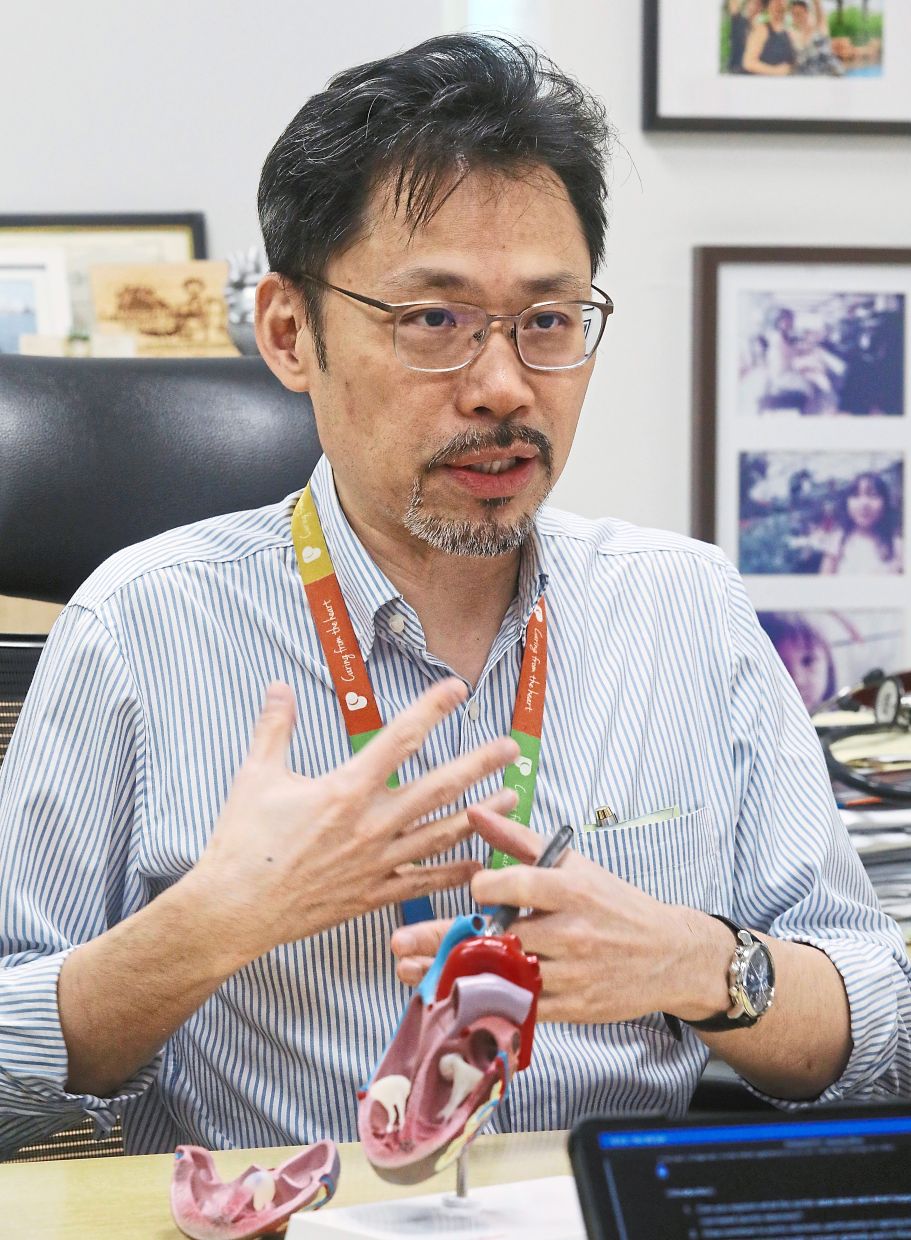
With every heartbeat, the valve opens to allow blood to flow out and closes to prevent it from leaking backward. In aortic stenosis, this valve becomes stiff and narrowed. With the opening restricted, the heart must work harder to pump blood through it. Over time, this strain can weaken the heart muscle.
Dr Yee says that the cardinal symptoms associated with aortic stenosis include the following triad:
> Chest pain or tightness;
> Dizziness or fainting;
> Shortness of breath.
He adds that because these symptoms often develop gradually, in some instances over decades, many people regard them as a natural progression of ageing, thus delaying diagnosis until the disease is well advanced.
“There is a well-known ‘5:3:2 rule’ associated with the prognosis of aortic stenosis. Once patients develop chest pain, around 50% will die within five years if left untreated.
“With episodes of fainting, the mortality rises, with 50% dying within three years.
“When shortness of breath develops—a sign of heart failure—50% may die within two years,” reveals Dr Yee, underscoring the critical importance of early diagnosis, close monitoring and timely intervention before the disease becomes advanced.
For patients diagnosed early, the specialist emphasises the importance of regular monitoring.
“They will undergo simple echocardiogram scans at regular intervals to assess valve and heart function. If symptoms develop, medications may be prescribed to help control them. However, once symptoms begin to worsen, surgical or catheter-based intervention becomes necessary.”
Understanding TAVI
TAVI, also known as transcatheter aortic valve replacement (TAVR), is a minimally invasive procedure used to replace a diseased aortic valve without opening the chest.
The conventional treatment for severe aortic stenosis is surgical aortic valve replacement, which requires open-heart surgery.
With TAVI, doctors can avoid open-heart surgery by delivering a new valve through a thin tube, or catheter.
“TAVI was first developed for patients who were considered too high-risk—too old or too sick—for conventional surgery,” says Dr Yee.
Today, advances in technology and growing clinical evidence have expanded its use to a wider group of patients.
From a patient’s perspective, TAVI is often seen as a far more straightforward option than conventional surgery, made possible by meticulous planning and imaging that are essential for safety.
Key steps include:
> Accessing a blood vessel, usually through the groin (femoral artery);
> Guiding the catheter to the heart under imaging guidance;
> Positioning the new valve inside the diseased valve;
> Deploying the valve so it begins working immediately.
Most procedures take two to three hours and can be performed under either light sedation or general anaesthesia, Dr Yee points out.
Patient selection
According to Dr Yee, while TAVI was once reserved mainly for elderly or high-risk patients, studies now show that it is also safe and effective in intermediate- and selected lower-risk patients.
Decisions are made by a multidisciplinary heart team, typically involving cardiologists, cardiac surgeons, imaging specialists and anaesthetists.
“Surgical aortic valve replacement remains the default treatment of choice, particularly for patients under 65 years of age. In this group, surgical risk is generally lower and the replacement valves are durable and time-tested,” says Dr Yee.
“TAVI is a relatively newer treatment option that is particularly suitable for patients at higher surgical risk, given its favourable risk–benefit profile. The valve used in TAVI typically lasts around eight to 10 years, hence it is most commonly considered in patients aged 65 years and above.
“However, it may not be suitable for everyone, as certain anatomical features or underlying conditions may make surgical valve replacement the more appropriate option,” he adds.
One of TAVI’s major advantages is faster recovery. Most patients can:
> Sit up and walk within a day or two;
> Spend only a few days in hospital;
> Experience less pain and discomfort;
> Return to normal activities much sooner than after open surgery.
This is particularly important for older adults, as shorter hospital stays reduce the risk of complications such as infections or muscle weakness.
Like all medical procedures, Dr Yee says that TAVI carries some risks, including vascular bleeding, heart attack, stroke, kidney injury or the need for a pacemaker.
With modern devices and experienced teams, complication rates have fallen significantly over the years and the risks are much lower than before.
Overall, TAVI is considered a safe and well-established treatment when performed in appropriate patients, Dr Yee points out.
For many patients, the improvement after treatment is dramatic. Activities that once felt exhausting like walking, climbing stairs or travelling often become possible again.
Dr Yee advises that long-term care includes regular follow-ups with a cardiologist, heart imaging to monitor valve function and taking medications such as blood thinners.
Timely care
Dr Yee observes that access to TAVI in Malaysia has its challenges.
These include high procedural costs, limited availability of specialised centres and the need for trained multidisciplinary teams. Despite these barriers, growing awareness and technological progress can help make TAVI more accessible to patients who need it.
The future of TAVI is also promising. Newer valve designs, improved imaging and refined techniques continue to enhance safety and durability.
Dr Yee emphasises that while aortic stenosis is a serious condition, it is treatable.
“The key message is simple: keep in mind that aortic valve disease is more common than we think, especially in the elderly.
“We must not ignore symptoms such as breathlessness, chest pain or unexplained fatigue, whatever our age.
“Early diagnosis allows timely treatment and prevents irreversible heart damage.”