
THE early years of a child’s life are crucial to development. This is the stage when the brain is developing at its fastest rate, when children are most receptive to learning and when educators and parents have the chance to make the most impact.
It is because the evidence is so strong that governments worldwide are being urged to spend more on early childhood education. Research shows that high-quality early years education, with a focus on both cognitive and social skills, improves children’s long-term prospects.
A child-centric approach to education
One of the ways we can maximise the receptiveness of the brain in the early years is by giving children as many stimulating experiences as possible.
This principle guided the development of the new Cambridge Early Years programme. Cambridge researchers analysed the characteristics of high-quality early years education and found that play-based learning is most effective in supporting all aspects of children’s development.
What is play-based learning?
Play-based learning is about giving children the time, space and autonomy to engage in activities and interact with resources that are going to be meaningful and interesting to them.
If you enter an early years classroom, you should see children taking part in activities designed to support their social, emotional, cognitive and physical development.
The children playing card games are beginning to understand the concept of rules. The child dressed as a doctor is developing their imagination. A pretend shop gives children a space to develop their social skills and learn about money.
Play also helps children develop maths and language skills. Word play, rhyming and songs allow children to play with words and language or sounds. Making models helps develop problem-solving skills, while sorting objects helps with sequencing.
Setting teachers up for success
Cambridge’s research review also found that play-based learning achieves the best results when it includes a mix of child-initiated and adult-led activities.
The role of the teacher in a play-based classroom requires skill and judgement – knowing when to lead a child in play and when to follow, which resources to use, and how to observe and evaluate a child’s development while they play.
For early years education to have the biggest impact, every element should be aligned – the curriculum, resources, assessment and teacher training – giving teachers a clear framework for success.
When the Cambridge Early Years programme was developed, play-based learning was embedded into every element to achieve maximum impact – it shaped the design of Cambridge resources, the guidance for teachers on how to use observational assessment approaches, and the content of teacher training modules.
Laying the foundations for the future
Another characteristic of high-quality early years education is that children’s knowledge and skills should be built up gradually, so that they are well-prepared for primary school.
By combining a play-based learning approach with a structured curriculum, like Cambridge Early Years, children develop academically, building strong foundations in literacy and numeracy.
They also learn how to work and play with others in a learning environment, helping them develop socially and emotionally.
Children learn to cooperate, help others and actively listen to one another. They develop the skill of self-regulation – the ability of a learner to control their thoughts and feelings.
Through autonomous play, children experiment and develop resilience and the determination to continue when things are hard. Play-based learning also encourages curiosity and questioning.
A good early years programme should help children recognise that education is fun, exciting and stimulating. This enthusiasm and experience will guide them through primary education and throughout their lifelong learning.
By giving young children a strong foundation in their learning, and motivating them to learn even more, we have a better chance of improving all our futures.
Cambridge Early Years in Malaysia
The Cambridge Early Years programme is now officially launched in Malaysia for children aged three to six, providing young learners with the best start in life, as well as helping them meet key early milestones and thrive in and out of school.
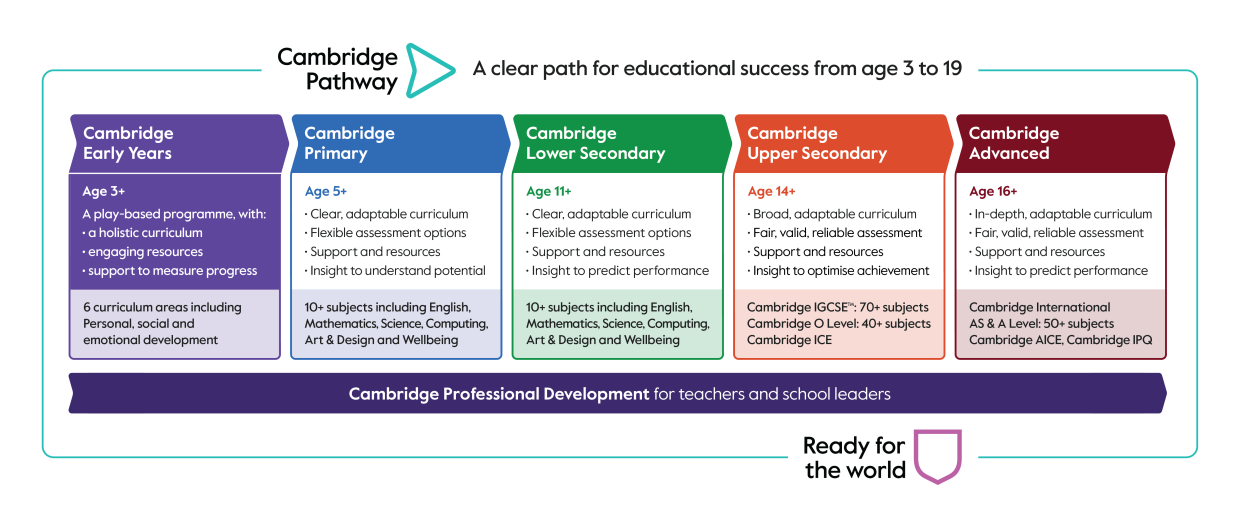
The new play-based programme is the first stage in the Cambridge Pathway, a high-quality and joined-up path for educational success for learners aged three to 19.
For more insights and information on Cambridge Early Years in Malaysia, you may visit www.cambridgeinternational.org/earlyyears.