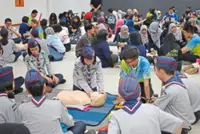
I REFER to the article, “Equipping public with lifesaving skills” published in The Star on June 24 (online at bit.ly/4g7HyTP). The initiative to train 800 members of the public in cardiopulmonary resuscitation (CPR) and the use of automated external defibrillators (AEDs) deserves commendation. Every additional person trained increases the likelihood that a life can be saved during a sudden cardiac arrest incident.
The encouraging news is that AEDs have become significantly more affordable than they were three decades ago, so more of them can be deployed.
However, every AED requires regular maintenance. Electrode pads expire every few years, batteries need replacement, and routine inspections are essential to ensure the devices function when needed. An AED that is poorly maintained may fail at the very moment someone’s life depends on it.
This is where partnerships among the government, private sector, and civil society become crucial. It is heartening to see companies sponsoring AED installations in public places.
The government can always be the enabler. Besides encouraging the installation of AEDs, it should introduce measures that ensure long-term sustainability. Tax deductions or tax incentives for purchasing AEDs, replacing batteries and electrode pads, and maintaining registered public- access AEDs would encourage more businesses, schools, places of worship, and community organisations to invest in these life-saving devices.
In strengthening the public access defibrillation ecosystem, digital tools such as the MyResQ app should also be highlighted. This platform serves as a potential bridge between the public and emergency response services by enabling users to quickly identify nearby emergency assistance resources, including possible AED locations and access to rapid response support networks.
If expanded, the app possibly can allow members of the public to “Adopt an AED” by assigning volunteers to check on AEDs near them. This will definitely ensure operability of the AEDs during emergencies.
Time is the greatest enemy during a sudden cardiac arrest. Studies consistently show that survival decreases by approximately 7% to 10% for every minute that defibrillation is delayed. Conversely, immediate bystander CPR can double or even triple a victim’s chances of survival, while early defibrillation for shockable cardiac rhythms can increase survival to as high as 70%.
Malaysia has made encouraging progress in promoting CPR and AED awareness. The next step is to ensure that every trained rescuer can quickly locate a functioning AED wherever a cardiac arrest occurs. A sustainable public access defibrillation programme – supported by education, maintenance, voluntary adoption, incentives, and enforcement – will save many more lives.
CHEW HOONG LING
Secretary
Persatuan Kemahiran CPR
(CPR Skills Association)