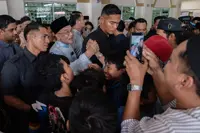
Tunku’s jovial manner even had him laughing with his detractors, such as Singapore’s Lee Kuan Yew (left). - Arkib Negara Malaysia
Today, March 20,2021, is the International Day of Happiness. It is thanks to the initiative of a tiny country that happiness is celebrated at a global level now.
Bhutan first proposed the idea of a World Happiness Day in 2011, and in the following year, the United Nations declared March 20 to be that day. The day is marked in recognition of the common belief that “happiness and well-being are universal goals and aspirations in the lives of human beings around the world”.
Today, Bhutan measures development and success not in terms of gross national product but as “gross national happiness". Following Bhutan’s lead, many other countries have appointed "Ministers of Happiness" to enhance the mental, spiritual and physical well-being of their people.
Although Bhutan deserves the credit for drawing world attention to happiness, the world in general, and Malaysians in particular, should not overlook the fact that long before Bhutan, it was Malaysia that first held out the principle of happiness as the measure of a nation’s success. We are most fortunate to have had a leader who provided valuable insights into the nature of happiness, which we need to consider as we gauge our success as a nation of happy people. That leader was Tunku Abdul Rahman, Malaysia’s first prime minister.
Like enlightened political philosophers of the past, Tunku (as he was widely known as) believed that governments exist for the most part to provide for the happiness of the people: “For us in the Alliance we have no dogmas other than to ensure happiness for the people," he once said.
Long before he became prime minister of the Federation of Malaya, Tunku used to say that the best solution to any problem facing the people lay in “treading the happy path”. Subsequently, as Prime Minister, Tunku wanted Malaya to be one of the world’s happiest countries, a vision that he articulated in 1960: "With our unity and cooperation, faith and tolerance for one another, with hard work and glad hearts, we can make our young nation one of the happiest in the world. This is my belief, this is what I live for, to ensure peace, happiness and prosperity for our Malaya which we all love so well."
Tunku did not distinguish between personal happiness and the happiness of the people: "Nothing will give me greater pleasure than to see people make merry and take things easy and be happy."
He once declared himself to be the happiest prime minister in the world. “I am happy because the people are happy. Is there anything more that I can wish for?” said Tunku in August 1962 after receiving a rousing welcome in Kuala Lumpur following the successful conclusion of the “Malaysia Talks” in London that led to our independence.
The reason for government
In line with his happiness principle, Tunku favoured policies that he believed would bring the greatest happiness to the greatest number of Malaysians. He said,"What I gave to one, I also gave to others. In this way, we made everybody happy. This has always been my aim."
And he pointed out: "This is the only country in the world that has provided funds for all faiths to prosper, that has provided money for the running of schools of all languages of the peoples of this country.... And so I am a happy prime minister and I have cause to be so."
Live and let live
Dwight Eisenhower observed that ‘a sense of humour is part of the art of leadership, of getting along with people, of getting things done’ - something Tunku used admirably in politics, even with one of his main detractors, Indonesia’s Soekarno (right). - Arkib Negara MalaysiaTunku’s basic concept of happiness is best expressed in his favourite maxim,"live and let live". This calls for accepting people as they are, although they may have a different way of life. "Foreign visitors have remarked on the happy state of affairs here and attributed this to ‘my wise and able leadership’. I said that it was mainly due to the desire of the people themselves, whose outlook in life is one of live and let live, ” said Tunku
In a press statement issued two days before Merdeka day in 1957, Tunku said: "I believe in allowing the people to have their own way so long as they observe the law and order of the country. I believe in allowing them to run their own lives and enjoy the fruits of their labour.
“Let them wear what they want to wear, let them do what they want to do, let them go where they want to go. I do not think it is right to order their way of life.... Let them have what they want so that they can have happiness and spread happiness in the country."
Similarly, in his private life Tunku wanted his friends to accept him for what he was. Unfortunately, the way our society has developed over the past few decades appears to indicate that it is not the easiest thing in the world to let people live their own lives.
Tunku with his Cabinet members - he referred to them as ‘one for all and all for the country we love so much’. - Photo from ‘Tunku Still The Greatest Malaysian’ by Tan Sri Rais Yatim & Prabhakaran Nair (Arkib Negara Malaysia)Importance of humour
One of the greatest treasures of our independence era is Tunku’s legacy of humour that he used to great effect in gaining independence from the British and drawing the different races and groups together in building a newly independent nation.
Tunku exemplified the truth of Dwight Eisenhower’s observation that “a sense of humour is part of the art of leadership, of getting along with people, of getting things done”.
The process of nation building in the early years of independence was no easy matter for Tunku and his Cabinet. The new leaders had to grapple with the grave security situation in the country at that time caused by the communists as well as unresolved issues, often involving racial and religious sensitivities.
Despite the hurdles, Tunku managed well, with his spontaneous ability to find humour in difficult situations. He had the natural ability to put people around him at ease, and bring down barriers. It was also his magnanimous character and wholesome personality that enabled him to gain independence and form a new nation soon thereafter.
The members of his Cabinet discussed and resolved intricate national problems in a creative and jovial manner, with a great deal of laughter.
“In this way we used to end our Cabinet sessions in good humour and with a mutual sense of belonging – one for all and all for the country we love so much, ” recalled Tunku. Said Tan Sri Khir Johari, “I have had the privilege of serving under the country’s first three prime ministers and I must say that Cabinet meetings under Tunku were an experience I shall forever cherish.”
Very often, Tunku pointed out his own shortcomings before anyone else could, and laughed with them before they could laugh at him. In this way, he skillfully anticipated and deflected the sting of his detractors’ criticisms.
He also used humour to defuse tense situations. In one instance, Tan Sri Lim Swee Aun, the Health Minister, absent-mindedly took out and smoked his pipe during the Muslim fasting month. The other Cabinet ministers gave him a hard stare, but Tunku simply smiled and remarked, “Don’t worry, doctor, keep on smoking. At least I can smell the sweet aroma of tobacco.”
After retirement, it was sad to hear Tunku speak of his vision of happiness in the past tense. "I boasted that I was the happiest prime minister in the world, and that was because the people were happy then, ” said Tunku.
Today, as Malaysians, let us rejoice that the world has finally come to re-discover the simple philosophy of happiness that was conceived by none other than our Father of Independence – a great statesman and leader who once called himself the world’s happiest prime minister.
PRABHAKARAN S. NAIR
Kuala Lumpur
Note: The letter writer is a former director of Pustaka Wira Negara, Arkib Negara Malaysia, and the author of two books on Malaysia’s history.