
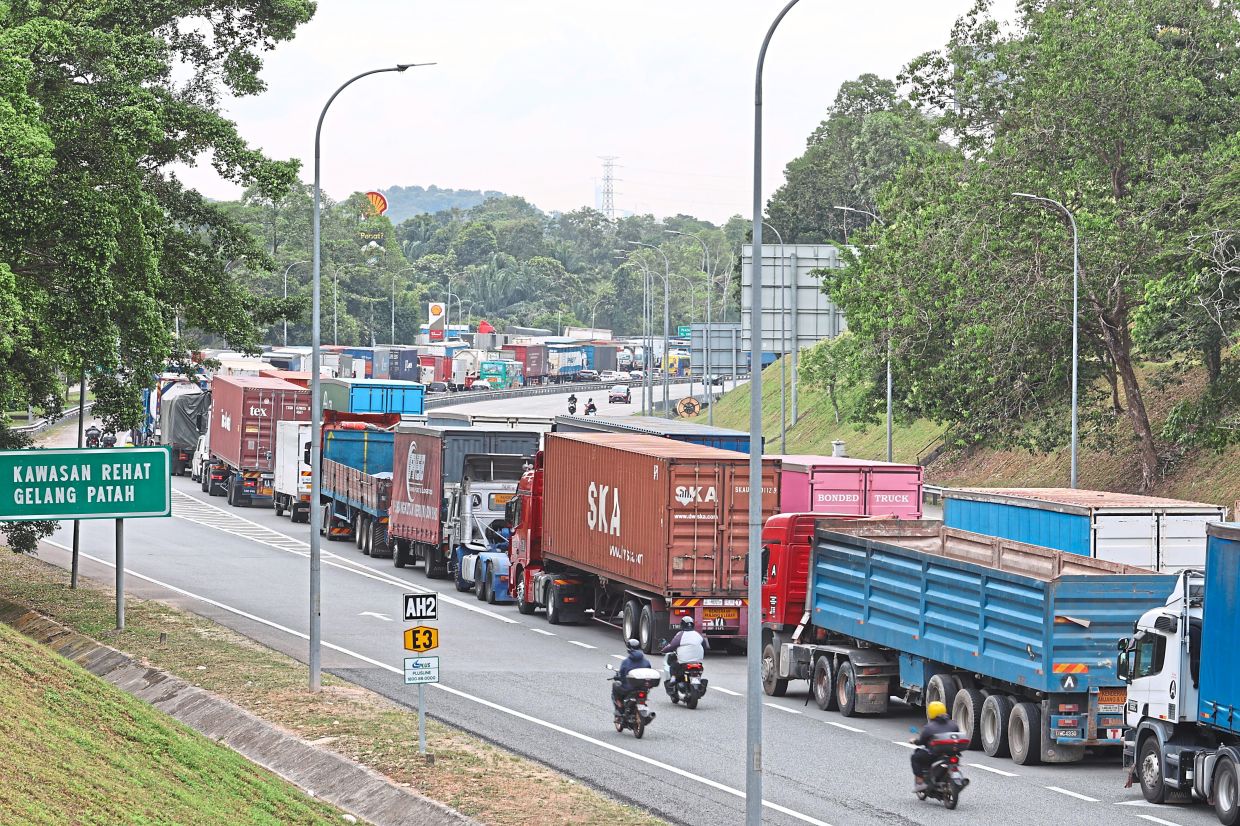
Authorities must find long-term solution to Iskandar Puteri customs congestion holding up trade worth millions
EACH day, almost 3,000 heavy vehicles use the Sultan Abu Bakar Customs, Immigration and Quarantine (CIQ) Complex (KSAB) in Iskandar Puteri, Johor, to travel to and from Singapore.
These lorries, which include trailers, carry an array of items, from vegetables to construction materials and advanced electrical and electronics components.
These vehicles are the important lifeline commuting between both countries, facilitating tens of billions of ringgit of trade annually.

This was done with the aim of easing congestion along the Johor-Singapore Causeway. At the Bangunan Sultan Iskandar CIQ – better known as BSI in Johor Baru – the GVL is capped at a maximum of RM200 for exit and RM100 entry.
(“Entry” refers to goods imported into Malaysia from Singapore while “exit” indicates goods exported to the island republic).
Lately, there have been some issues hampering the smooth flow of goods via KSAB.
Previously all the checking of goods entering and exiting the checkpoint was handled by the Customs Department, but since the end of last year, the duties had been taken over by the Malaysian Border Control and Protection (AKPS).
The Star reported that since early this month, more than 3,000 lorries were caught in these massive jams each day, stretching almost 8km, following the implementation of mandatory scanning for all heavy vehicles.
The problem?
KSAB only has one scanner for lorries headed to Singapore.

The island republic, on the other hand, has six scanners for lorries entering the nation.
It also does not scan lorries leaving the country, while Malaysia has two scanners to check lorries arriving at KSAB.
The congestion worsened just before Chinese New Year with the last-minute push to send goods to Singapore, as lorries were prohibited from using the roads on Feb 14, 15, 21 and 22.
Since Feb 14, the long jams to KSAB are no longer there, as AKPS’ temporary solution was to divert all lorries to a huge holding area within the CIQ complex.
Drivers were required to walk to the counter to get the paperwork done before proceeding through the scanners.
This move is akin to a public relations stunt to resolve the public outcry about the massive number of lorries on the highway, which was a huge nuisance to peak-hour road users commuting to Singapore.
However, the problem of long waits and delays have not been resolved.
The new ruling was also causing a lot of hardship to drivers who had to park their vehicles and walk almost 500m to and from the office to submit their paperwork.
Many drivers are hoping that AKPS will revert to the old system of not carrying out mandatory scanning during peak hours, especially in the mornings.
They are also lamenting that their incomes have been slashed by half because of the long delays.
Previously, they would have been able to make at least two trips to and from Singapore.
Drivers are also forced to walk under the rain or sun, as there are no covered walkways.
They lament that the lorry clearance area is also riddled with huge potholes.
So, why the sudden decision by AKPS to carry out mandatory screening?
Did Singapore’s immigrations and checkpoints authority file a complaint about more contraband being smuggled into the country?
Has AKPS busted any major smuggling racket involving lorries after implementing its mandatory screening?
It is time that AKPS call all the stakeholders, such as the lorry associations and drivers, to find a long-term solution to this problem.
Based on my calculations, with the RM100 levy collected from each lorry travelling to and from Singapore each day, the government generates about RM300,000 per day, which amounts to a whopping RM100mil annually for KSAB alone.
BSI, with an average of 1,500 lorries daily, is also generating tens of millions of ringgit annually.
So why can’t a portion of this be used to purchase additional scanners or even patch up all the potholes and for the upkeep of the checkpoint?
Johor is expected to be the next economic powerhouse, especially with more Singapore-based companies relocating their operations to this state under the Johor-Singapore Special Economic Zone.
It is paramount for the government to find ways to promote seamless travel and movement of goods between both countries.
Already a subscriber? Log in
Get 20% OFF The Star Digital Access
Cancel anytime. Ad-free. Unlimited access with perks.