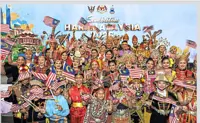
The last few weeks have witnessed some courageous and commendable decisions that uphold our nation’s dazzling diversity, multiculturalism and pluralism.
ON Wednesday, March 13, the Education Ministry issued a directive for school canteens to remain open during Ramadan, particularly in schools that have non-Muslim students.
In reply to PAS Ulama Council chief Datuk Ahmad Yahaya’s criticism that this was disrespectful to Muslims who were fasting, Education Minister Fadhlina Sidek gave a razor-sharp reply: “I do not want... non-Muslim students having to eat their meals in storerooms or inappropriate areas when all schools have canteens.”
This was the first of the decisions made in the last few weeks that reflected maturity, tolerance and mutual respect in the country.
The second involves a proposal for gender equity in public sector employment.
During his speech at the International Women’s Day Celebration 2024 on March 8, Prime Minister Datuk Seri Anwar Ibrahim announced that the Civil Service Remuneration System being drawn up is considering shorter working hours for women employees on slightly lower salaries to enable them to better care for their families.
According to the PM, Malaysia could become the first country in the world to provide such flexibility to female civil servants.
This proposal is highly commendable because it recognises the social, cultural and religious realities of women’s lives. The existentialist reality is that many women employees are also homemakers and have a disproportionate share of domestic responsibilities.
Despite their undoubted professional ability, they often face structural and systemic hurdles in the path of upward mobility. They have to choose what to prioritise – work or family. The formal equality in Article 8(2) of the Federal Constitution does not help because formal rights do not always function as such.
Commendable though the PM’s proposal is, it is humbly submitted that it may run foul of Article 8(2)’s ban on gender discrimination. Many men with infirm spouses or whose spouses have passed away face the responsibility of taking care of the home and children. It may, therefore, be better to allow this flexibility of reduced hours on reduced pay to all employees – female or male, and married or unmarried.
The aim of “caring for family” should cover not only caring for children but also spouses and parents. That will be consistent with our Eastern religious and cultural values.
The third heartening matter is that the existence of vernacular schools has been upheld by the courts. In the case of Mohd Zai Mustafa v Menteri Pendidikan (2024), the existence of Chinese and Tamil schools under Sections 2, 17, and 28 of the Education Act 1996, and the use of Chinese and Tamil languages as the medium of instruction in vernacular schools, were challenged by some non-governmental organisations as violative of Article 152 of the Federal Constitution, which honours Malay as the national language for all “official purposes”.
Under Article 152(6), “official purpose” means any purpose of the Government and includes any purpose of a public authority”.
At the KL High Court, Justice Mohd Nazlan Mohd Ghazali (as he then was), and at the Court of Appeal, Justices Supang Lian, M. Gunalan and Azizul Azmi Adnan rejected the challenge and upheld the constitutionality of vernacular schools. Last month, the Federal Court refused leave to appeal, which means that the Court of Appeal decision is now final.
Justice Azizul, in affirming the earlier judgment of Justice Nazlan, made several important rulings:
(i) A vernacular school cannot come under the concept of “public authority” or “Government” within the meaning of Article 152(6). As such, the use of Tamil and Mandarin languages as the medium of instruction for teaching in those schools was constitutionally permissible.
(ii) The use of a language as a medium of instruction in vernacular schools does not come within the ambit of “official purpose”.
(iii) The Zai Mustafa vernacular school case is distinguishable from the Merdeka University Sdn Bhd v Government (1982) case where the use of Chinese language as a medium of instruction in a private university was ruled to be for an official purpose. The distinction can be based on the fact that a university established under the Universities and University Colleges Act 1971 was a statutory body with a very strong government involvement and control. Vernacular schools, on the other hand, were not statutory bodies or a government or a public authority.
(iv) To uphold the constitutionality of vernacular schools, Justice Azizul relied on a number of provisions in the Constitution, among them Article 152(1)(a), which provides that “no person shall be prohibited or prevented from using (otherwise than for official purposes), or from teaching or learning any other language”.
He disagreed with the Mark Koding v PP (1982) view that Article 152(1)(a) permits the teaching or learning of a language and not the teaching or learning in a language. According to him, the right to use is broad enough to cover both aspects.
(v) Article 152(1)(b) provides that “nothing in this Clause shall prejudice the right of the Federal Government or of any State Government to preserve and sustain the use and study of the language of any other community in the Federation”.
This means that the pre- Merdeka reality of vernacular schools was allowed to be preserved and sustained. Government aid for vernacular schools is permitted by our Constitution.
With all due respect to the Merdeka University judges, it is humbly submitted that a public purpose is not synonymous with an official purpose. A private school or institution or service may exist for a public purpose, but that does not make its operation an official purpose.
If Chinese and Tamil schools are a public authority, and all education is an “official purpose” (as the Merdeka University case implied), then all kindergartens, primary and secondary schools, religious schools, private schools, matriculation centres, colleges and universities using English or other foreign languages would also have to be regarded as violating Article 152(1)(a).
All exemptions permissible under the Education Act will come under constitutional questioning.
In any case, the Merdeka University case has been overtaken by events. Private universities are now flourishing and are allowed much flexibility by the Private Higher Education Institutions Act 1996 as long as they teach Malay and English as prescribed subjects.
In response to the court decision, Fadhlina reiterated her ministry’s commitment to acknowledging and supporting vernacular schools. This is a refreshing contrast to the defiance of some state governments to the recent Nik Elin Federal-State division of power case.
National Unity Minister Datuk Seri Aaron Ago Dagang also observed that vernacular schools are not a divisive factor but rather a platform for unity.
He pointed to enrolment data that indicates a steady increase in non-Chinese students attending Chinese vernacular schools and non-Indian students enrolling in Tamil vernacular schools between 2018 and 2023.
This columnist’s search for data found that there are nearly 1,200 Chinese and 523 Tamil primary schools in the country.
Data for 2020 indicates that in national primary schools, the ethnic breakdown was 94% Malay, 0.73% Chinese and 2.63% Indian. In Chinese vernacular schools, the ethnic breakdown was 15.33% Malays, 80.25% Chinese and 2.75% Indians. In Tamil schools, 99% of the pupils were Indians.
Private schools are gaining popularity. Their enrollees constitute 65.88% Chinese, 26.96% Malays and bumiputras, 4% Indian and 3.17 Others.
The Unity Minister’s remarkable statement that vernacular schools “provide a platform for students from diverse backgrounds to interact and understand each other” should open some eyes to the serious dilemma that national schools have lost their diversity and vernacular schools have gained inclusivity!
The author is Holder of the Tunku Abdul Rahman Chair at the Faculty of Law, Universiti Malaya. He wishes all Muslim readers the blessings of the holy month of Ramadan. The views expressed here are the writer’s own.
Already a subscriber? Log in
Get 20% OFF The Star Digital Access
Cancel anytime. Ad-free. Unlimited access with perks.