Food banks, donors reshaping aid to go beyond filling stomachs, by respecting privacy and providing much-needed personal hygiene care
A LARGE canister on the Buddhist temple’s altar, labelled “Take One”, was filled with small, tightly rolled pieces of paper.
I took one out of curiosity, unrolled it and read: “One Tin Milk Powder”.
I then learned that the temple was running a charity project for the poor, where devotees were invited to contribute the item they drew from the canister.
That was around 1993 or 1994, when I was a cadet journalist earning RM640 a month.
Back then, milk powder came in large, 2kg tins that looked like small drums.
I could not even afford a tin of milk powder for myself, so my “lucky draw” ate at me for weeks until I received my year-end bonus.
The first thing I bought was a big tin of milk powder.
I felt immense relief and happiness after handing the tin to the temple monk.
This memory returned when The Star recently detailed the workings of Mutiara Food Bank, a Penang Government initiative that began in 2017, and its latest campaign called Semeja Harapan.
The concept is simple. While shopping for groceries at the supermarket, buy an extra pack of affordable, nutritious food with a long shelf life and drop it into a Mutiara Food Bank bin.
Our visit to the food bank shows us that Penangites are generous as the shelves are well-stocked.
We also learned a few things that did not quite fit into a standard news report, but are worth sharing.
Initially, the food bank tried to collect details of aid recipients to properly account for distributed food.
However, some people were reluctant to show their MyKad. Some would rather walk away even when they plainly needed food.
So, Mutiara Food Bank eventually relented.
Instead, staff would ask how many people were in the household, offer an initial batch of supplies and request only a name and a photo with the food for verification, promising that the photos would not be shared.
From my observations, the last thing people lose during bad times is their dignity.
Showing their identity card and revealing their details in exchange for food can feel like surrendering and being labelled as “needy” or “underprivileged”.
There is a difference between asking for help and having to prove one deserves it. Some would rather go hungry and retain their pride.
And we learned another
valuable lesson from Penang Community Care (PGCC), an NGO formed in 2008 that focuses on single-parent families and the elderly living alone.
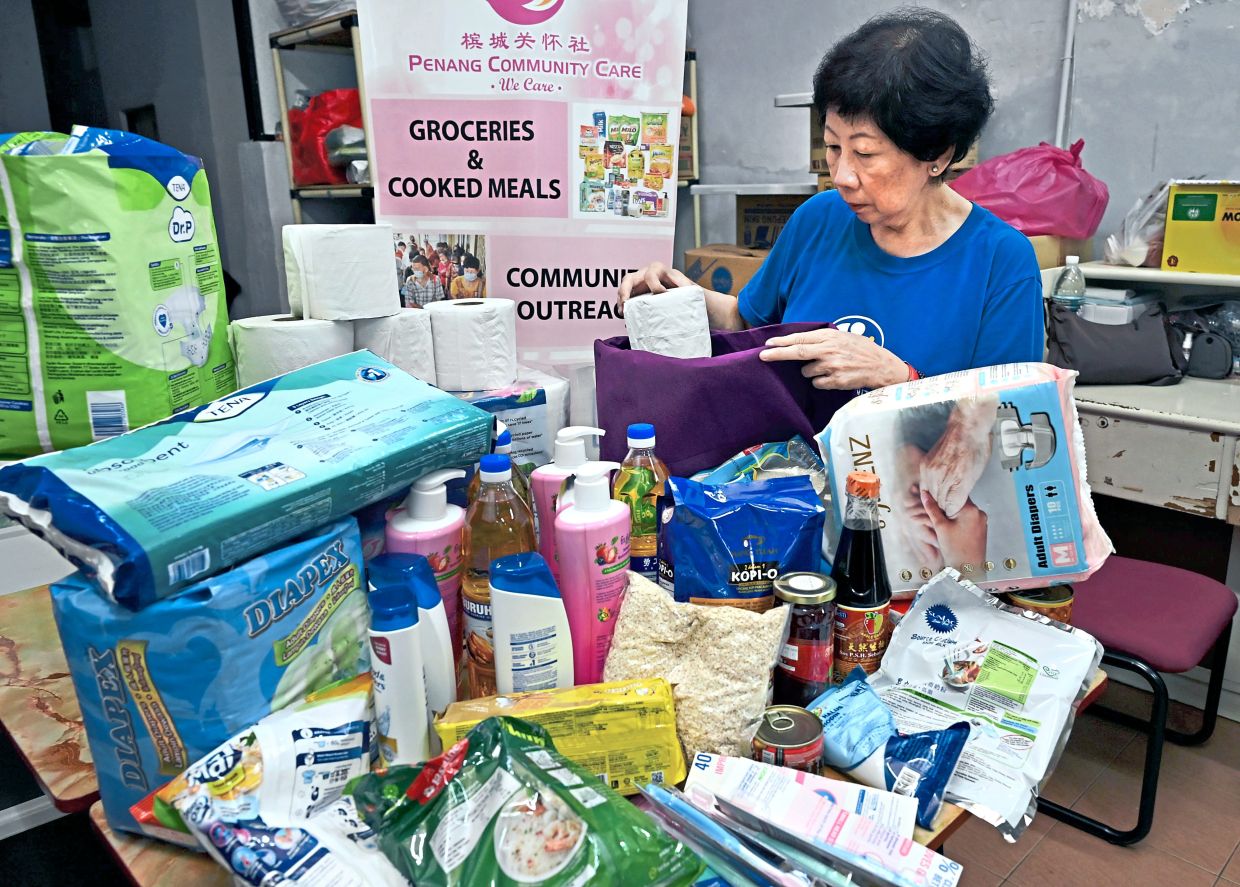
On top of much-needed food aid, PGCC recommends that donors, particularly companies wanting to spend their charity budgets, buy household essentials such as laundry or dishwashing detergent, toilet paper, toothpaste and toothbrushes, soap and even diapers.
While some donors prefer buying cooking oil, flour and sugar in bulk to maximise reach, being able to maintain personal hygiene and wear fresh, presentable clothing can be a lot more valuable than filling one’s
stomach.
A bag of laundry detergent costs as much as oil, flour or sugar, yet lasts a month or more in most households.
Something state welfare committee chairman Lim Siew Khim said stuck in my head.
Penang has no households in the hardcore poor category.
But there are 11,105 households in the poor category and “without timely intervention, some may risk falling into hardcore poverty”.
Intervening effectively gives people a chance at a better future, enabling them to stand on their own feet and eventually help others.
Already a subscriber? Log in
Get 20% OFF The Star Digital Access
Cancel anytime. Ad-free. Unlimited access with perks.