
LAST Saturday, at a campaign rally in Cleveland, Ohio, former US president Barack Obama took aim at the renovations to the White House under US President Donald Trump. “He’s got the White House looking like Saddam Hussein opened a Cheesecake Factory,” he said. “Just gold everywhere.”
(The Cheesecake Factory is an American casual dining chain known for its vast menus and lavish décor, while Saddam was known for his gilded palaces.)
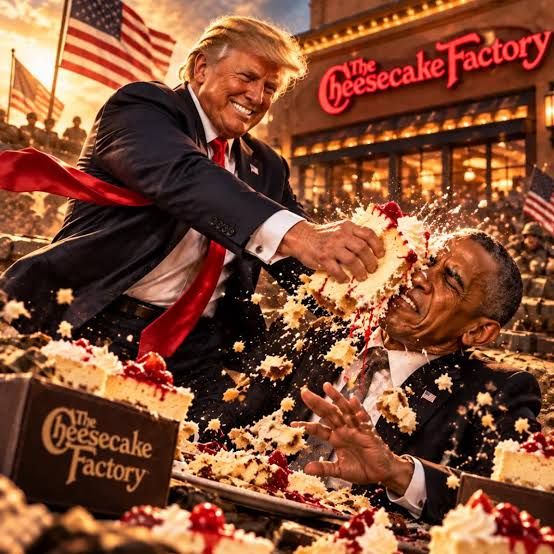
The White House piled on. It shared a mock Cheesecake Factory menu, streamed an hours-long YouTube video featuring an AI-generated cartoon of Trump outside a Cheesecake Factory, and had US Treasury Secretary Scott Bessent hold a press conference at an actual outlet in Washington.
Obama kept the feud going on Wednesday, at a rally in Georgia. As a father of two daughters, he said, he had “lived” at places like Chuck E. Cheese and The Cheesecake Factory for about a decade.
At that same rally, Obama went on a scathing attack about how Trump and his allies were obsessing over this Cheesecake Factory thing while completely ignoring vital issues like the soaring cost of living, increasing gas prices, healthcare, and so on.
He also joked that Trump did not care about the Saddam comparison, only about the Cheesecake Factory thing.
This has become an interesting comparative case study in strategic communication in politics.
If you listen carefully to the arguments, do your research, and pay close attention to the facts, I would imagine most would sympathise with Obama’s perspective here.
The question is: do people listen, research, and pay attention?
If they don’t, which of these two headlines is more likely to stick?
“Obama compares White House redecoration to Saddam Hussein opening a Cheesecake Factory.”
“Elitist Obama makes fun of beloved Cheesecake Factory.”
It somewhat pains me to say it, but if it was my political career on the line, I’d bet on the second one sticking more effectively in people’s heads.
To be honest, I reached this conclusion before even really listening to most of the attacks from the Trump side.
I consume mostly leftist media, so I guesstimated the general shape of those attacks just from Obama’s response, and from The Daily Show making fun of Republicans and Fox News for their attacks about the Cheesecake Factory.
The gist of the counterattack from the left-centred around the absurdity of focusing on something like The Cheesecake Factory at a time when so many serious issues were at stake.
Make no mistake, I agree 100% that there are more important issues at stake for Americans.
All the words about cost of living, healthcare, and so on are in my mind 100 per cent the truly important “real issues”.
But are the real issues the ones that grab attention?
To expand on this question a bit, let’s take a swing into Malaysia.
Recently, Rafizi Ramli made a scathing attack on the government over the Zetrix AI Bhd controversy. The company, formerly known as MyEG Services Bhd, has seen its share price collapse since Aug 28, and Transport Minister Anthony Loke has said Zetrix and MyEG failed to remit RM314mil in government revenue collections.
I believe Zetrix is an important issue. There are serious questions of governance and possible financial wrongdoing that need serious attention.
My question, though, is: is Rafizi’s attack on this politically effective?
While of course he is doing what opposition politicians are theoretically tasked with doing, will it really score significant political mileage for him?
I think one reason the answer is “probably not” is because it does not bring much that is new or memorable to the table – not in the way he did it, at least.
Rafizi made his bones hitting hard on scandals like the National Feedlot Corporation (NFC) way back in 2011, at a time when it was still pretty taboo and challenging to speak up so openly and accuse government ministers of such corruption.
Since then, what was once taboo and groundbreaking has become a little bit... “boring” might be the most brutally honest way to describe it.
Malaysians are no stranger to political controversies like these. We’ve had NFC, the Littoral Combat Ship (LCS) fiasco, and of course, the mother of them all, the 1Malaysia Development Bhd (1MDB) scandal.
So yes, of course the Zetrix controversy deserves scathing scrutiny. Of course, massive losses of public money need unrelenting investigation.
But are people going to react to Rafizi’s cookie-cutter attacks the same way they reacted to NFC or 1MDB back then?
I think the equally honest answer is again: probably not.
Firstly, stories of such corporate corruption has sadly just become par for the course. Most often, things only stick in people’s minds when there is a vivid, visceral flashpoint – an instant image association.
For NFC, there was an image that did exactly that – cows living in luxury condominiums.
The association of the then minister related to the case with cows stuck particularly hard. It can be argued that her political career never recovered.
This issue of the Cheesecake Factory is similar. When Obama first used it in an offhand way, many things, ideas, and concepts were involved – the White House, Saddam Hussein, gold, and then, The Cheesecake Factory.
The Trump camp whittled it down to: Elitist Obama hates The Cheesecake Factory.
The next general election is not too far away for us Malaysians. Aspiring politicians might do well to take heed of these lessons.
Even when talking about seriously important issues like cost of living, we need to always find ways to make things visceral and memorable.
One image that remains from as far back as 2008 was that of Joe the Plumber, used by then Republican presidential candidate John McCain to attack, once again, Obama, who was then the Democratic candidate.
The Malaysian equivalent comes from a slightly unlikely source – Mak Cik Kiah, invented by then prime minister Tan Sri Muhyiddin Yassin in 2020 to explain his Prihatin stimulus package.
It wasn’t a particularly good example, and it didn’t come from a particularly good prime minister, but I’ll be the first to admit: I still remember the name.
The takeaway here is that if you want a message to stick, you have to find a way to feel real, solid, and relatable.
Some Americans will be too young to remember much about Saddam Hussein, but almost all will know what a Cheesecake Factory is like.
Ask a regular Malaysian what or who Zetrix is, and they’re not likely to have the faintest idea. But almost all would have encountered someone like a Mak Cik Kiah selling pisang goreng by the roadside.
So, when it comes to designing your political messaging – real facts and real issues matter, but they will fade into obscurity unless you find just the right way to package them.
Nathaniel Tan is a strategic communications consultant who likes no-bake peach cheesecake. He tweets @NatAsasi and can be reached at nat@engage.my. The views expressed here are solely his own.
Already a subscriber? Log in
Get 20% OFF The Star Digital Access
Cancel anytime. Ad-free. Unlimited access with perks.