

The scathing commentary rattled political leaders, local authorities and tourism operators, all of whom bristled at the harsh assessment of the gateway to Sabah’s world-famous diving haven of Pulau Sipadan.
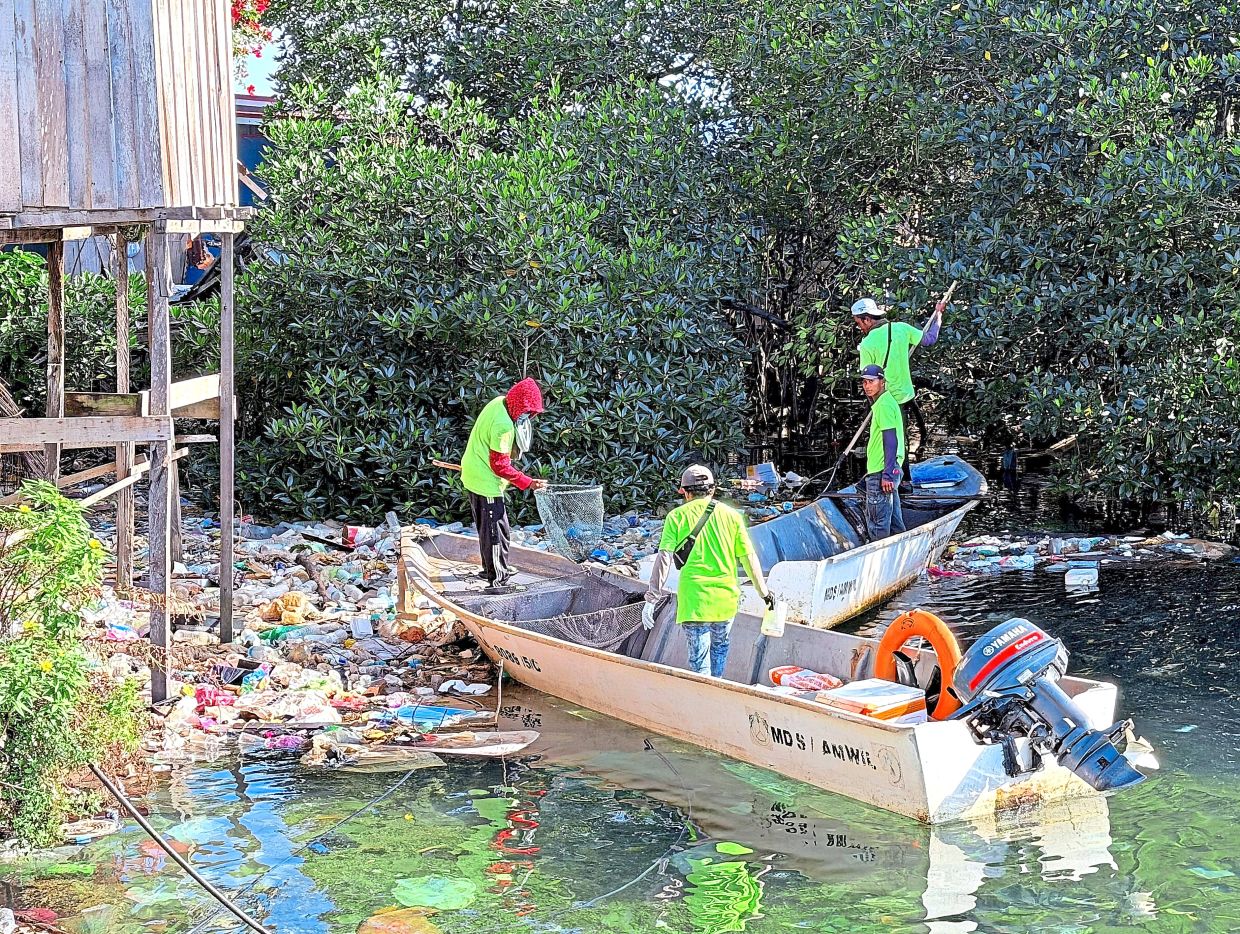
While social media postings frequently trigger political arguments over which administration bears responsibility for maintaining the district’s cleanliness, the floating rubbish along the town’s shoreline and around the numerous stilt houses dotting the coastline remains undeniable.
Politicising the issue has done little to resolve the chronic challenges faced by this east coast town, where over 50 islands see regular movements of islanders, sea gypsies (Bajau Laut) and traders crossing over daily from southern Philippines.
Experts and environmentalists say Semporna’s waste problem is not solely a failure of the local district authority, but stems from a complex mix of geography, sea currents, inadequate infrastructure, rapid population growth and governance gaps.
The most critical obstacle is a severe shortfall in waste management infrastructure.
Water villages on the mainland and communities across the surrounding islands have no access to regular rubbish collection or disposal facilities, hence generated wastes end up in the sea.
Dive instructor Aquila Chu, whose photographs of polluted waters went viral earlier this year, argued that the primary issue is not merely public awareness but a fundamental lack of proper disposal infrastructure.
Waste generated on outlying islands must be transported back to the mainland for processing, making collection and enforcement more difficult than in conventional urban centres.
Furthermore, impoverished coastal settlements are forced to prioritise basic daily survival over proper waste management practices.
Expanding tourism activities have added further volume to the waste stream, placing additional pressure on fragile local ecosystems.
Despite these significant hurdles, community-led initiatives and non-governmental organisations (NGOs) are proving that sustained solutions are achievable.
Under the Eco-Pledge Programme, marine conservation group Reef Check Malaysia and Persatuan Usahawan Pelancongan Bumiputera Semporna (Puspabumi) actively encourage tourism operators to collect operational waste and transport it back to designated mainland facilities.
Simultaneously, grassroots community-based waste management projects -- such as one implemented in Kampung Sri Aman on the mainland -- have introduced systematic waste segregation, collection points and regular monitoring.
Having successfully expanded from a trial of 50 households to encompass all 100 households in the village, the initiative has diverted thousands of kilogrammes of waste from entering the marine environment.
Regular cleanup campaigns involving local residents, NGOs, schools, tourism operators, and volunteer divers have also removed quantities of rubbish from beaches, coral reefs and villages.
In one notable joint initiative, participants retrieved over 22 tonnes of waste from Semporna’s islands and marine areas.
Other targeted environmental programmes have focused on establishing island-specific waste management plans, training community “Plastic Rangers”, supporting local recycling initiatives and deploying divers to clear submerged debris directly from the seafloor.
For former Semporna district officer Bianus Kontong, restoring the township’s cleanliness is entirely achievable through sustained and collective effort.
Bianus, who led the “Waste Free Sabah” campaign launched in Semporna in January 2019, observed that local authorities were able to clean up the district within a few months through a combination of firm enforcement, spot fines, waste-skimmer boats and public education.
However, that momentum stalled with the onset of the Covid-19 pandemic and subsequent changes in state administration.
As firm enforcement relaxed and campaign efforts lost traction, the district gradually slipped back into old habits.
Semporna’s environmental challenges should neither be dismissed nor sensationalised for political gain.
Going forward, Semporna District Council must move away from reactive crisis management and establish proactive, permanent operational measures.
Reliable waste collection, proper maintenance of public spaces, strict penalties for illegal dumping, upgraded facilities at jetties and markets, and direct collaboration with island communities must become standard daily operations.
The local council is duty-bound to match its world-class island appeal with a cleaner, better-managed township to silence its critics and cement its standing as one of Malaysia’s premier tourism destinations.
Already a subscriber? Log in
Get 20% OFF The Star Digital Access
Cancel anytime. Ad-free. Unlimited access with perks.