
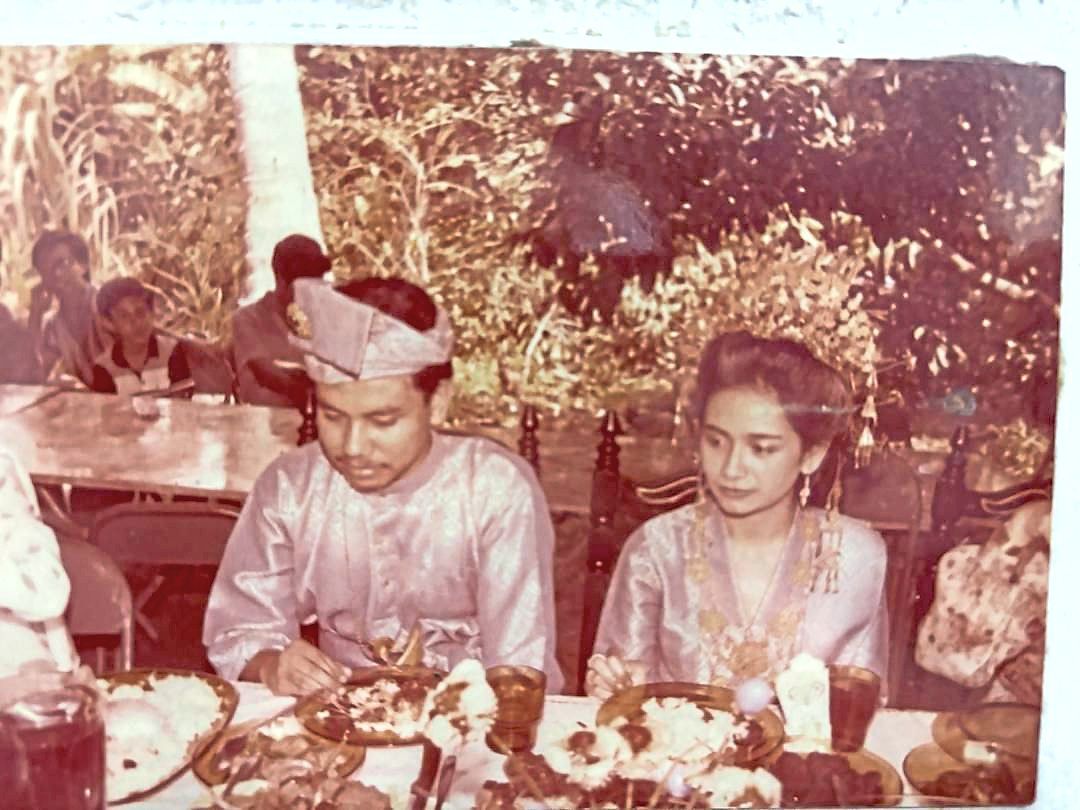
We usually just spend our anniversary having a private dinner and talking about the children and grandchildren and our lives.
It’s usually the one dinner when my wife isn’t subjected to my latest theories and concerns about the state of politics in the country or the state of education in our schools and universities. Though I also listen when she shares about which friend travelled where and who was in hospital.
But our anniversary meal is always reserved for thoughts and concerns about our children and grandchildren.
However, for this anniversary, I decided that, in addition to our special meal, I would surprise her with this column about what it takes to live together and to grow in a happy relationship, warts and all. She usually knows what topic I’m writing on but not this time – she’ll be reading this today with the rest of the country, shy one day of our nikah date 42 years and five children ago.
I met Norhayati for the first time at the Subang Airport just before Merdeka in August 1980.
She was part of the group that would travel to the University of Wisconsin, Green Bay, in the United States to begin tertiary education.
Neither of us – and I think this applied to most in the group – had ever travelled overseas before or on an airplane, and here we were, about to embark on a 36-hour journey halfway around the world. I should have been nervous but I was distracted by the thought that this Norhayati looked like famed actress Roseyatimah in Pendekar Bujang Lapok, a favourite film of mine.
I think perhaps the first spark of something between us could have been fate as Yati had registered for Calculus 1 as I had but one of its four class days clashed with her humanities class.
As the two other boys were too shy to function around girls, I was appointed to share the content of the missed class with Yati.
She would come to our dorm at 8pm, and for an hour we would sit together going through the notes and exercises.
As government scholarship students, the 11 of us were to study in the US for six years and return with both a Bachelors and a Masters. We were given a return ticket home every two years.
When I began having feelings for Yati just before our first visit home, I decided to ask her to be my fiancee.
When I returned home to Taiping, Perak, and she to Kajang, Selangor, I asked my father to do the necessary for the engagement and we returned to the US engaged.
Thanks to studying architecture, it was not difficult to grow closer as the studio work required sleepless nights, and we shared moans about aching backs from lugging huge drawings and models around campus – I guess our relationship prospered under the duress of discipline.
We decided to marry during the next visit home and returned as husband and wife to finish our first degree. We began our lives as a married couple in various tiny studio apartments, trying to make ends meet as we completed our studies.
We did not plan our first child so Fatimah came into the world in an American hospital with Yati’s mother, bless her soul, flying all the way from Kajang to Milwaukee to care for the granddaughter of her youngest child.
As new parents we had a lot to learn and were most grateful for her guidance.
After we returned home in 1986 and began our working lives, our family blossomed with four more children, two born in Scotland during my PhD studies, one in Johor, and another in Kajang.
Yati and I are exact opposites. She is as soft spoken as I am, well, loud (as most Orang Utara are).
She isn’t a fan of mental multitasking while I am always thinking of the next article to write and the next video to produce.
There were many arguments about expenditure and the children’s schooling, I remember. As opposites we came to, not a compromise, but an acceptance of each other’s concerns about how to raise our children.
I learned to accept her many thoughts on family issues which I had originally thought was not appropriate while she also accepted many of my political and philosophical concerns about the children’s growth.
I learned that some of the change in her that I wanted was never to be and I had to willingly accept her and change some of my ways for her.
We both changed to meet in the middle, and I think that is why we have lasted this long.
The movies are all about love being what binds us but I think more important words are patience and acceptance, to go with a willingness to change ourselves for our family.
As a nation, I think people need to learn this and not expect change to come at a flip of a switch or at a change of governing parties. We must recognise that true, lasting and effective change is built slowly as we work towards respect, dignity and progress in our lives.
To me, love between a man and a woman is the ability to change while looking inwards at one’s self to discover how to grow older, wiser, and blissfully fulfilled with what we have in front of us.
Prof Dr Mohd Tajuddin Mohd Rasdi is Professor of Architecture at the Tan Sri Omar Centre for Science, Technology and Innovation Policy Studies at UCSI University. The views expressed here are entirely the writer’s own.
Already a subscriber? Log in
Get 20% OFF The Star Digital Access
Cancel anytime. Ad-free. Unlimited access with perks.