FOR this nation of ours to progress, what do we need?
More money? Higher productivity? Better leaders?
No, we don’t need all of those things. What we do need, we can find within ourselves: Humility, respect for others, inclusiveness, learning, and integrity. That’s all.
I believe we need to sincerely embrace these values to build a nation with a strong heart and a deep soul.
Humility is the highest form of spirituality that I know; it means that we are at the peak of our knowledge, aspirations, and abilities, and yet, when we feel the urge to celebrate our prowess and “greatness”, we realise how small we are against the backdrop of the world, against the backdrop of any human experience, and against the backdrop of humanity in its entirety.
I see arrogance everywhere when Malaysians make anonymous comments online or write columns or letters dictating our leaders to do this and not to do that.
I wonder, where is our sense of humility? Clearly, there is something wrong with us if we do not appreciate what others can do or have done for us.
No man is an island. I believe in this, and it’s an idea that comes across in a lesson from the honourable academic and spiritualist, Dr Siddiq Fadzil, who proclaimed that the differences among us are the sum total experience that God gives to us.
There is no soul without humility. The soul recognises all frailty when the body suffers from old age and illness, and physical weaknesses that occur in all of us at every age and time, even when we feel so superior to others.
Respecting others is an important and critical cornerstone of spirituality and civilisational maturity. The acknowledgement that we can never survive without others is something we forget easily in this age of “independence” where technology, money and a service economy seemingly answer to our every need.
Respecting others is more than just smiling nicely; it is a deep feeling of gratitude and appreciation that others were and are there for you. Your wife, your friend, your boss, your colleague are all there for you in some form or the other during times of need.
We all need others, and in this, religion – as (mis)interpreted by prideful “experts” – and secular education both fail us.
Saying hurtful and derogatory words about those not of our faith and belief is the highest form of arrogance and stupidity there is.
I do not care if the person advocating this is a “religious scholar” or teacher; stupidity and arrogance are undeniable.
Presently, we in Malaysia fight over our ethnicity and our religion, but we deny ourselves the truth about the importance of others in completing our lives.
Inclusiveness means we become a part of another life.
Inclusiveness also means that the other changes into something else when included with us.
In marriage, one plus one equals a new entity. Humans were never meant to grow alone. Growth needs all the many parts of others: the spouse, the children, the friends, and the co-workers.
The other people we include in our lives provide for us the total sum of experience and understanding. If we do not inculcate this idea of inclusiveness because, say, we fear another religion, then we deny the fundamental reasons we were put on this earth, which is to change and grow.
We cannot grow without the help and inclusiveness of others, in us and in them. That’s how we are wired and that’s how we define our humanity.
The value of learning goes without saying. To be human means we must learn. To learn means we must accept the presence and importance of others. To grow and mature means we must learn from practice, tradition, and trial and error.
What then, after we learn? Then we unlearn that which we have learnt. So? So, then, we learn new things and relearn old things in new ways.
There is a sad idea that has taken root: that the religion one inherits is already perfect, and that knowing others or learning from others is no longer required.
There is another sad idea: that the packages of history, politics, and understanding of the world are all already complete and that there is nowhere else to go. Thus, we judge based on outdated experiences and knowledge.
There no longer seems to be a desire to learn. Death does not mean the end of life as we know it; death means the end of learning anything new. Our society is nearly dying and the spark of life required to rejuvenate it and ourselves is not some new pill, new exercise regime, or a new diet.
The true spark of life is to learn and relearn, and unlearn, and then learn some more.
Integrity. What is integrity? It means that who we are is based on our principles, to which we remain true, and that others can expect an outcome from us that is beneficial to all.
Integrity requires us to be at the mercy of others’ judgement. Although we do not need anyone’s judgement to better ourselves, we do need an understanding that what we stand for and what we represent are things that others can find worthwhile, and so our mutual business enriches us in more ways than just more money.
Integrity is the final product of a soul that is clear about what it means to be human and a mind that is clear about what it means to think critically and with good judgement.
To have integrity, all the inclusiveness, all the respect for others, and all the learning we have done and will be doing still, as well as all the humility we feel, must come together in a total summation of who we are and become a potential force for positive change in ourselves, in our community, in our nation, and in our world.
There you go: five values to form the soul of a true and progressive nation. Without these values, we may feel we are “perfect” in every way with our wealth, faith and tribal community, but in reality, what we are is just “katak di bawah tempurung” (a frog under a coconut shell). What world does the katak know and where is the katak going, pray tell?
Humility, respect for others, inclusiveness, and learning all the time result in a person, a citizen, and a human being that has integrity and is worth more than all the gold and diamonds this planet holds.
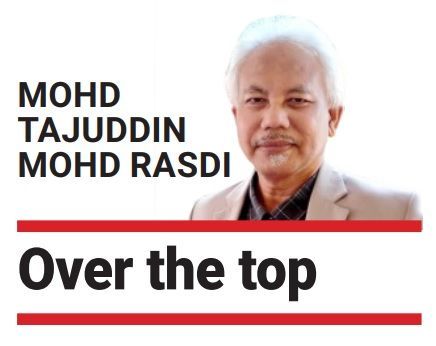
Prof Dr Mohd Tajuddin Mohd Rasdi is Professor of Architecture at the Tan Sri Omar Centre for Science, Technology and Innovation Policy Studies at UCSI University. The views expressed here are entirely the writer’s own.
Already a subscriber? Log in
Get 20% OFF The Star Digital Access
Cancel anytime. Ad-free. Unlimited access with perks.