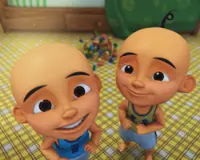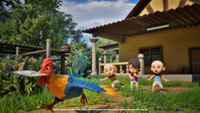
TODAY, I would like to pay tribute to the creators of Upin and Ipin and offer a small suggestion of how the cartoon series could assist in rebuilding this nation, a feat that educators, politicians and even civil society have attempted with little success so far.
Why Upin and Ipin? Well, the answer is pretty shocking and it addresses a cornerstone of education that has isolated 40 ethnic groups from each other.
The Upin & Ipin series has been acknowledged as a Malaysian success story in animation by many people. I would be the first to agree that it gets an A for engaging storytelling, an A for scriptwriting and another A for animation technology.
However, I would give it a dismal D for stories and characters that reflect “Malaysia” as a whole. Upin & Ipin carries on the single ethnic dominance construct that has torn this nation apart for 60 years and is set to do so for another 60. A “national children’s story”? Well, it fits every definition of that label except for the “national” part.
For as long as I remember watching this series, it has centred only on a Malay-Islamic construct. Even though the cartoon has lovable and relatable characters who are Malay, Chinese and Sikh as well as a smattering of Indonesian and Indian ones, the episodes are a single cultural construct.
The non-Malay characters barely have any life outside of their school and we know absolutely nothing about their parents, way of life or belief systems and rituals. There has been one episode that featured Chinese New Year and another on a traditional Chinese custom, and that’s it.
I don’t remember any other cultural episodes that explore in depth the way of life of the Sikh and Indian characters. And the Chinese character, Mei Mei, is a stereotype of a Chinese girl speaking Malay with a Chinese twang. Where are the other 35 ethnic groups in Malaysia and their stories?
When I asked 11 Chinese postgraduate students in my Masters of Architecture class whether they had ever watched Upin & Ipin during their childhood, all except one answered in the negative. The only one who had watched it, I found out, had attended a public school whereas the other 10 students were educated in Chinese vernacular schools. Wow.
The question that begs to be asked is why there was no interest in watching Upin & Ipin if only to understand Bahasa Melayu better and learn about the manners and customs of Malays and Islam? Why had parents or teachers not recommended their students watch Upin & Ipin?
The usual extremist NGOs would probably have a field day accusing the Chinese of “rejecting” the Malay language and Islamic mannerisms of the stories and characters.
But a more constructive question is why did the writers not create stories that focused on the different cultural contexts of their existing characters?
And why have the creators not devised a way for Upin and Ipin to travel to Sabah and Sarawak and have adventures with the children of longhouses or those of the seafaring coastal people? Why is it possible for Upin and Ipin to travel through time in a modern super-hero storyline or travel into a different dimension but not be able to cross the South China Sea?
Why am I so concerned about the Upin & Ipin series to the point of making it a national issue? Because I feel that the isolating separateness among our 40 ethnic groups began with this kind of oversight or “undersight”.
Why would we, as Malaysians, not feel slighted that the cultures of the Dayak, Murut, Bajau, Indians and others are not dealt with at all in a nationally acclaimed cartoon series about kampung life in Malaysia? Are kampungs specifically Malay? There are no kampungs in Sabah and Sarawak?
Perhaps the writers of Upin & Ipin need help to write stories that would do justice to each of the other 39 ethnic groups.
Thus, writers from all ethnic groups should work together to provide 39 times three episodes of each ethnic group. Or perhaps the creators could spin off other characters from all the ethnic groups who would speak Bahasa Malaysia while engaging in their own value and belief systems.
How about it, Malaysians? Up for the challenge?
This is where we rebuild the nation, starting with our children.
Politicians of Sabah, Sarawak and the Federal Government could fund the 200 or so episodes that would take our children deep into each other’s cultures so that we would be proud to call Upin & Ipin our cartoon heritage.
Donald Duck and Mickey Mouse may have been created to be culture-free and without racial and religious issue but I feel that we should teach our children to embrace, accept and honour each and every tradition in our country.
We are a nation rich in cultures and beliefs that colour our strength and fortitude as well as a vision of a Malaysia for all.
Prof Dr Mohd Tajuddin Mohd Rasdi is Professor of Architecture at UCSI University. The views expressed here are entirely the writer’s own.
Already a subscriber? Log in
Get 20% OFF The Star Digital Access
Cancel anytime. Ad-free. Unlimited access with perks.