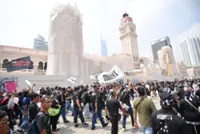
OVER the past weekend, Kuala Lumpur witnessed the return of something once synonymous with Malaysian resistance politics – a street protest.
The "Turun Anwar" rally, as it was called, gathered Malaysians unhappy with the current state of the country under Prime Minister Datuk Seri Anwar Ibrahim.
The grievances aired during the demonstration were serious and grounded in everyday realities: the soaring cost of living, stagnant wages and what protesters saw as a sluggish approach to reforms promised by the ruling government.
The rally drew mixed reactions. Some criticised the turnout, claiming it was small compared to the massive crowds drawn by the Bersih rallies that rocked the capital during the Barisan Nasional administration.
But in politics, size is not always the most important metric.
Sometimes, it is the irony of the situation that tells us more about the state of the nation than any headcount could.
What made this protest remarkable was not how many people attended but who was now standing on which side of the street.
A number of senior figures in the current Pakatan Harapan dispensation were once frequent participants in similar street protests.
Back then, they were the ones demanding change, calling out abuse of power, urging the people to take to the streets.
Today, many of those same voices were quick to condemn the protesters or dismiss the rally altogether.
Social media, especially Twitter and TikTok, was full of comments from Pakatan politicians and their supporters.
Many were visibly uncomfortable with the fact that a protest was being directed at their coalition.
Some attempted to undermine the protest by questioning the motives of those involved.
Others argued that street rallies were no longer a legitimate form of dissent now that Malaysia has a functioning democratic process.
The irony could not be more obvious. The same political actors who once stood in opposition and claimed the streets as a platform for the people to voice dissatisfaction now find themselves struggling to defend their new position of power from that very same platform.
It is one thing to believe in street protests as a tool of democracy when you are out of power. It is quite another when those protests are aimed at you.
To his credit, Anwar responded with a level of maturity and political composure that deserves recognition.
The government allowed the rally to proceed without major interference.
There were no mass arrests, no attempts to ban the assembly, no aggressive dispersal tactics.
Anwar himself acknowledged the right of citizens to protest, noting that it is part of democratic life.
However, the same level of grace was not evident in the reaction of some of his political allies and supporters.
On platforms like TikTok, videos circulated mocking the protesters.
Some ridiculed the participants' supposed lack of understanding about governance.
Others chose to speculate about internal power struggles and succession plans, turning the protest into a political soap opera rather than confronting the legitimacy of the public's frustration.
This disconnect is troubling.
I cannot help but recall my own experience during the Bersih protests. Back then, I was critical of the rallies.
I believed – and still do – that the removal of a prime minister should happen through a general election or a formal vote of no confidence in Parliament.
I stood by that position even when it was unpopular and it came at a personal cost. Friends unfriended me and relatives stopped speaking to me.
Some accused me of defending the indefensible. But I did not and do not regret speaking my truth.
Now as a lawyer, I am used to standing firm in court, sometimes in the face of hostility, because my job is to represent my client without fear or favour.
My political training did me a lot of good.
It is striking, therefore, to see Pakatan leaders now echoing the very arguments they once rejected.
Street rallies, they say, cannot bring down a government. Change must come through the ballot box.
It is a sobering reality that comes with the transition from opposition to power.
Suddenly, what was once a moral high ground becomes a strategic liability.
But beyond the irony lies a more important message. The rally, no matter how small or large, sent a signal.
There are Malaysians who feel left behind, disillusioned, even betrayed.
They expected more from a coalition that campaigned on the promise of reform, accountability and justice.
They are not just upset about macroeconomic indicators.
They are frustrated by the day-to-day challenges of making ends meet, the sense that reform has been delayed or diluted, and the perception that politicians are now more interested in defending their positions than fulfilling their promises.
Pakatan cannot afford to ignore this sentiment.
It would be a mistake to dismiss the protesters as fringe voices or political opportunists.
Some of them may even have voted for this government in the hope of real, measurable change.
Their grievances deserve to be heard and addressed, not mocked or marginalised.
Having served in government myself, I understand the complexities of reform.
Change does not happen overnight. Bureaucracy moves slowly.
Political buy-in is hard-won and compromise is often necessary.
The opposition, meanwhile, will do everything it can to exploit every delay and shortcoming.
That is the nature of politics. But what is sorely lacking from this government is clarity.
A roadmap. A detailed plan with clear timelines.
What reforms are being implemented now? What will happen in six months? One year? Three years?
Malaysians are tired of vague promises and broad statements.
They want concrete answers and tangible results.
On top of that, immediate relief measures are needed.
Not band-aid solutions, but real interventions that address the root causes of economic hardship.
How do we raise wages in a meaningful and sustainable way?
How do we reduce the cost of living without compromising fiscal responsibility?
How do we ensure that the average Malaysian sees and feels the benefits of reform?
This government was elected on a platform of doing better.
It cannot fall back on the same excuses that once infuriated its own base when used by previous administrations.
To do so would be to repeat the same cycle of disappointment that eventually led to the fall of Barisan Nasional.
There is another irony here, and it is one that should keep the current leadership awake at night.
The very issues that brought down Datuk Seri Najib Razak – economic discontent, corruption, broken promises – are the same issues that could eventually undermine Anwar's leadership if left unaddressed.
The slogans have changed. The personalities have changed.
But the expectations remain high.
It is still not too late.
Anwar remains one of the most experienced and seasoned political figures in the country.
His instincts have often served him well.
But he must not allow himself to be surrounded by sycophants who would rather spin than solve, who mock critics instead of listening to them.
The protesters who gathered under the banner of "Turun Anwar" are not the enemy.
They are part of the same Malaysia as all of us.
They may not speak with one voice, and they may not offer clear solutions, but their frustrations are real.
If ignored, those frustrations will grow.
If addressed with sincerity and seriousness, they can become a valuable feedback loop for a government that claims to serve the people.
In the end, democracy is not just about voting once every five years.
It is about participation, accountability – and yes, sometimes protest.
The question is not whether the government should tolerate criticism, but whether it is willing to act on it.
This is the political moment we find ourselves in.
A moment full of ironies, yes – but also a moment full of opportunity.
Whether Pakatan Harapan chooses to learn from it or dismiss it will determine not just its legacy, but the future of Malaysia.
Already a subscriber? Log in
Get 20% OFF The Star Digital Access
Cancel anytime. Ad-free. Unlimited access with perks.