Mind your language


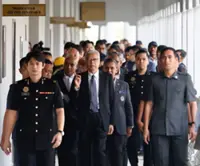
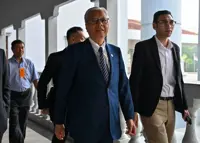
IN the past one year in office Datuk Seri Ismail Sabri Yaakob (pic) has travelled for working visits to several countries in his capacity as Prime Minister, focusing on Asean countries as well as important trading partners and major Organisation of Islamic Cooperation (OIC) member countries.

These are important trips as he needs to lead the way for the country to pick up momentum after the more than two “lost” years due to the Covid-19 pandemic that have impacted global economies.

As the Prime Minister, one would assume, hopefully, that he too has picked up some pointers along the way as he met world leaders in dealing on bilateral or multilateral issues.

Who can forget that one of the first things he championed was the use of Bahasa Malaysia as Asean’s second language, something that has, unfortunately, not picked up steam among our neighbours and that was publicly rejected by an Indonesian Cabinet minister?

But Ismail Sabri persevered. He continued to promote the national language domestically and at international platforms but whether he got his message across when translated into English or any other language remains a question mark.

Perhaps that is the only major shift in Ismail Sabri’s adminis-tration in dealing with anything foreign.

Seriously, what is the motivation in using the language?

“Is it political? To score points with the right-wing nationalist elements within Umno?

“Or is it personal insecurity? Who knows. But I don’t think it is helpful towards ensuring effective diplomacy,” said a government official.

Those who have met and dealt with the Prime Minister generally agree that he is a simple man. It would be unfair to compare him with other more sophisticated and experienced foreign leaders.

He was hardly exposed to foreign issues or policies in his years as a Cabinet member under previous administrations.

“He appears uncomfortable speaking in English. Most times meetings will be in Bahasa,” said another official.

Last week he gave a series of media interviews for his one year in office as the Prime Minister.

One of the sessions was with the foreign media where he spoke on, of course, international issues.

But what caught the interest of a few people was a Bernama report where Ismail Sabri touched on China and the South China Sea.

He spoke about Asean calling for expedited negotiations of the Code of Conduct (CoC) in the South China Sea and that China should comply with the UN Convention on the Law of the Sea (UNCLOS 1982) to improve the situation in the disputed area.

“UNCLOS 1982 is an international law that should be complied with by Malaysia, Vietnam and the Philippines among the countries that are directly affected by China’s policies, especially in relation to the position of these countries on the “nine-dash line” (the line unilaterally declared by China covers most parts of the South China Sea, and overlaps with the claims of Brunei, Indonesia, Malaysia, the Philippines, Taiwan and Vietnam).

“If China can comply with the CoC, many issues can be resolved. Freedom of navigation needs to be respected by all parties,” Ismail Sabri has said.

In a July meeting in Putrajaya with China’s Foreign Minister Wang Yi, Ismail Sabri was informed that China would speed up consultation on the CoC.

If the PM has been quoted correctly, and since there is no denial from the Prime Minister’s Office so far, obviously he is questioning China’s compliance with UNCLOS. It’s surprising for him to do this because all this time Malaysia has emphasised the need for all countries to uphold the rule of law. Brunei, Malaysia, the Philippines, Vietnam, Taiwan and China are all claimants in the territorial dispute.

In the world of diplomacy, the choice of the right word is extremely important. Words are carefully used and uttered, and joint statements are crafted to get the message across. You do not want to confuse officials on the ground about what our policy is on certain things.

Even when he is being asked by the media, especially on foreign issues, the PM must be savvy enough to navigate difficult questions. Less is actually more when it comes to sensitive issues. Often times the media would be asked to submit questions in advance but in between the interview, there would be surprise questions.

This really begs the question: who are the PM’s foreign affairs advisors. Surely they would brief him regularly to help him better understand global issues. But in the last few months the PM has committed several faux pas when he spoke on such issues and this column has addressed the matter.

One of the most important elements of foreign policy or international relations is to understand the nuances of diplomatic relations. The Prime Minister is the head of government and he should not be seen as being undiplomatic in addressing foreign issues – and if he does not follow Malaysia’s principled position on certain issues and goes off tangent, there can be repercussions.

Get 20% OFF The Star Digital Access

Monthly Plan

RM 13.90/month

RM 11.12/month

Billed as RM 11.12 for the 1st month, RM 13.90 thereafter.

Best Value

Annual Plan

RM 12.33/month

RM 9.87/month

Billed as RM 118.40 for the 1st year, RM 148 thereafter.

Follow us on our official WhatsApp channel for breaking news alerts and key updates!

Next In Columnists

The incredible star power rising from the East
Make Penang AI plan a bridge for majority
Giants fall, England survive – World Cup quarter-finals take shape
Who shapes global AI rules: Asean-China cooperation role
Why the Johor election is good for Malaysian democracy
Confessions of a durian season sinner
Looming threat to social security
More predictable than the World Cup
America at 250
Coexistence with wildlife key for public safety

Others Also Read