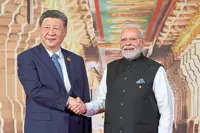
SINCE no timely summit of major world leaders has ever been held with less than solemn intent, the Trump-Xi summit at a crucial time for them in mid-May could not have been merely symbolic.
Yet the reality remains vastly different. Serious violence still rages in Gaza, Ukraine and Iran, tensions mount in multiple locations, global shipping and energy supplies are disrupted, and international trade is in upheaval.
New problems emerge even before older ones are resolved. No prospective solution is in sight.
Trade wars are as intractable as hot and cold wars, tariffs and counter-tariffs are increasingly taxing, global business is constrained by uncertainty, and the subject of international security has been replaced by the reality of insecurity.
Presidents Donald Trump and Xi Jinping have needed serious talks even before the 2024 US presidential election when Trump expressed keenness for it. His need for the summit in particular has only grown ever since.
The world’s two most powerful individuals, heading the world’s two biggest economies at a time of great economic turbulence, require much more than kabuki-style theatre in mending bilateral relations.
They have no need for a “kumbaya moment” of performative goodwill of little consequence. A summit with only futile photo opportunities only distracts, detracting from the tough business at hand.
If Trump only wanted to calm the markets, he only had to suspend being himself for a few days. Any serious decision he is able to take would not last any longer than that anyway.
That would not have required all the pomp and pageantry of a full-scale official state visit. But both the US and China embarked on it with all the frills, so they must have wanted to do the kind of serious diplomatic business which they needed to do.
Yet there have been few reports of the content of the discussions. Compared with the colour and scale of formality in Trump’s visit, the known substance of the talks seems meagre, if not miserable.
The easy conclusion that they had nothing urgent to discuss, or had no wish to discuss anything seriously, is at odds with reality. Such a simple answer conflicts with the complexity of their relationship and the urgency of the situation.
Both Trump and Xi entered the meeting room with multiple challenges weighing on their minds and shoulders. They could not have emerged from the meetings with the issues having evaporated without being addressed vigorously.
If they had reached substantial agreement, they may need time to prepare how best to present it publicly without causing undue consternation to loyalists. What appears like a precipitate compromise may look too much like having surrendered to the other side.
The more substantial the agreement, the more a compromise would need to avoid appearing like capitulation. For Trump, more challenging than dealing with China may be presenting a compromise solution that can win domestic approval on the eve of mid-term elections.
Trump may ignore punters who generally regard him as being excessively transactional. But even he would care about the prospect of losing yet more support within his Make America Great Again (MAGA) base, if they think he had succumbed to China in a lopsided deal.
Another possibility is that both Trump and Xi had agreed to agree, while evaluating each other’s position in approaching a deal later in the year. Trump’s recent praise of Xi then serves as the appropriate preparatory tribute in setting the scene.
They are set to meet again three more times this year: Xi’s reciprocal state visit to Washington in September, Trump’s visit to Shenzhen for the Apec summit in November, and Xi’s visit to Miami for the December G20 summit. That provides enough time to unpack their policy agreements to their respective publics in stages, with less risk of any loss of face from perceptions of having hastily submitted to the other side.
Diplomatic niceties are not unimportant with big egos and a culture of saving face. Subtle symbolism is often deployed for intended effect in both East and West, as King Charles’ gift of a bell from the scrapped submarine HMS Trump to its namesake President may have shown.
Chinese observers were amused since gifts of bells and clocks amount to administering the last rites. While symbolism in the Anglosphere differs, there are other negative connotations in the gift of a bell.
“For whom the bell tolls” and “belling the cat” imply a forewarning or foreboding of risks in a precarious or untenable position. The current relations between Washington and London over Trump’s foreign policy missteps more than ever imply such a situation.
Beyond the symbolism, actual events on the ground between Washington and Beijing are very much to watch.
Bunn Nagara is director and senior fellow of the Renaissance Strategic Research Institute, and honorary fellow at the Perak Academy. The views expressed here are solely the writer’s own.
Already a subscriber? Log in
Get 20% OFF The Star Digital Access
Cancel anytime. Ad-free. Unlimited access with perks.