


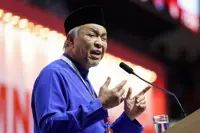
It looks like Umno is the kingmaker du jour.
Today I thought I’d take a look at the journey Umno took to reach this point, and how that might shed some light on its potential next steps.
Back when it first started, Umno had quite a respectable reputation. It was known as a party of teachers, civil servants, and the like.
Umno’s major upheaval probably began around the time Tun Dr Mahathir Mohamad became the party president in 1981.
I think it was Tian Chua - ever a fountain of interesting observations at the time - who shared the following view with me when I was starting out in politics.
He said Dr Mahathir’s grand ambition was to transform Umno into a party of entrepreneurs and captains of industry.
He imagined a breed of Malay leaders and corporate titans that would take Malaysia to the industrial heights of Japan.
Unfortunately, he did not appear to have achieved his goal.
During this period where Dr Mahathir and Umno reigned supreme in Malaysian politics with practically no meaningful rival, being in Umno was synonymous with being in government.
The general model was the higher one’s political position, the greater influence one had over the awarding of government contracts and other forms of patronage and this influence could translate into millions or more.
While Dr Mahathir wanted to see the rise of a business-savvy class, the contours of the political game created the rse of a politically savvy class instead - people who were adept at turning political success into financial profit for some.
Some of Dr Mahathir’s grand economic gambits worked better than others, but in general, the business titans he envisioned did not emerge at the forefront of Umno in the way that he hoped.
As years went by, Dr Mahathir centralised more and more power into the office of the Prime Minister, weakening each and every institutional check and balance in turn.
This is perhaps Dr Mahathir’s most enduring and significant legacy in Malaysia - a legacy we are still struggling with over thirty years later.
Dr Mahathir fervently believed that the more he was able to exercise unchallenged power, the better it would be for the country. While he and Singapore’s Lee Kuan Yew were rivals, the two men shared nearly identical approaches to politics in this regard.
This type of attitude gave Dr Mahathir chronic problems when it came to deputies. One by one they fell - Tun Musa Hitam, Tun Ghafar Baba, Datuk Seri Anwar Ibrahim.
Only one deputy crossed the finish line - Tun Abdullah Ahmad Badawi.
Abdullah had supported Tengku Razaleigh Hamzah against Mahathir in the 1987 elections, but by 2003 his softer image was seen as what was needed after decades of Dr Mahathir’s heavy hand.
Abdullah’s reign was generally unexciting, even though it saw Umno going from one of its best electoral showings to one of its worst in the short space of one term.
His poor showing in 2008 paved the way for Dr Mahathir and others to push him out and replace him with Datuk Seri Najib Razak.
Najib was a much more savvy politician, and a master of playing the feudal patronage game.
This game reached its zenith in the 1Malaysia Development Berhad (1MDB) scandal, which arguably came to be a defining feature of his stint as Prime Minister.
Najib probably believed that three-corner fights with PAS and Pakatan Harapan would work to Umno’s advantage, but they resulted in Umno’s first ever electoral defeat in 2018.
Since then, Umno has undergone an identity crisis. There is no longer consensus about what the party really is or where it is headed.
In the 2018 party elections, Khairy Jamaluddin pressed for radical change and redefinition, while Tengku Razaleigh represented elements of a pre-Dr Mahathir Umno. Both lost, and Najib loyalist Datuk Seri Dr Ahmad Zahid Hamidi became president.
In the 2020 Sheraton Move, Umno supported Tan Sri Muhyiddin Yassin as Prime Minister. Indeed, arguably the only reason Dr Mahathir did not remain Prime Minister of a totally different coalition was because he refused to accept Umno’s support en bloc as a party.
In a few short years, Umno had gone to being the Opposition for the first time to being a backbencher party for the first time.
Neither were particular comfortable fits for Umno.
I doubt seasoned observers were surprised when Umno eventually came to be dissatisfied with playing second fiddle to Bersatu.
While the Sheraton Move featured great talk of ‘Malay unity’, it became clear (predictably) that it was extremely difficult for Umno, Bersatu, and Pas to remain in one coalition while having the same electoral base.
Umno is not foolish enough to believe it can go it alone any more. But there are no clear answers to the question of who they should court to be their next partners.
They probably feel their traditional allies do not bring enough to the table. But everyone else has made something of a career fighting Umno for years, or decades.
The grassroots of many traditionally opposition parties tend to have a very strong allergy towards anything and everything Umno.
Allahyarham Tok Guru Datuk Nik Abdul Aziz Nik Mat was famous for his unyielding stance on this issue. As long as he was alive, there was absolutely zero possibility of PAS working Umno ever again - once bitten, twice shy.
When people criticised Anwar’s overtures to Umno for these reasons, his diehard supporters got very defensive.
Pasir Gudang MP Hassan Abdul Karim even took the trouble to write a barbed attack against such critics. In my line of work, that type of communication is a sure sign of the anxiety and stress of fighting a losing battle.
Basically, there are a sizeable number of Malaysians for whom the Umno brand is irrevocably and irredeemably toxic.
This is going to present a considerable challenge in Umno’s exploration of new partners and the party is of course internally split on these matters.
Ahmad Zahid and the still-influential Najib clearly want a split from Bersatu, and are probably the ones most interested in looking towards PKR.
The likes of Tan Sri Annuar Musa and perhaps Datuk Seri Hishammuddin Hussein are probably more inclined towards staying with Bersatu.
Perhaps there are more leaders with even more theories about where to go.
Any leader wanting to survive internally in Umno however, is likely to have to position themselves as aiming to re-seize power come GE15 while any Umno leader trying to sell the idea that they will go into GE15 supporting an external candidate for Prime Minister is likely to get eaten alive by the party faithful.
Those courting Umno should be cognisant of this fact, and not be overconfident about their own ability to ride the Umno dragon. Failure to do so will put them - at best - in the same position Bersatu is in now.
NATHANIEL TAN is a strategic communications consultant who also works with Projek Wawasan Rakyat (POWR). Twitter: @NatAsasi, Clubhouse: @Nathaniel_Tan, Email: nat@engage.my.
Already a subscriber? Log in
Get 20% OFF The Star Digital Access
Cancel anytime. Ad-free. Unlimited access with perks.
