
WITH no ceasefire in sight for the US-Iran war and the Strait of Hormuz remaining heavily blockaded, consumers – facing both persistent uncertainties and tangible price hikes – have begun to tighten their belts. This wave has hit every sector, with business owners across all industries lamenting that the market has gone dead quiet.
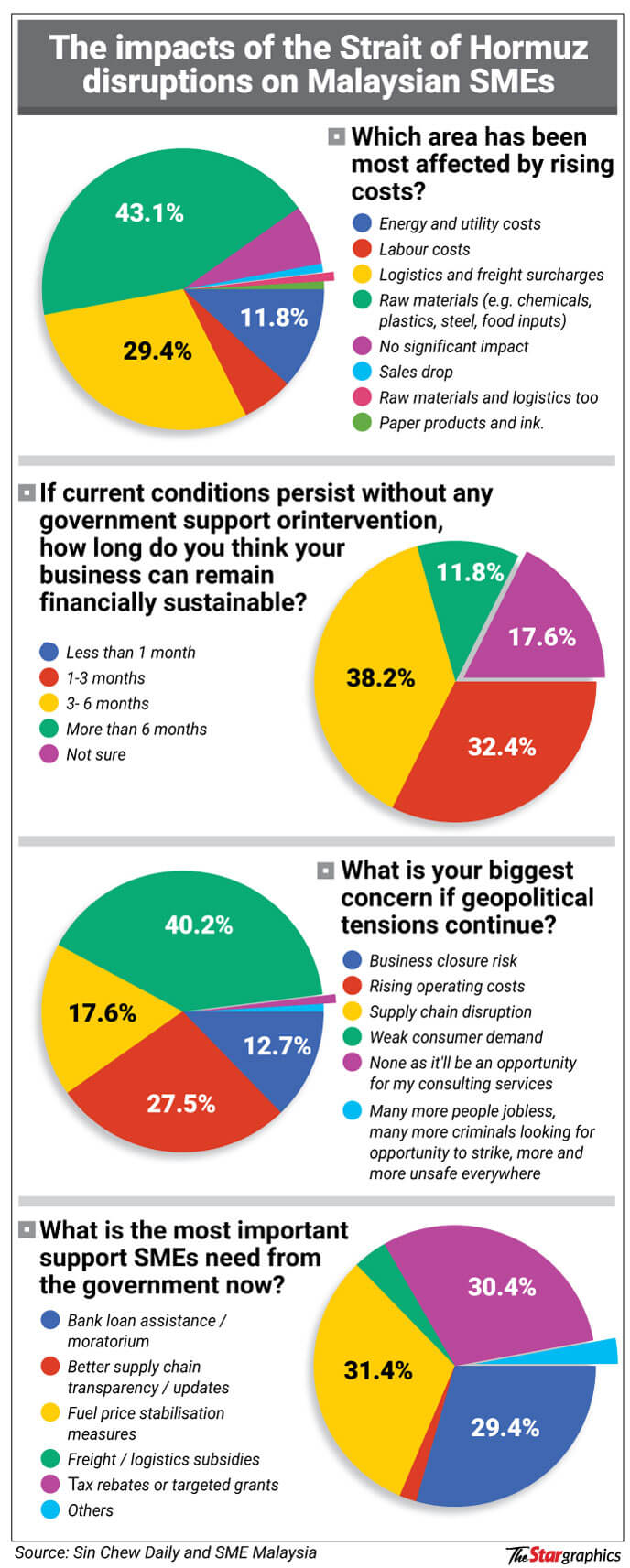
Among the respondents, 70.6% believe their business finances can sustain them for a maximum of six months. Furthermore, a pessimistic 32.4% expressed that if conditions do not improve or if no assistance is provided, they will not survive past the next one to three months.
The survey was conducted from May 12 to May 20, with 102 SMEs participating.
The survey indicates that if geopolitical tensions persist, the biggest concern for SMEs is weak consumer demand (40.2%), followed by rising operating costs (27.5%) and supply chain disruption (17.6%).
Amidst weak market demand, most businesses dare not hastily raise prices despite escalating operating costs. Currently, 40.2% of respondents are absorbing the costs themselves, 32.4% have already increased prices, and 26.5% plan to raise prices within the next one to two months.
Among the 41 businesses absorbing the costs, the majority are already experiencing significant upward pressure on operating costs. Specifically,
two businesses reported an overall increase in operating costs of over 50%; eight reported a 31% to 50% increase; 19 saw a 10% to 30% increase;
only five experienced an increase of less than 10%, while another seven were uncertain or remained unaffected for now.
Cooling demand
SME Malaysia national president Dr Chin Chee Seong points out that consumer demand began to cool down right after the Chinese New Year. Businesses worry that once consumers reduce their spending, it will directly hit revenues, subsequently affecting cash flow.
“Even though the costs of raw materials and transport fees continue to rise, operators still dare not rashly pass these costs on to consumers. Because market demand is already weak, businesses risk losing customers if they adjust prices upward,” he says.

He adds that the results of this latest survey are largely consistent with the findings of another survey conducted by the association in April.
In April, SME Malaysia conducted a survey regarding the impact of rising petrol prices on SMEs, which garnered participation from 335 respondents.
At that time, respondents expressed concerns over reduced consumer spending, shrinking profit margins, and market competition making it difficult for businesses to freely adjust prices, while inflation weakened the nation’s overall purchasing power.
Many respondents noted that SMEs are nearing their tipping point, and continuing to absorb costs is no longer sustainable.
The latest survey by Sin Chew Daily and the association shows that in the face of cost pressures, SMEs have begun making various operational adjustments. About 26.5% of respondents have decided to defer business expansion or recruitment, 18.6% have reduced orders, and 9.8% have switched to cheaper raw materials or substitutes.
Cautious environment
The current business environment is leaning towards caution, says Chin.
Businesses are scaling back expenses to prioritise safeguarding cash flow, while adopting a wait-and-see approach toward international developments.
They are observing if the consumer market improves, as well as the situation in the Middle East, and the outcomes of the US-China and China-Russia leadership summits.
He notes that the primary concern for SMEs remains cash flow. Although the government is providing loan assistance, many SMEs maintain a cautious stance toward taking out loans.
“The loans are not easy to apply for. Furthermore, businesses are worried that since business is already poor, taking on additional loans will become a double burden, leaving them to face repayment pressures later on,” Chin points out.
He notes that moving into the second quarter, most SMEs can still hold the line for now.
However, if the situation in the Middle East persists or worsens, businesses will inevitably face cash flow issues down the road.
According to the survey, most respondents have already begun to feel a tight cash flow. Among them, 50 companies stated that their cash flow is under pressure and they may require financing or assistance; 45 stated they can still manage but things are gradually tightening, while nine admitted that their cash flow is already at serious risk.
On the cash flow status, respondents were allowed to select multiple options. Some enterprises selected both “manageable but gradually tightening” and “under pressure,” or both “under pressure” and “serious risk” at the same time. Therefore, the total number of companies across all options exceeds 102.
The survey also indicates that if the current situation persists without government assistance or intervention, the financial resilience of most SMEs will be highly limited.
A total of 70.6% of respondents believe their finances can only sustain them for less than six months, with 38.2% believing they can last three to six months, and 32.4% stating they can only hold out for one to three months.
Among the categories affected by costs, 44 companies stated that raw material costs suffered the most obvious impact, followed by logistics and freight surcharges (30 companies).
Out of the 24 respondent companies that heavily rely on Middle Eastern shipping routes and the Strait of Hormuz for import supplies, 10 companies saw their overall operating costs surge by 31% to 50%; 9 saw increases of 10% to 30%; 4 companies experienced surges exceeding 50%, while only one company reported an increase below 10%.
In terms of specific cost pressures, 19 companies felt that raw material costs dealt the biggest blow, followed by logistics and transport surcharges, as well as energy and utility costs (with two companies each citing these as the most obvious impacts), while the remaining one company felt that labour cost pressure was the most prominent.
The assistance most needed by SMEs is for the government to stabilise fuel prices, which is a critical area where a single move affects the entire chain.
About 31.4% of surveyed businesses believe that fuel price stabilisation measures are the most urgent need.
As Chin puts it, fuel prices affect transport, logistics, raw material prices, and overall supply chain costs.
Any fluctuation in fuel prices will trigger a chain reaction.
He explains that fuel prices directly affect transport fees, and an increase in transport costs alone is enough to impact the entire supply chain, driving up the costs of various goods and operations.
Chin urges the government to reduce political distractions and assist the citizens and SMEs facing cost-of-living and business pressures, thereby stabilising the national economy and business environment.
He hopes that when providing assistance, banks would be more flexible in approving applications from genuinely affected businesses to help them tide over their cash flow difficulties.
Chin also calls on consumers to increase domestic consumption within their means and prioritise supporting local products to collectively stimulate the economic cycle.