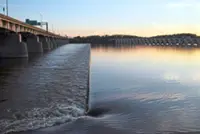
EVEN though the two dams spanning the river in Bedford, Pennsylvania, were old, troublesome and functionally useless, locals just couldn’t quit them.
The dams were built for swimming and fishing, but so much silt had built up that the river was very shallow. They trapped debris, worsened flooding and thwarted migratory fish.
They were also falling apart, drawing warnings from the Environmental Protection Agency that they would have to be replaced, repaired or removed, at local taxpayer expense.
Yet, the people of Bedford had grown attached to the dams, which dated back 50 years. Some also believed, wrongly, that the barriers housed important utility wires or cables.
“Somebody always came forward and gave a reason those dams could not possibly be removed,” said Kenny Fetterman, who sits on the Bedford Borough Council.
He was determined to find a fix, and spearheaded an effort that led to the dams’ removal last summer.
“Now the river is so much cleaner,” said Fetterman, who, as far as he knows, is not related to Democratic Senator John Fetterman of Pennsylvania. “The quality of water has improved drastically. There’s freshwater clams in there.”
It was part of what might be called the undamming of America.
Last year, more sections of the country’s rivers were reconnected thanks to dam removals than at any other time in history, according to the non-profit group American Rivers.
In 2025, more than 100 dams were dismantled in 30 states, reconnecting around 7,900km of waterways, including 250km of a branch of the Juniata River that are now reconnected thanks to the removal of Bedford’s two dams.
The resulting free-flowing waterways are healthier, cooler and less prone to algal blooms and serve as vital habitat for migratory fish and other aquatic life.
They’re also safer. The average age of America’s dams is 60 years.
While dams needed for flood regulation, water storage or irrigation must stay in place, many no longer serve their original purpose and are at risk of collapse.
“Our dams aren’t getting younger,” said Serena McClain, who oversees the dam removal programme for American Rivers. “With more extreme weather, more of these structures are failing over time. If we don’t remove them, Mother Nature is going to do it for us.”
It is unclear exactly how many dams are scattered across America.
The National Inventory of Dams, compiled by the US Army Corps of Engineers, lists about 92,000 dams, nearly 17,000 of which are deemed high hazard risks should they fail.
But, according to the National Aquatic Barrier Inventory, there are hundreds of thousands of smaller and unregulated structures that block waterways.
The majority were built to create swimming and fishing holes or reservoirs for water supplies, or to generate power and irrigate farm fields.
Most are privately owned and increasingly obsolete, making them a liability both for people and the environment.
Low-head dams, which are designed to have water flow over them, create a recirculating current downstream that can trap people and debris. They’re known as “drowning machines” and have caused nearly 800 reported fatalities.
There is broad bipartisan support for dam safety and repair, according to Del Shannon, a geotechnical engineer and dam expert.
“We’re one of the few areas where those guys can agree on,” said Shannon, who helped write the American Society of Civil Engineers Infrastructure Report Card, which gave American dams a D+ grade.
But federal money allocated to rehabilitate and remove dams is far less than what’s needed, Shannon said.
Hydropower dams have been a source of inexpensive energy, but the cost of repairs and relicensing can outstrip the benefits, said Desiree Tullos, a professor in biological and ecological engineering at Oregon State University. And fewer than 3% of the country’s dams generate power.
In 2023 and 2024, four major hydroelectric dams on the Klamath River in Oregon and California were dismantled, the biggest dam removal project in history.
It was touted as an environmental win, but the main reason PacifiCorp, the owner, opted to take down the dams was because it was cheaper than leaving them in place.
The Trump administration has since cut funds for the river’s restoration.
Tullos said there are some scenarios where it doesn’t make sense to remove dams, such as when stored sediment is contaminated and remediation proves too expensive.
But, she added, “the economic and environmental costs of maintaining obsolete dams never seems to justify any potential benefits.”
She noted that big dams are outnumbered by smaller ones that often do more harm than good.
“The vast majority are these dinky little dams,” Tullos said. “There’s just so many of these deadbeat dams on the landscape.” — ©2026 The New York Times Company
This article originally appeared in The New York Times