Beijing is likely to view the growing defence cooperation between India, South Korea and Australia as a strategic effort to contain China in the Indo-Pacific, according to analysts.
They said closer defence ties between the three reflected concerns over a possible security vacuum in case the United States reduced its military presence in the region.
The Indian naval vessel Sahyadri docked at Busan naval port in South Korea on October 13, according to a statement from India’s Ministry of Defence.
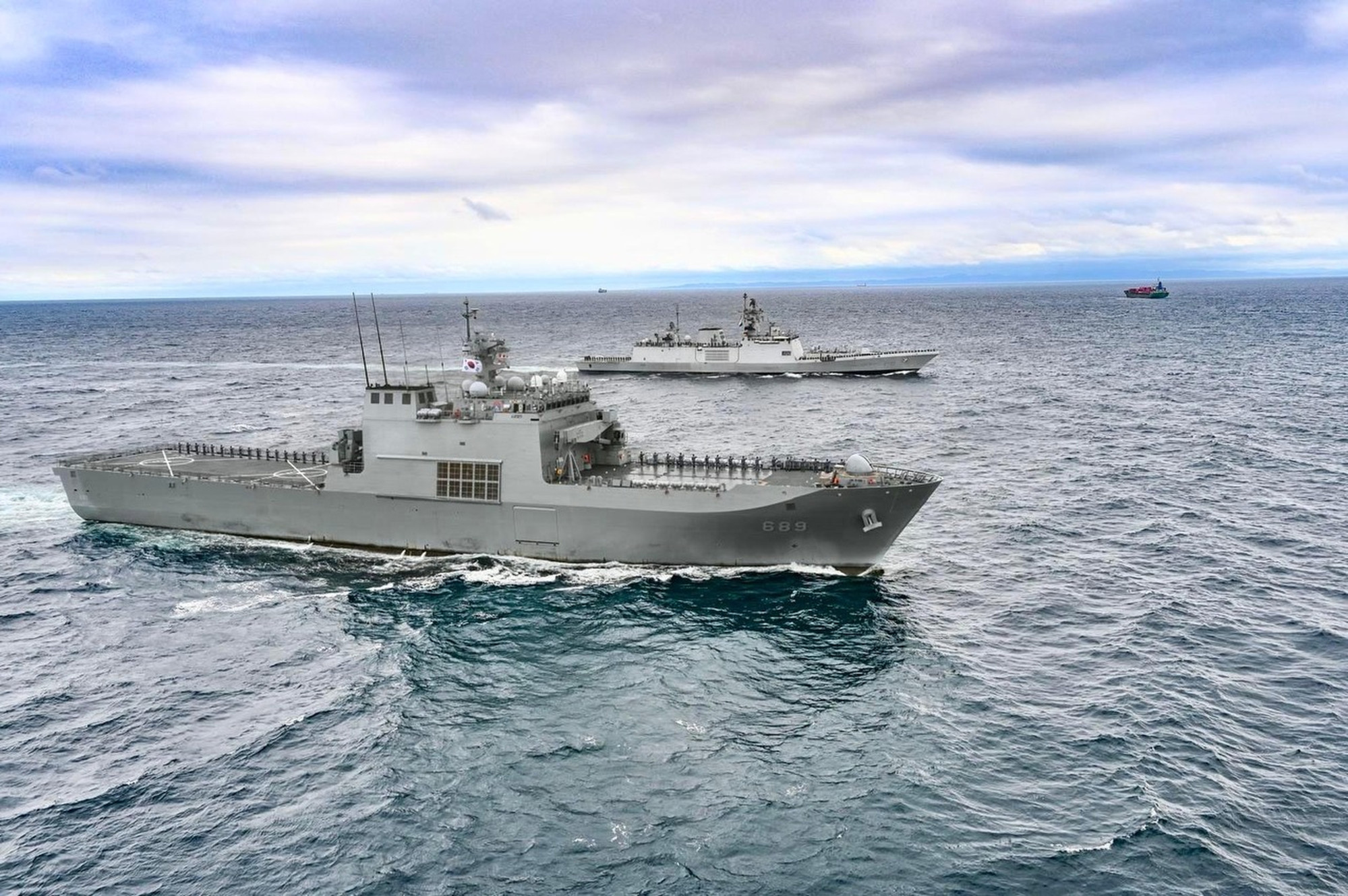
The vessel was there to take part in the first joint bilateral exercise between the Indian and South Korean navies, the ministry said on October 14, describing it as “the culmination of years of discussions and planning”.
The exercise was part of India’s “ongoing operational deployment to the South China Sea and the Indo-Pacific”, the statement said.
Sahyadri is a Shivalik-class guided missile stealth frigate designed by India and commissioned in 2012.
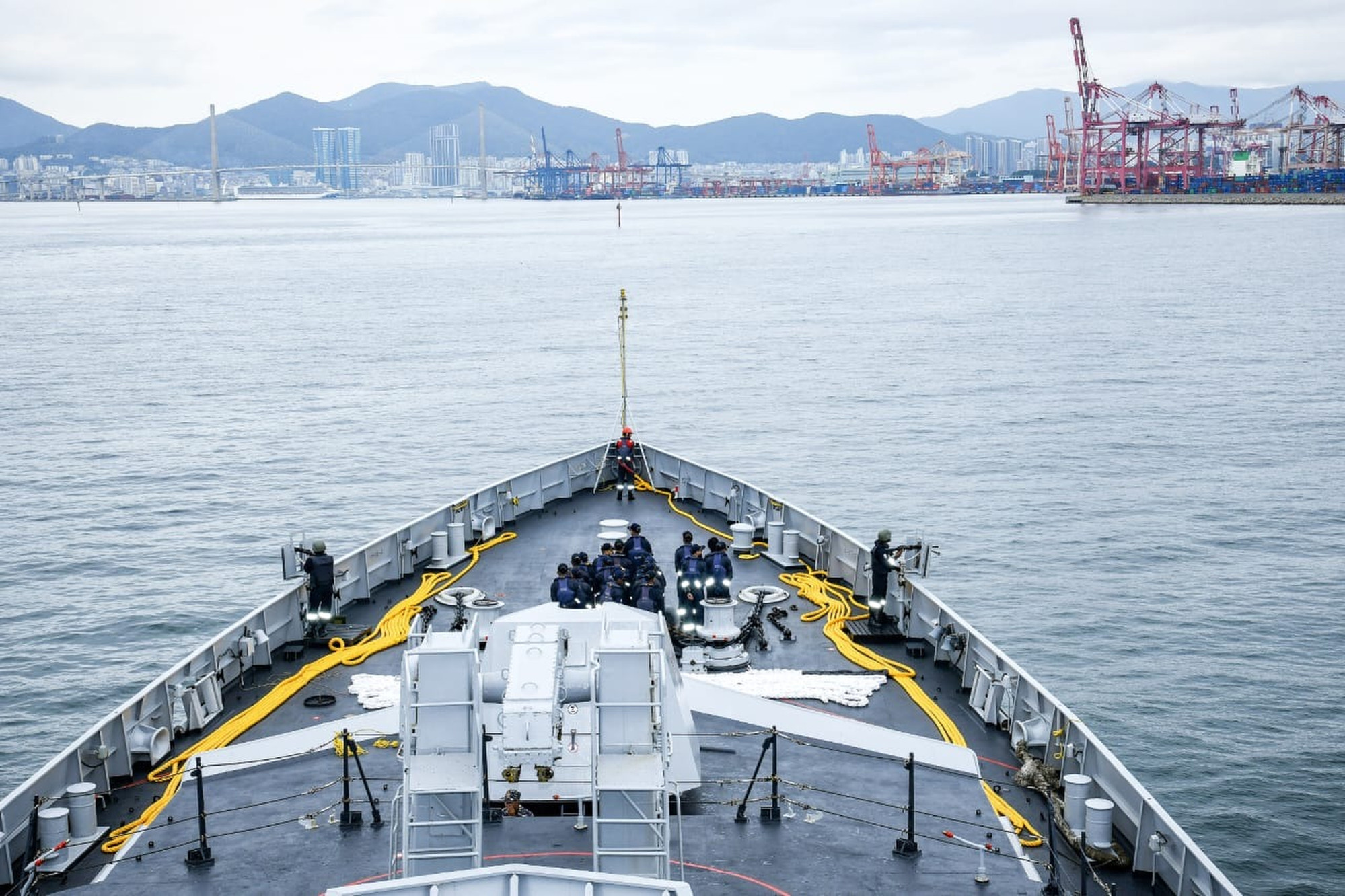
According to the ministry, the two sides carried out harbour manoeuvres and sea exercises, and the captain of the Indian frigate visited senior South Korean naval officers and local dignitaries.
On October 9, Indian Defence Minister Rajnath Singh visited Canberra for the inaugural Australia–India Defence Ministers’ Dialogue with his counterpart, Richard Marles.
Both sides affirmed the importance of boosting cooperation with regional partners to help maintain a free, open, peaceful, stable and prosperous Indo-Pacific, according to a statement released by Canberra.
Analysts have suggested that India’s growing defence cooperation with South Korea and Australia is aimed at China.
Liselotte Odgaard, a senior fellow at the Hudson Institute in Washington, said that Singh’s visit to Australia signified closer defence ties between the two countries, both of which are members of the Quad four-way military pact alongside the US and Japan.
She said the developments in their defence ties would be seen in Beijing as “strengthening containment of China in the Indo-Pacific”, which would increase tensions in the Indian Ocean.
Those areas could become “more contested” as India and Australia boosted joint capabilities to monitor and counter Chinese naval operations, she added.
“The submarine rescue and logistics support agreements strengthen India’s ability to sustain operations in the Indian Ocean, challenging China’s ability to project naval power and maintain influence across both the Pacific Ocean and the Indian Ocean as part of its efforts to become a global maritime power,” Odgaard said.
Drills between India and South Korea, which involved the deployment of an Indian stealth frigate in the Indo-Pacific, signalled India’s active presence in contested waters, she added.
“The drill strengthens India’s position as a ‘preferred security partner’ and adds to India’s growing network of naval partnerships in East Asia, which also encompasses Japan and Vietnam [and] which also try to balance China’s maritime assertiveness.”
“India is engaging defence-wise minilateral groupings to counterbalance China while avoiding direct confrontation, expanding its defence footprint through joint exercises, logistics agreements and technology partnerships, and it is signalling to China that it is actively engaged in shaping the Indo-Pacific’s security architecture,” Odgaard added.
China would interpret India’s moves as part of a “broader encirclement strategy” led by the US and supported by regional countries, she said.
According to Odgaard, Beijing might respond by increasing its naval deployments in the Indian Ocean and the South China Sea, while exercising pressure on South Korea and Australia to moderate their defence ties with India.
A Chinese government-backed foreign policy think tank, meanwhile, has warned about potential risks to regional peace from closer cooperation between India and Australia.
In an article published on October 16, the China Institutes of Contemporary International Relations said that increased defence collaboration between the two countries had become “a new variable that cannot be ignored amid shifting geopolitical dynamics”.
The article warned that such collaboration could “threaten regional peace” and urged both countries to “exercise careful balancing to prevent exacerbating regional divisions and confrontation”.
The article characterised the defence ties between India and Australia as “mutual support”, as both find US relations strained under President Donald Trump’s “America first” strategy.
However, two Chinese analysts argued that India’s actions were not entirely directed against China.
Lin Minwang, vice-dean at the Institute of International Studies at Fudan University in Shanghai, said that defence cooperation among Asia-Pacific nations reflected concerns over the possible absence of a counterweight to China should the US withdraw from the region under Trump.
He added that India’s collaboration with South Korea and Australia “appears to be cooperation in a broad sense”, and that “the influence of India’s defence cooperation should not be overestimated”.
The target of such exercises must be judged by their content, Lin said. He cited India’s joint anti-submarine exercises with the US and Japan in previous years, which were widely perceived as being directed against Beijing.
Song Zhongping, a mainland military commentator and former PLA instructor, said that India’s engagements with Australia and South Korea showed a pursuit of “multilateral diplomacy aligned with its strategic imperatives”.
“The Sino-Indian issue pertains to border disputes, which require bilateral resolution without third-party intervention,” he said. “Nor does India need to leverage America’s Indo-Pacific strategy to manage its bilateral relations with China.”
China and India have moved towards rapprochement this year after ties plunged to their lowest level since a deadly border clash in 2020 that left at least 20 Indian and four Chinese soldiers dead.
Meanwhile, India-US relations have faced challenges during Trump’s second term, marked by his repeated demands that India stop buying Russian oil and warnings of steep tariffs being imposed on New Delhi.
As a traditional US ally, Australia has maintained a strong military presence in the Pacific region.
Jagannath Panda, head of the Stockholm Centre for South Asian and Indo-Pacific Affairs at the Institute for Security and Development Policy in Sweden, said that Australia had “moved well beyond” being an elementary defence partner for India and was now a “preferred and strategic defence partner in the Indo-Pacific”.
“While the partnership remains less dense than India’s ties with the US or France, it has acquired strategic depth centred on maritime domain awareness, defence technology and regional stability,” Panda said.
Referring to India’s bilateral drills with South Korea, Panda said Seoul was willing to diversify its defence partnerships beyond its traditional security alliances.
“The drill sets the foundation for broader cooperation in maritime security, defence industry collaboration – for example, tech transfer, shipbuilding – and possibly future joint logistics or supply chain arrangements,” he said. - SOUTH CHINA MORNING POST