“YOU may need a bigger display cabinet soon,” a board member recently remarked to Pengurusan Aset Air Bhd (PAAB) chief executive officer Zulkiflee Omar.
It was a light-hearted nod to the influx of accolades, ranging from the Asian Water Awards and the Malaysia Book of Records to honours from the Institution of Engineers Malaysia and the Malaysian Institute of Integrity, now filling the office.
With his usual humility, Zulkiflee shares that he responded with: “The team has worked very hard, and it is heartening to see their efforts being recognised.”
It reflects the steady progress of an organisation undergoing significant transformation.
Established two decades ago to rescue a national water industry in financial crisis, PAAB has evolved from a silent debt-restructuring vehicle into the master builder of a multi-billion-ringgit infrastructure empire.
As it marks its 20th anniversary, PAAB is shedding its legacy image to emerge as a more forward-looking organisation, setting a new standard for water security through blue sukuk, innovative engineering and continuing to finance and deliver water infrastructure for the nation.
Engineering national resilience
While PAAB’s genesis was a response to an unsustainable debt crisis, its current impact is measured by the sheer scale of the infrastructure it has unlocked.
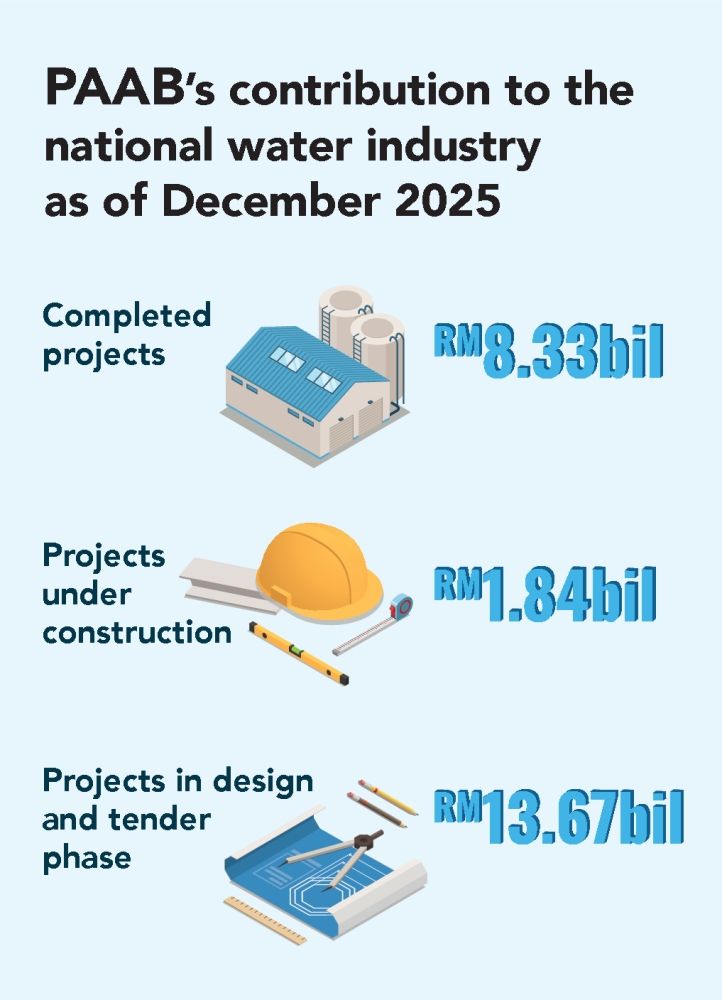
To date, the organisation has absorbed approximately RM23bil in federal and commercial loans to clear state balance sheets, but the true operational miracle lies in its 45-year payback model.
“It gives operators the breathing room to develop new assets rather than just servicing old debt,” Zulkiflee explains.
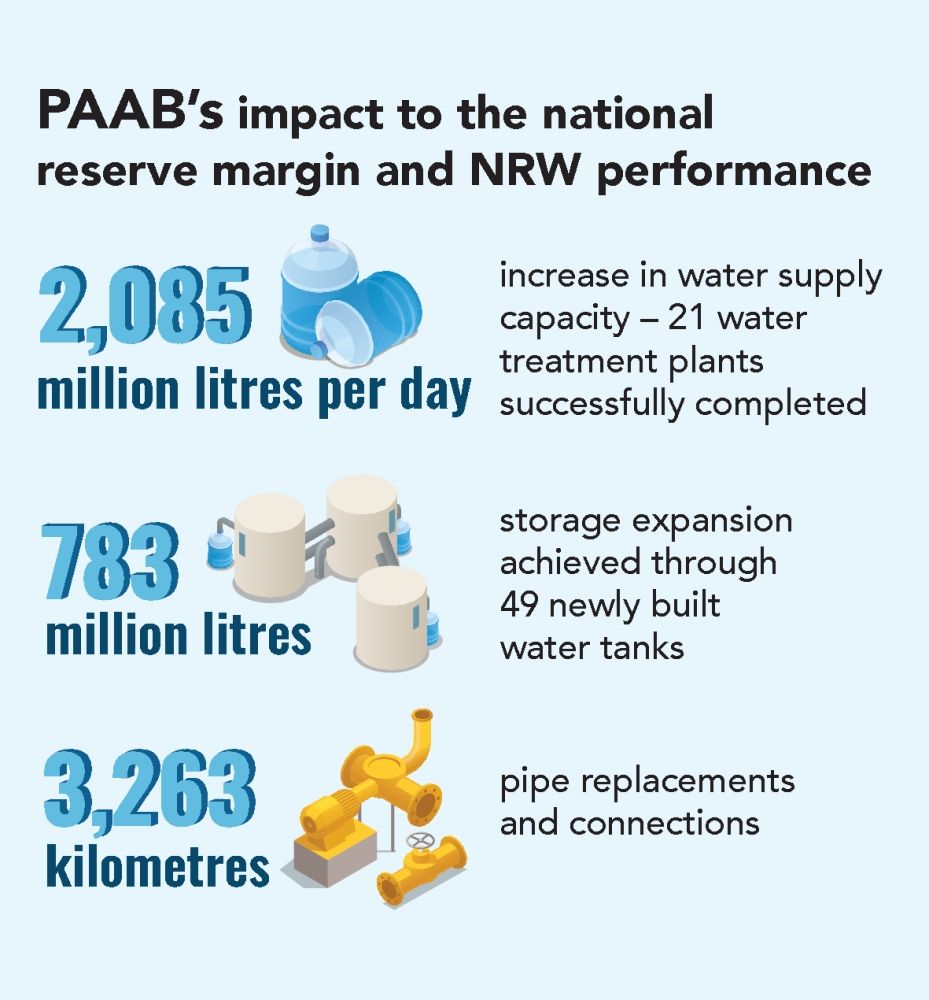
This unique financial cushion has powered a total investment commitment of RM46bil including the completion of 21 water treatment plants that produce 2,085 million litres per day (mld) and 3,263 km of pipeline.
These facilities now account for roughly 11% of Malaysia’s total water production capability, a critical safeguard that prevents nationwide shortages by supporting the current 14.9% national reserve margin.
The digital asset management
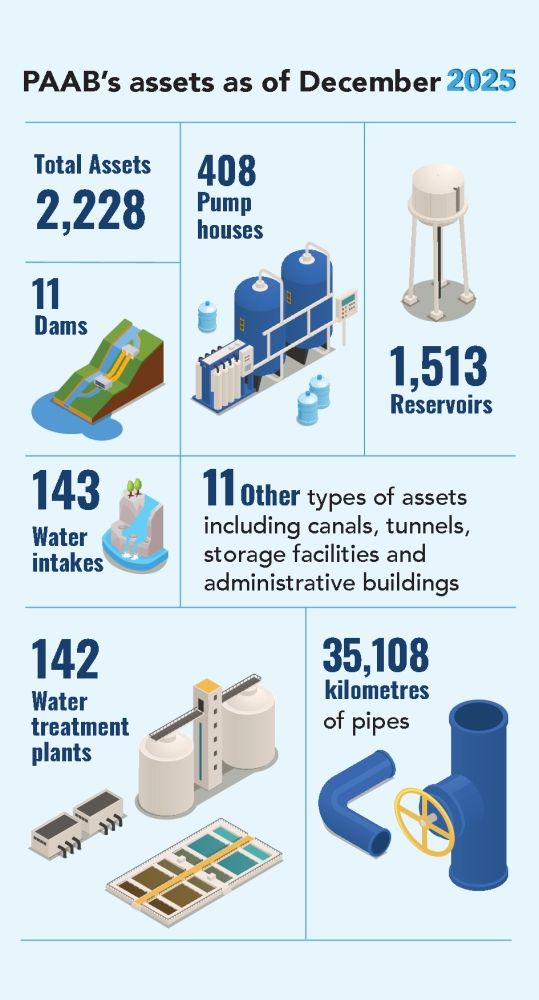
As PAAB’s asset base grows, manual oversight – literally sending someone with a clipboard to check every site – is no longer viable. Today, PAAB manages over 2,228 assets nationwide.
To monitor this scattered empire, the organisation developed a bespoke digital tool called the Information Water Asset (i-WA) system.
Think of i-WA as a high-tech Google Maps specifically for water infrastructure.
“We had to develop it in-house because the water industry is unique. We need to know where our assets are, what their status is, and what type of equipment is being used,” Zulkiflee explains.
Before this system, keeping track of thousands of pumps, pipes and treatment plants across different states was a monumental task.
Now, i-WA acts as a digital ledger that handles everything from asset registration to real-time geographical tracking.
“We have all the information at our fingertips. If we want to know how many water treatment plants have reached their designed life span and need to be refurbished, all of them are there in the system. It facilitates our regular audit on the assets,” he notes.
Blue finance and agile execution
Simultaneously, PAAB is pioneering a shift toward independent financial sustainability. For the average Malaysian, this means PAAB is finding ways to fund massive water projects without relying on government guarantees or sudden hikes in water bills.
Central to this is the Sustainable Islamic Finance Framework, which is the first in Malaysia to feature a blue finance component.
This allows PAAB to issue blue sukuk, which are syariah-compliant bonds specifically ring-fenced for water-related environmental projects like water treatment plants, water pipe replacement, water treatment residue management or drought-resistant reservoirs.
The credibility of this approach was solidified in 2026 when RAM gave the framework a Platinum rating, which is the highest possible score.
Zulkiflee explains that this high rating makes it possible for PAAB to borrow money at much lower costs, a saving that eventually benefits the consumer.
“We must remain agile. When government guarantees are no longer available, we leverage our AAA credit rating and Platinum sustainability rating to raise funds innovatively and competitively, and channel those funds into building the necessary assets for the water operators.”
This sustainability maturity is further reflected in PAAB’s collaboration with the Green Building Index to develop a green tool specifically for the water industry.
This ensures that every ringgit spent on new plants meets international environmental standards, or as Zulkiflee puts it, “Whatever PAAB builds, it must be green and sustainable.”
This agility also proved critical during the Covid-19 pandemic. When steel prices surged by more than 30%, PAAB stepped in as a stabilising partner by implementing variation of price provisions, adjusting contracts to accommodate higher material costs, and granting extensions of time to mitigate delays and help contractors remain financially viable.
“It was a win-win. They remained solvent, and we completed the projects on time for the people,” says Zulkiflee.
Expanding horizons
Under Zulkiflee’s leadership, PAAB expanded its role in Kedah and Penang to help both states access funding for the development of critical water assets.
In Kedah, PAAB is currently spearheading the design of three major plants, Sungai Karangan (150 mld), Sidam Kiri (200 mld), and Kodiang Phase 1 (100 mld), representing a RM1.94bil investment.
The commitment to Penang is equally formidable, with PAAB set to fund the Sungai Perai (136 mld) and Sungai Muda (114 mld) plants, an investment amounting to RM980mil.
Together, these RM2.92bil projects are central to the state’s Water Contingency Plan, helping to meet domestic water demand.
Establishing excellence
Beyond the concrete and steel, Zulkiflee is obsessed with the soul of the organisation. His ultimate ambition is to elevate PAAB to a level of national prestige usually not visible in the water industry.
He believes PAAB’s transformation into a leading force in the water industry must be supported by a workforce that is ready to move beyond traditional bureaucratic practices and embrace a culture of professionalism, integrity and continuous improvement.
“Our mission is only as strong as the people who deliver it. It means our people shall be competent or skilled, innovative, agile and committed, This is our new DNA,” he asserts.
He sees this cultural transformation as an important step in helping PAAB grow into an organisation that is recognised and respected for its role in the water industry.
“In oil and gas, you know PETRONAS. In water, it should be PAAB. That is the level of brand recognition we aspire to be,” says Zulkiflee.