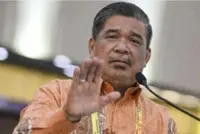
AFTER spending close to two years in jail for blasphemy, Jakarta’s former governor Basuki Tjahaja Purnama walked free on Thursday into a new job – and possibly a second marriage.
According to reports, the ethnic Chinese Christian, 52, plans to become a consultant to local governments, helping them to navigate the country’s electronic budgeting system, and wed his girlfriend, a 21-year-old Muslim policewoman named Puput Nastiti Devi.
Devi is reportedly his ex-wife’s bodyguard from the time he served as governor.
Ahok divorced Veronica Tan after a 20-year marriage in April last year, citing personal issues between them that have lasted for seven years.
The divorce took place after a Jakarta court found there was adequate evidence of infidelity by Tan.
The couple have three children and the court has granted Ahok custody of the second and third children, who are below the country’s legal age of 17.
“He has so many plans for his life after he’s freed from the prison. he plans to marry his girlfriend on Feb 15,” PDI-P politician and City Council speaker Prasetyo Edi Marsudi, who is also one of Purnama’s close friends, told reporters recently.
Ahok had also accepted offers to speak at events in New Zealand, Japan, and in Europe and would feature on a new YouTube Channel – named BTP, after his initials – to “make money”, Prasetyo added.
The rumored wedding between Ahok and Puput has been a hot topic among netizens over the past week – and the rumours are picking up steam after Jakarta Post reported that their marriage forms have been submitted.
Both families of the alleged couple, however, have denied the news.
Ahok’s sister Fifi Lety Tjahaja Purnama said on her Instagram account last Saturday that the family was unaware of any marriage plan or that her brother had converted to Islam to marry his girlfriend.
What will undoubtedly happen, however, is an attempt by President Joko “Jokowi” Widodo’s opponents to make Ahok a major issue and political pawn in Indonesia’s coming general elections.
Ahok, a close associate of Jokowi, was charged with blasphemy against Islam after the circulation of a doctored video, which purportedly showed him telling residents of the Thousand Islands, a group of islets off the Jakarta coast, not to be fooled by a Quran verse that says Muslims should not vote for non-Muslims.
Muslim hardliners, naming themselves the 212 Movement, rallied on Jakarta’s streets in December 2016 to demand he be jailed.
Ahok went on to lose the Jakarta election and after his conviction in May 2017 was sent to a prison in east Jakarta.
Authorities later moved him to a jail in the city of Depok in West Java due to “security reasons”. He was granted a remission of three months and 15 days.
The editor of the video, Buni Yani, a former journalist, was found guilty of violating the country’s information and electronic transaction law and sentenced to 18 months in prison.
But he has appealed the decision and has not yet served a day in jail – in fact, he is a media relations staff member helping presidential contender Prabowo Subianto in his upcoming fight to unseat Widodo.
The blasphemy case against Ahok fuelled religious intolerance in the country and encouraged its use as a political campaigning tool, analysts said.
According to a survey by Indonesia’s Survey Institute (LSI) in September, 38% of Muslim respondents objected to non-Muslims’ religious activities, a jump from 36% in 2017.
More than half of Muslim respondents also said they objected to non-Muslims building religious facilities, a 4% increase from 2017.
“The 212 Movement is not the peak of radicalism, but it has widened the tap for religious intolerance in Indonesia,” said Burhanudin Muhtadi, a researcher at LSI.
The 212 Movement also resulted in a coalition between Muslim hardliners and politicians: Muslim conservatives are supporting Prabowo Subianto and his running mate, former Jakarta vice-governor and entrepreneur Sandiaga Uno.
Though in prison, Ahok was still able to capture the public imagination.
A movie about his life in Belitung, A Man Called Ahok, was released last year and as of November had been viewed by at least one million people.
Former president Megawati Sukarnoputri, the grand dame of Indonesian politics whose political party now supports Widodo, is said to be among supporters who sent Ahok food, fruits, clothes and books while he was in jail.
Playing politics
Ahok started his political career in 2004 when he successfully ran for the Regional Legislative Council in his home province of Bangka Belitung.
In 2008, he joined the Golkar Party and was elected to the House of Representatives in 2009.
In 2012, he defected to the Gerindra Party, which backed his bid in the 2012 Jakarta gubernatorial election with then Surakarta mayor Jokowi.
He left Gerindra not long after Jokowi, who had been elected Jakarta governor, decided to challenge Gerindra Party leader Prabowo Subianto in the 2014 presidential election. Jokowi won, leaving his gubernatorial post to Ahok.
In 2016, Ahok signed a political contract with the PDI-P, which supported his reelection bid with PDI-P politician Djarot Saiful Hidayat as his running mate.
Djarot said in November that Ahok told him that he would certainly join his party if he returned to politics.
The Indonesian Solidarity Party (PSI) is another possible political home for Ahok.
The party strongly supported Ahok throughout the 2017 election and the ensuing blasphemy trial and many of its executives are former members of Ahok’s campaign team or former members of Ahok’s staff when he was governor.
But a week before his release, Ahok had written an open letter to his supporters indicating a reluctance to return to the political race.
He had asked his supporters not to celebrate or greet him when he is released, but many had gathered outside Mako Brimob Prison on Thursday wearing his signature checked shirt.
As he said in his open letter to supporters, his time in prison had helped him learn self-control.
“If I were elected I would become a man who only controls the City Hall, but (in prison), I learned how to control myself,” Ahok said.
“If I were elected I would be more arrogant and rude and I would hurt more people’s feelings.”
He also urged his supporters to call him by his initials BTP and not Ahok to mark how he was a changed man.
“I also want to apologise to Ahokers, all of Jakarta’s civil servants, even my haters, of all the things that I’ve said and done that have hurt you and your family,” he said.
Centre for Strategic and International Studies (CSIS) researcher Arya Fernandez believes that despite the hopeful waiting of his followers, it was unlikely that Ahok would swing back into politics right away after his release.
“It is very unlikely he would return to practical politics, such as by joining a political campaign before the election in April,” he told Jakarta Post.
According to Arya, in light of the controversy around Ahok’s case, Ahok would avoid politics and his chances of being appointed to any strategic position, such as minister or regional head, were slim.
“Maybe after the presidential election, if the political atmosphere and psychology has changed, there would be a place for him,” he said.
Arya added that Ahok’s loyal admirers would not lose interest in him even if he did not immediately re-enter politics this year.
“What people like about Ahok are his ideas, vision, character and integrity.
“Even if he did not appear on the political stage, his integrity would not disappear,” Arya said.
Indonesian political experts have urged politicians, particularly Jokowi and Prabowo as presidential candidates, to not see the release of Ahok as a political opportunity.
Tim Lindsey, director of the Centre for Indonesian Law, Islam and Society at the University of Melbourne said Ahok’s release happened during a sensitive time in Indonesian politics — just three months shy of the presidential elections.
“Anything that happens at the moment that connects to religious politics or Jokowi is going to have an impact,” he told Australia’s ABC News.
CSIS executive director Philip Vermonte told ABC News it is best for both parties to stay away from making public comments during a time when the nation is fragmented.
“It will be easier to create political turmoil if either Jokowi or Ahok do something that could be perceived by others as an act of provocation,” Vermonte said.
“We saw that Jokowi has been neutral in Ahok’s case and I hope he won’t make Ahok a political proxy to mobilise masses to support him.
“That would be better for not only Jokowi and Ahok, but for the whole country.”
Rian Ernest, a PSI legislative candidate who also worked as an Ahok staffer for two years, said he hoped Ahok would take time to be with his family and rest before deciding what to do next.
“After that, whatever position Pak Ahok holds next, I’m sure he can contribute a lot to the nation,” Rian told the Post.
“Whether he decides to join PSI or some other political vehicle, the important thing is that he sticks to his values of uprightness, transparency and professionalism.” — South China Morning Post/Additional reporting by Associated Press
Already a subscriber? Log in
Get 20% OFF The Star Digital Access
Cancel anytime. Ad-free. Unlimited access with perks.